SWOT Analysis Generator: How to Fill Each Quadrant With Evidence

A SWOT analysis generator turns a short description of your business into four lists: strengths and weaknesses inside the business, opportunities and threats in the market around it. Each line is only as good as the fact under it: "Threat: Color Me Mine Naperville covers most of the offer" beats "strong competition." The free idea check collects those facts from your idea, place, customer and price; you sort them into quadrants and keep the backed lines.
It returns demand, named competitors, complaints and unit economics; the steps below sort each into a quadrant; the worked example shows the finished grid.
What a SWOT analysis generator should give you
A useful generator gives you:
- evidence: a named rival and its visibility share, not “crowded market”;
- the right quadrant: rent as a weakness, not a threat (sorting rules);
- a ranking: the biggest risk first, not mid-list (step 5);
- actions: a task with an owner and a test, not “improve marketing” (TOWS pairs).
What goes in each quadrant
The standard definition of SWOT treats strengths and weaknesses as internal factors and opportunities and threats as external ones.1
| Quadrant | Question to ask | Evidence that counts |
|---|---|---|
| Strengths (inside) | What do we decide that gives us an edge? | Unit economics, price, an asset you own |
| Weaknesses (inside) | What could sink the business? | Cost base, operations, gaps in the offer |
| Opportunities (outside) | What demand does nobody serve well? | Search interest, unanswered complaints, market sizes |
| Threats (outside) | Who could take our buyers? | Named rivals, closures, local rules |
Internal does not mean fully under your control: rent is a weakness you accept when you sign the lease.
How to build a SWOT from evidence: five steps
- Describe the idea with all four inputs.
- Gather outside evidence before you write any lines: search interest, your direct competitors, customer complaints in reviews.
- Sort each fact. What you own or decide (price, cost base, offer, operations) is a strength or a weakness. What exists in the market without you (demand, rivals, complaints, published sizes) is an opportunity or a threat.
- Back each line with one piece of evidence, or mark it “hypothesis.” For unit economics: LTV = price × purchases a month × lifetime in months × margin; payback in months = CAC ÷ (price × purchases a month × margin). An LTV-to-CAC ratio of 3 or more is a strength, under 1 a weakness, anything between a test; 3:1 is the commonly cited benchmark.2 A complaint theme no rival answers is an opportunity; one your own plan would share is a weakness to design out.
- Rank each quadrant: risks in the order the check rates them, direct rivals by visibility share, alternatives last. The verdict and score sit above the grid, never in a quadrant.

Example: a paint-your-own pottery studio in Naperville
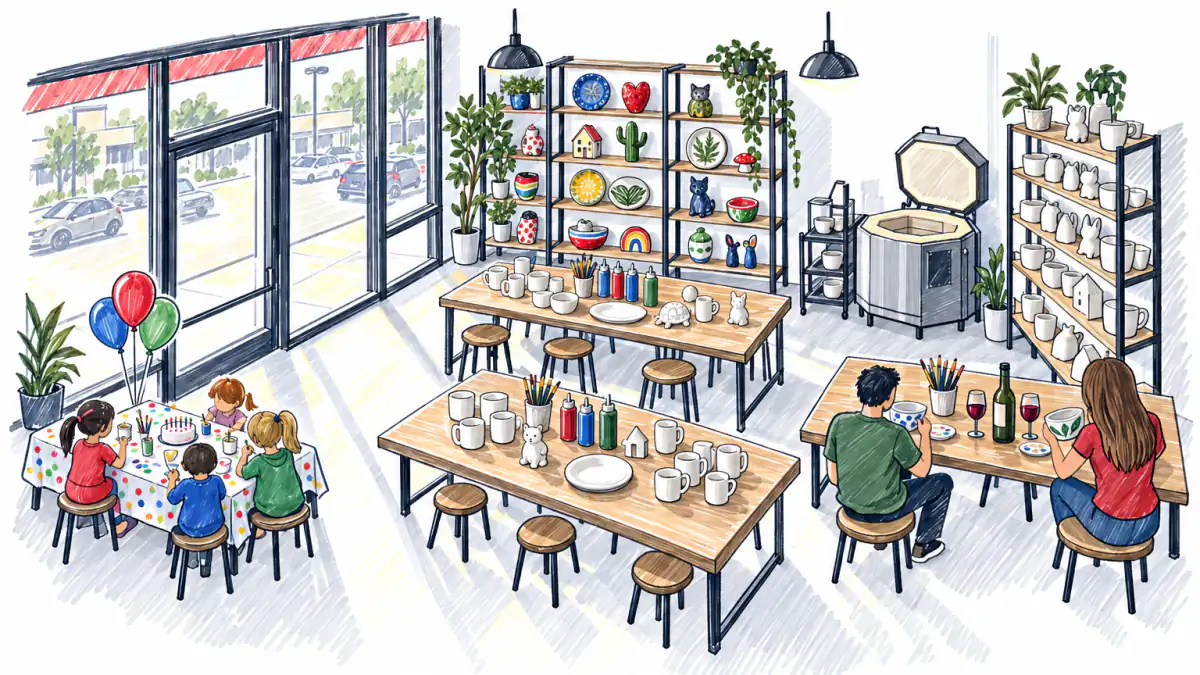
The idea, example by our method: “Paint-your-own pottery studio in a suburban strip-mall unit in Naperville, Illinois: parents booking kids’ birthday parties, plus adult BYOB date nights.”ex The check returned “Possible, with caveats”ex with a score of 55ex. Every figure below is an example by our method.
| Quadrant | Line | Evidence |
|---|---|---|
| S | Unit economics clear 3:1 | LTV $252ex, LTV/CAC 8.4ex, payback 1.4 monthsex |
| S | Two revenue lines: parties and adult nights | Hypothesis: no evidence yet |
| W | Strip-mall rent plus staff | Clay Art Space closed because income did not cover bothex |
| W | Glaze turnaround | Delays can sour parties and repeat visitsex |
| O | Price complaints nobody answers | 2 complaintsex; price may decide who booksex |
| O | People search for the activity | Top phrase “pottery painting”ex, from search-interest dataex |
| O | Published industry size | $22.5 million, 2024, IBISWorldex3 |
| T | Color Me Mine Naperville covers most of the offer | The check’s first riskex; part of a franchise chain4 |
| T | 7 direct competitorsex | Visibility: Pottery Bayou 26%ex, Color Me Mine Naperville 14%ex |
The strength rests on the check’s inputs: a $30 priceex, 2 purchases a monthex, a 12-month lifetimeex, a 0.35 marginex and a $30 CACex. Test the visit rate first: a parent who books one party never visits twice a month. Run your own unit economics.
Neither demand line sizes Naperville. Google Trends scores relative interest on a 0 to 100 scale, not search volume,5 and the IBISWorld size covers the whole US industry.3
Turn the grid into decisions your team can act on
The TOWS matrix pairs SWOT factors into strategies; Heinz Weihrich introduced it in Long Range Planning in 1982.6 Four actions for the studio, as advice by our method (owner; test):
- S–O: answer the price complaints with a party package the margin can carry. Founder; pre-sell it at a school fair.
- S–T: put the fast payback into local search ads against Pottery Bayou. Founder; track bookings per search.
- W–O: fix glaze turnaround, then print the pickup date beside every price. Studio manager; log every late piece.
- W–T: promise a pickup window you can keep before competing with Color Me Mine Naperville on parties. Studio manager; run trial kiln batches.
Where generated SWOTs go wrong
Language models can state false content with confidence; NIST’s Generative AI Profile calls this confabulation.7 Common mistakes and their fixes:
- No evidence: back the line or mark it “hypothesis.”
- Internal filed as external: ask whether the factor exists without you. Your kiln schedule does not.
- A planned feature as an opportunity: move it to strengths, marked “planned.”
- One factor in two quadrants: keep it where its evidence points.
- Unchecked local rules: the check did not confirm how Naperville treats BYOB in an unlicensed space, so check before you advertise those nights.
Templates and tools for each quadrant
To fill a grid by hand, use the blank SWOT template: anyone can read it, and the download asks you to sign up. To rank weaknesses and threats, rate risks before you launch.
FAQ
What should I type into a SWOT generator?
The idea, the place, the customer and the price in one or two sentences. For example: “Meal-prep kitchen in Columbus selling weekly boxes to shift nurses.”
How often should you update a SWOT?
Whenever a fact under a line changes: a new rival, a price move, a closure.
What does it cost, and what happens to what I type?
The idea check is free to run; see the current allowances. How your input is stored and used is set out in our terms.
Run the same check on your idea: Check your idea for free
Sources
- guides.ucf.edu, 09/21/2010
- hibob.com, 08/27/2025
- ibisworld.com, 02/02/2024
- colormeminefranchising.com, 10/03/2026
- support.google.com, 07/31/2024
- elearning15.unibg.it, 07/15/2026
- nvlpubs.nist.gov, 10/15/2026
Check your idea for free
Describe your idea and the check collects demand, competitors, complaints and prices, with sources.