Competitor Analysis: How to Do One in 8 Steps, With a Worked Example

A competitor analysis lists, side by side, the businesses your customers could pick instead of you. It covers who they are, how often customers see them, what they charge, what their customers complain about, and how much of your offer they already provide. It ends in a decision you can act on, whether that is a price to set or a reason to rethink the idea.
What a competitor analysis is
Competitive analysis is “the assessment of the strengths and weaknesses of current and potential competitors”, and it gives your strategy both an offensive and a defensive context: the opportunities rivals leave open and the threats they pose1. “Competitive analysis” and “competitor analysis” are two names for the same work. A business that could enter your area next year belongs on the list too.
It is narrower than a market analysis, which sizes the whole market and its demand: here you study the players. Its findings also feed a SWOT, where a rival’s weakness becomes your opportunity and its strength your threat.
What a competitor analysis gets you
For each rival you compare six things:
- its offer;
- its price;
- how often customers see it;
- what its reviews say;
- how far it overlaps with your offer;
- what risks it poses to you.
You walk away with four outputs, and each feeds a decision. The price band shows what customers already pay nearby, so you can set your price against it. Counted complaints show where rivals fail, so your position can answer a complaint customers actually make. The risk list shows a threat before you sign a lease or buy equipment. The scored grid ranks the rivals, so you know whom to watch first.
Direct, indirect and substitute competitors
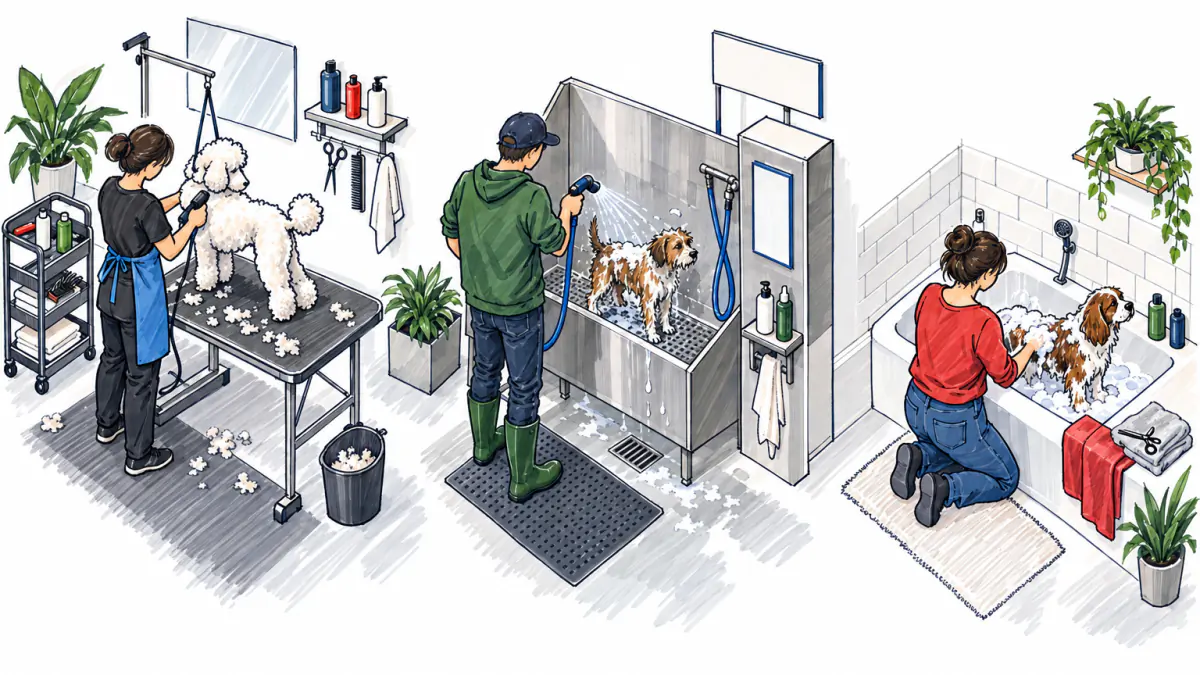
Sort every name into one of three types. The grooming examples match the worked example below.
| Type | What it is | Dog grooming example |
|---|---|---|
| Direct | The same service for the same customers | Another salon doing full grooms nearby |
| Indirect | A different service for the same need | A self-service dog wash |
| Substitute | The customer solves it another way | The owner bathes and trims the dog at home |
Analyze direct rivals first. They set the price customers expect and take the bookings you want. Give indirect rivals and substitutes one line each, unless they keep showing up in the steps below.
How to do a competitor analysis in 8 steps
Each step has a free manual method and a line that tells you when it is finished. Time-box the first pass: set a date for collection and one working session to decide.

Step 1. Write down the decision it must support
Start from the decision and collect only what moves it. Write one yes-or-no question, such as “Should we open in this location at our planned price?” It can also be about the launch price, the position to take, or whether to enter a market at all.
A vague goal like “learn about the market” leaves you with notes and no decision.
You are done once the question is written down with a date to answer it by.
Step 2. List the businesses your customers could pick instead
Search the phrases your customers type, the way they type them, from the area you plan to serve. Read the regular results and the map listings, then check review sites. Google ranks local results in Maps and the local pack mainly on relevance and distance, plus prominence2, so a nearby rival with many reviews tends to appear early. Ask people who used other businesses where they went. Put the same questions to an AI assistant and note the names. Check local “best of” lists.
Sort the list by how often each name shows up. Keep the top 10 (an assumption: a working cap that keeps the next steps to one sitting; raise it in a dense market). Add one line for possible entrants, such as a chain opening stores nearby or a mobile service that could add your area.
For a deeper pass, see how to find competitors and review their sites, or run a competitor search.
Done when: every name on your ranked list carries a tag for how directly it competes with you.
Step 3. Measure who customers actually see
Pick 10 to 20 phrases your customers would type (an assumption: a range to choose from, wider for broad services). For each phrase, log every business in the top results and in the map listings. Then compute:
visibility share = a rival’s appearances ÷ all result slots you logged × 100 (the × 100 only converts the result to percent)
The rival with the highest visibility share is the one customers see before they find you. Our idea check reports a visibility share per competitor from search results. Its weighting differs from this hand count, so use your count to rank rivals and do not compare it with the check number for number.
Repeat the exercise with AI assistants. Ask each one the customer questions word for word and log which businesses it names. Keep that log separate from the search count.
Done when: each direct rival has a share, and you know which ones get seen most.
Step 4. Collect prices and offers
For each direct rival, write down the listed price of the service closest to yours. Then answer five questions:
- What does the base price include?
- How good is the result? Look at photos and, if you can, buy the service once.
- How long does it take, and how long is the wait for a slot?
- How do customers book, by phone or online?
- What happens when something goes wrong: a refund, a redo, a named contact?
Note bundles, memberships, first-visit discounts and add-ons as well. Record the price range and the median. Place your planned price against the median and write down why a customer would pay the difference. More in how to set your price.
Done when: you have a price band with its median and your price marked on it.
Step 5. Read the reviews and count complaints by theme
Open the recent negative reviews of each direct rival and tag each complaint to one theme:
- Quality: the result itself.
- Reliability and trust: missed appointments, injuries, broken promises.
- Service and support: rude staff, no reply, hard booking.
- Price: too expensive, surprise charges.
Count the tags per theme. The theme with the highest count is your first opening to test. When the counts are small, treat the top theme as a lead and check it in customer interviews before you build a position on it. The method in detail: finding customer pains in reviews.
Done when: you have a count per theme for each direct rival.
Step 6. Score strengths and weaknesses in one grid
The classic competitor array weights the key success factors so the weights add up to one, rates each competitor on each factor and multiplies each rating by its weight1. Finish it: add up each rival’s weighted ratings into a total, then read the result.
Give each criterion a weight; by definition the weights together must total 100%. Rate each rival from 1 to 10 on each criterion (our scale; any fixed scale works). A rival’s total is the sum of weight × rating across all criteria.
| Criterion | A 10 looks like | A 1 looks like |
|---|---|---|
| Offer | Everything customers ask for, done well | Basic service, frequent redos |
| Price | At or below the median for the same work | Far above the median with no visible reason |
| Visibility | In most logged result slots | Rarely appears |
| Reviews | Few complaints, recent praise | Repeated complaints in one theme |
| Convenience | Online booking, open slots this week | Phone only, long waits |
Read the totals first: the highest total is the rival to beat. Then read the columns. A criterion with a high weight where every rival rates low is the opening. The competitor table template has the grid ready to fill.
Done when: each rival has a total, and you have named one high-weight criterion where all rivals score low.
Step 7. Check the money at the market price
Run your unit economics at the rivals’ median price. Customers compare you with that number, so it is the price you can count on before you prove you deserve more. The formulas:
- LTV = price × purchases per month × lifetime in months × margin
- LTV/CAC = LTV ÷ CAC
- payback in months = CAC ÷ (price × purchases per month × margin)
CAC is what you spend to win one customer. Our worked example uses a price of $44ex, 0.5 purchases a monthex, a lifetime of 12 monthsex, a 35% marginex and a CAC of $30ex. That gives an LTV of 44 × 0.5 × 12 × 0.35 = $92.40, roundedex, an LTV/CAC of 3.08ex and a payback of 3.9 monthsex. A commonly cited benchmark for a healthy LTV to CAC ratio is 3:13.
If the business only works at a price above the median, step 8 has to justify that price. Test your own figures in the unit economics calculator.
Done when: you know LTV/CAC and payback at the median price.
Step 8. Pick your position and list the risks
Build the position from two findings: the most frequent complaint theme and how much you overlap with your closest rival. Overlap is the share of your offer’s items a rival already provides. List what your offer includes, tick what each rival also does, and divide. A high overlap with a well-seen rival is a risk, because that rival can copy your angle fast.
Write the position as one line that names the customer, the result you deliver, and the rival you differ from. Then test it. It has to change what customers do, so that they choose you over rivals or pay more to stay. A line that changes none of these is a slogan.
Pick a direction. Lead on the theme rivals fail, follow on what they all do well, or go where none of them plays. Let counted complaints set the direction and treat rivals’ moves as one input.
Score each risk on probability from 1 to 3 and impact from 1 to 3. Handle any 3/3 risk first. Go further with positioning and your unique offer, business risks before launch and SWOT analysis.
Done when: you have a one-line position with a direction, plus a scored risk list.
Worked example: a dog grooming salon in Tampa
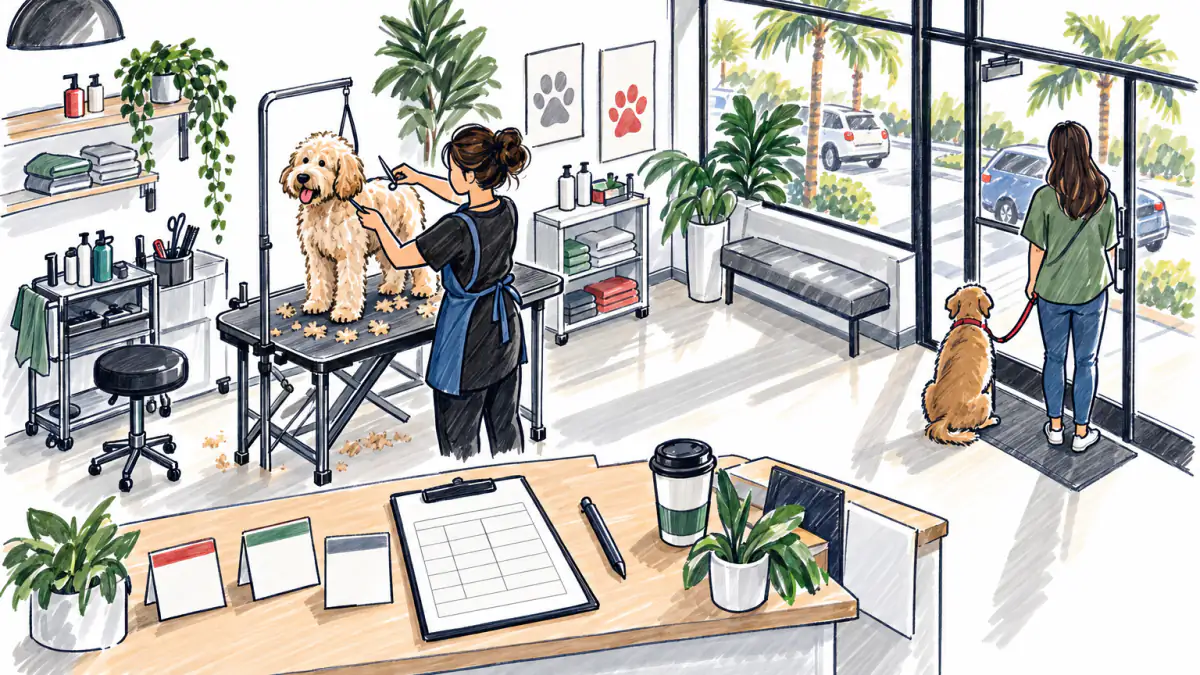
The idea, checked on October 15, 2026 (example by our method): a neighborhood pet grooming salon in a strip-mall unit in suburban Tampa, Florida, with dog owners booking $60–$90 full grooms every 6–8 weeksex. The check returned “Possible, with caveats”ex with a score of 63ex, after 17 search queriesex and 32 sourcesex (example by our method).
Each part below applies one or two steps to the salon and ends in a finding. Rivals and visibility (steps 2 and 3) show which groomers Tampa dog owners see first. The price band (step 4) places the planned full groom against the rivals’ median. Complaints (step 5) show which themes rivals’ customers raise most. Money (step 7) tests the salon at the median price, not the planned one. Risks and the reading (step 8) rank the threats and end in the salon’s next action, a demand test.
Rivals and visibility
The check found 8 direct competitorsex (example by our method). Five of them are named with a visibility share:
| Direct rival | Visibility share, example by our method |
|---|---|
| Happy Tails of Tampa | 11%ex |
| Woofie’s of South Tampa | 7%ex |
| Woof Gang Bakery & Grooming South Tampa | 14%ex |
| DapperTails Mobile | 14%ex |
| Pet Wize | 14%ex |
In our example, no named rival sits above 14%. Search attention is spread, so a new salon does not have to unseat a single leader.
Price band
Rivals’ prices run from $22 to $89, with a median of $44, below the planned $60–$90 full groom (example by our method)ex.
| Measure | Value, example by our method |
|---|---|
| Lowest rival price | $22ex |
| Median rival price | $44ex |
| Highest rival price | $89ex |
| Planned full groom | $60–$90ex |
The whole planned range sits above the median, and its upper end sits above the highest rival price.
Complaints by theme
| Theme | Complaints, example by our method |
|---|---|
| Quality | 2ex |
| Reliability and trust | 2ex |
| Service and support | 1ex |
| Price | 1ex |
Six complaints in all is a small sample. Quality and reliability lead, and both are leads to verify with dog owners before the salon builds on them.
Money
The check computed unit economics at $44ex, the same figure as the rivals’ median; the planned $60–$90 was not used (example by our method). At that price LTV/CAC is 3.08ex and payback is 3.9 monthsex (example by our method). Charging above the median means the salon has to earn the gap on the themes rivals’ customers complain about.
Risks
| Risk, example by our method | Probability | Impact |
|---|---|---|
| Happy Tails of Tampa already offers about 70% of this idea and could match the trust angle quicklyex | 3 | 3 |
| Price pressure: rivals charge $22 to $89, median $44, below the planned full groomex | 2 | 2 |
| Rising costs and construction have closed grooming businesses elsewhere, which could hit a strip-mall unitex | 2 | 3 |
| No search-volume data exists for this market, so demand size is unknownex | 2 | 2 |
The check found no demand source for this marketex (example by our method).
The reading
- Visibility is spread: no named rival above 14% (example by our method)ex.
- The closest rival overlaps heavily. Happy Tails of Tampa covers about 70% of the idea (example by our method)ex, and that 3/3 risk comes first.
- Trust and quality complaints are the opening. The price above the median has to be paid for by visible proof on both.
- The next step is a demand test, such as a waitlist page with local ads, because the market has no search-volume data.
Free sources first, paid tools second
| Source | What it gives you | Cost |
|---|---|---|
| Search results | Who ranks for customer phrases | Free |
| Map listings | Nearby rivals, ratings, review counts, hours | Free |
| Review sites | Complaints and praise to count by theme | Free |
| Rivals’ sites and social pages | Prices, packages, booking, promotions | Free |
| Business registries | Legal name, filing date, status | Varies by state |
| AI assistants | Which businesses they name for customer questions | Free tiers exist |
| Paid SEO suites | Rankings and traffic estimates across many phrases | Paid |
| Social-listening suites | Brand mentions across platforms | Paid |
Start with the free rows. Pay for a suite when the list outgrows what you can log by hand, for example when you compare several locations.
Mistakes that waste the analysis
- Starting without a decision. The notes pile up and nothing changes.
- Listing only the big brands. Local customers often pick the salon down the street.
- Reading reviews without counting them. One angry review then sets your position.
- Comparing prices without comparing offers. A bath-only service and a full groom are different products.
- Running the money at your hoped-for price instead of the market median.
- Copying the leader. You inherit its position and its complaints.
- Doing it once. BDC recommends a full competitive analysis at least once a year and a quick refresh of the data every couple of months4.
FAQ
What is a competitor analysis?
A side-by-side record of the businesses your customers could pick instead of you: their offer, price, visibility, reviews and overlap with your offer, plus the risks they pose. Its scope covers current and potential competitors1.
Is competitive analysis the same as competitor analysis?
Yes. Both names describe the same work, and the steps are the same.
How do you identify your competitors?
Search the phrases your customers type, read the map listings and review sites, and ask customers where else they went. Rank names by how often they appear and keep the top 10 as a working cap (an assumption you can raise).
How do you find a competitor’s strengths and weaknesses?
Score every rival on weighted criteria in one grid, then look for a high-weight criterion where all of them rate low. Counted complaints from reviews show the weaknesses customers feel.
How long does a competitor analysis take, and how often should you update it?
Is a SWOT analysis enough?
SWOT is one way to present the findings, and it needs the data from steps 2 to 7 underneath it. See SWOT analysis for how to build one.
Run the same check on your idea to see its direct competitors with their visibility and prices: Check your idea for free.
Sources
- en.wikipedia.org, 06/23/2003
- support.google.com, 09/30/2024
- hibob.com, 08/27/2025
- bdc.ca, 09/12/2020
Check your idea for free
Describe your idea and the check collects demand, competitors, complaints and prices, with sources.