Business Risks: 7 Types, a Risk Matrix, and How to Manage Them

A business risk is any event that can cut your profit below plan or close the business: a new competitor, an unforeseen cost, a cyberattack, a lawsuit, a bad review. Risks fall into seven types: strategic, financial, operational, cybersecurity, compliance, reputational and hazard. You manage them in five steps: list them, rate each on likelihood and impact, rank them, choose a response (avoid, reduce, transfer, accept), and review the list on a schedule.
What business risk means
ISO 31000:2018 defines risk as the “effect of uncertainty on objectives.”1 Each risk gets two ratings: how likely it is and how much it would hurt.
A hazard is the source of harm, such as a wet floor. A risk is the chance that it hurts you, and how badly. An issue is a risk that already happened.
The 7 types of business risk
A risk starts with a choice you make (a loan, a new market), an event you cannot control (a recession) or a hazard in the work itself (a fire).
| Type | What it is | Example | First control |
|---|---|---|---|
| Strategic | Your plan stops matching the market | A cheaper rival opens nearby | Track direct competitors |
| Financial | Cash runs short or does not come in | A large customer pays late | A monthly cash forecast |
| Operational | People, processes, systems or suppliers fail | Your only supplier misses a delivery | A second supplier |
| Cybersecurity | An attack exposes data or stops systems | Phishing takes over the payment account | Multi-factor sign-in |
| Compliance | You break a law, permit or contract | An injured employee, no workers’ comp | A list of state and city duties |
| Reputational | Customers stop trusting you | A one-star review spreads | A reply to every review |
| Hazard | Physical harm to people or property | A fire closes the shop | Property insurance |

Strategic risk
Strategic risk is the chance that your offer stops working. You set prices and choose the product and markets. The market controls tastes and new entrants; for that half, learn how to do a market analysis.
To manage it, list your direct competitors and their prices, then write a contingency plan for the top risk: what you do if a cheaper entrant opens next door.
Financial risk
From the business’s side, financial risk is cash flow (bills due before customer money arrives), credit (a client stops paying), debt (a variable rate rises) or currency (imports get dearer).
Forecast cash monthly and hold a reserve of the months of fixed costs you choose to cover. For B2B sales, trade credit insurance protects receivables against non-payment due to insolvency or protracted default.2 Before you set a price, check your unit economics.
Operational risk
Operational risk is a breakdown in daily work: the only employee who knows the bookkeeping quits, or your single supplier closes. The first control is concentration: if one supplier or customer carries a large share of revenue, find a second.
Cybersecurity risk
In the Allianz Risk Barometer 2026, cyber incidents rank as the top global business risk for the fifth year in a row, with 42% of responses.3 The FBI’s Internet Crime Complaint Center logged 1,008,597 complaints and $20.877 billion in reported losses in 2025, a 26% rise in losses from 2024.4
NIST released Cybersecurity Framework 2.0 on February 26, 2024, with six functions: Govern, Identify, Protect, Detect, Respond and Recover.5 Five actions for a small business:
- Assign a security owner (Govern).
- List devices and accounts, then customer data (Identify).
- Lock accounts with multi-factor sign-in; update software (Protect).
- Watch sign-in and payment alerts (Detect).
- Back up data offline; write down whom to call (Respond, Recover).

Compliance and legal risk
A US business with employees must manage these by law:
- Workers’ compensation is mandatory for nearly all employers in every state except Texas, which allows employers to opt out.6
- OSHA’s General Duty Clause, Section 5(a)(1), requires a workplace free of recognized hazards likely to cause death or serious physical harm.7
- All 50 states have data-breach laws: if customers’ personal information is breached, you notify them.8
- Licenses and permits come from your city and state.
Reputational risk
Reputational risk is sales lost when customers stop trusting you. It is direct (a customer posts your failure on Google reviews or Yelp), indirect (a partner misbehaves in your name) or peripheral (your industry gets bad press). Answer every review and fix the cause it names.
How to identify business risks in 5 steps
- Identify: list every risk. A SWOT analysis is another way to find threats.
- Analyze: rate each 1–3 on likelihood and impact; note whether it hits fast or slow.
- Evaluate: multiply the two scores, then rank by band.
- Respond: choose a response and name an owner.
- Monitor: re-score on your schedule and after any change.
Six questions find the big risks: What would stop sales for a month? Which supplier or customer is a large share of revenue? What would a rival undercut? What data do you hold? Which law governs your work? What would a bad review say?
Two rows of the example’s risk register (L = likelihood, I = impact):
How to assess risks with a likelihood × impact matrix
Our method in the open. Likelihood 1–3: unlikely within a year, could happen, expected or under way. Impact 1–3: an annoyance you absorb, hurts the year’s profit, threatens the business. The idea check uses the same scales.
Score = likelihood × impact, from 1 to 9. We read it in three bands:
- 6–9, act now: respond and assign an owner this week.
- 3–4, plan: write the response down and name a trigger to watch.
- 1–2, watch: review at the next scheduled check.
Deciding in advance which band you accept without action is your risk appetite. The worked example on the grid:
| Impact \ likelihood | 1 | 2 | 3 |
|---|---|---|---|
| 3 threatens the business | 3 | 6: R2, R4 | 9: R1 |
| 2 hurts the year’s profit | 2 | 4: R3 | 6 |
| 1 an annoyance | 1 | 2 | 3 |
If a risk rests on an unmeasured figure, such as demand or margin, measure it first; a good-looking guess does not lower the risk.
Four ways to respond to a risk
| Response | What you do | When it fits | Example |
|---|---|---|---|
| Avoid | Drop the activity | Score 6–9, activity optional | An uninsurable delivery route |
| Reduce | Lower likelihood or impact | Risks you can influence | A second supplier |
| Transfer | Shift the cost | High impact you cannot reduce | Insurance, a contract clause |
| Accept | Live with it and watch | Score 1–2 | A small supplier price rise |
Give each action an owner and a date, and carry the list into the risks section of your business plan.
Which insurance covers which risk
The NAIC describes a business owner’s policy (BOP) as a package product that typically includes property, business interruption/continuation and liability insurance.9
| Risk | Policy | What it covers |
|---|---|---|
| Fire, theft, an injured customer | BOP | Property and liability |
| A shutdown after a fire | Business interruption | Lost income, generally only after direct physical loss from a covered peril10 |
| An employee hurt at work | Workers’ comp | Mandatory for nearly all employers outside Texas6 |
| A breach or ransomware | Cyber | Costs after an attack, per the policy |
| A B2B customer who does not pay | Trade credit | Receivables lost to insolvency or protracted default2 |
A worked example: a laundromat in Columbus, Ohio
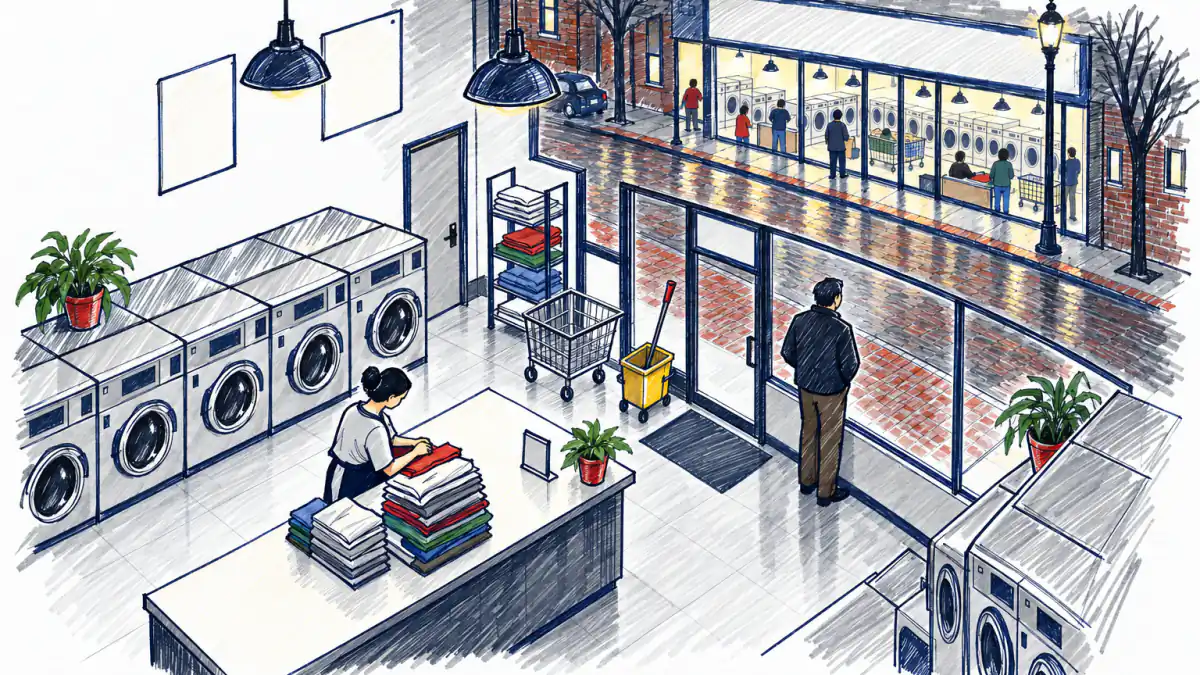
The idea, in the example by our method: a neighborhood laundromat with wash-and-fold drop-off service in a dense renter area of Columbus, Ohio, for apartment dwellers without in-unit washers.ex In the example, the check returned “Possible, with caveats”ex with a score of 64ex and found four risks:
- R1 (3 × 3 = 9, act now): Columbus Express Laundry already offers about 70% of the idea, so the new site must win renters on something else.ex In the example, the check counts 10 direct competitors.ex
- R2 (2 × 3 = 6, act now): labor costs for wash-and-fold may erode the 35% margin estimate, which is not measured in Columbus.ex
- R4 (2 × 3 = 6, act now): demand is unmeasured because no search-volume data existsex, so the buyer count may be smaller than assumed.ex
- R3 (2 × 2 = 4, plan): rising rents may push self-serve laundromats out of the neighborhood, as seen in other cities.ex
Responses by our method:
- R1, reduce: in the example, 3 complaints concern priceex and 3 convenienceex, so build the offer on your customers’ pain points.
- R2, reduce by measuring: price wash-and-fold labor in Columbus before signing.
- R4, reduce by testing: run a demand test or a fake door test before the lease.
- R3, plan: write down the lease terms you need and a second site.
Stress-testing R2, in the example: $6 a purchaseex, 4 purchases a monthex, a 12-month lifetimeex, a $30 customer acquisition cost (CAC)ex and a 35% marginex, giving a lifetime value (LTV) of $100.80ex, LTV to CAC of 3.36ex and payback in 3.6 months.ex LTV = price × purchases a month × lifetime × margin. In our example, if labor cuts the margin to 25% (an assumption), LTV falls to $72, LTV to CAC to 2.4, and payback grows to 5 months. Check your unit economics with your own figures.
Two of the three act-now risks rest on unmeasured figures, so both get tested before any money goes into a lease.
Your next step
List your risks, score each one, act on the 6–9 band this week and review the register on your schedule. For your own idea, check your idea’s risks free.
FAQ
What are the 7 types of business risk?
Strategic, financial, operational, cybersecurity, compliance and legal, reputational and hazard.
What is an example of a business risk?
In the example by our method, a new Columbus laundromat faces a competitor already offering about 70% of the idea.ex A common beginner mistake: treating an unmeasured figure as fact. See how to start a business.
How do you identify business risks?
List them, rate each 1–3 on likelihood and impact, rank them, choose a response and review on a schedule.
What insurance does a small business need?
What is the difference between business risk and financial risk?
Business risk is the uncertainty of operating income (EBIT) from the business itself. Financial risk is the added risk from using debt.11
Sources
- iso.org, 02/15/2018
- allianz-trade.com, 04/09/2026
- commercial.allianz.com, 09/24/2025
- ic3.gov, 08/25/2026
- nvlpubs.nist.gov, 08/25/2026
- congress.gov, 09/02/2025
- osha.gov, 10/02/2026
- documents.ncsl.org, 01/19/2026
- content.naic.org, 08/24/2026
- insurance.ca.gov, 10/03/2026
- ssrudlp.ssru.ac.th, 07/10/2026
Check your idea for free
Describe your idea and the check collects demand, competitors, complaints and prices, with sources.