Business Concept: What It Is, 7 Elements and a Real Example

A business concept puts your business on one page before you spend money, in seven fields: what you sell, who buys, their need, why they pick you, rivals, revenue and what it rests on. It comes before the business plan. The concept says what and why; the plan says how. The free check fills most of these fields for your idea from search data.

What is a business concept?
A business concept is a short statement, written for someone else to judge, of what a business sells to which buyers and how it earns from them.
Here is one sentence in that form, an example by our method: treat-only soft-serve cones, sold to fans from a franchise stand on a minor league ballpark concourse in Durham, run with the stadium’s concessionaire.ex It names a product, a place, a partner and a buyer, and you can check each before you sign anything.
The concept is the input to a business plan, which adds staff, equipment, funding and forecasts. If the concept fails a check, you skip writing the plan.
The 7 elements of a business concept
Each element answers one question in one or two lines, marked as a fact (with its source) or an assumption. Assumptions go into the last row, your list of things to test.
| Element | The question it answers | What to write | Fact or assumption |
|---|---|---|---|
| What you sell | What does the buyer get? | One plain sentence with no adjectives | Your decision |
| Who buys | Who pays, where, at which moment? | One line: the person, the place, the trigger | Assumption until you talk to buyers |
| The need | Which problem does it solve, and for how many? | The problem in the buyer’s words, plus a demand signal | Fact if you have search, sales or interview data |
| Why you | Why pick you over the alternatives? | One sentence a buyer could repeat | Assumption until buyers confirm it |
| Who else serves them | Where does the buyer go today? | Direct rivals (same product, same buyer) and indirect ones (another product, same need) | Fact if you searched |
| How it earns | Who pays how much, how often, at what margin? | Price, purchases a month, margin, months a customer stays, cost to win a customer | Assumption until you have quotes or sales |
| What it rests on | What has to be true for this to work? | Every assumption above, each with the test that would confirm it | Your test list |
- Who buys. The guides on how to describe your target audience and build an ideal customer profile show how narrow to go.
- The need. Collect customer pain points in the buyer’s own words. Size the market with a market analysis after you know who buys.
- Why you. This row is the short form of your value proposition.
- How it earns. Paul Graham tells founders to make something people want and not to worry much about the business model at first.1 Fill the row anyway, with assumptions. A concept with an empty money row cannot be compared with any other.
If you prefer a grid, a lean canvas holds the same fields on one page.

Business concept vs. business plan
| Business concept | Business plan | |
|---|---|---|
| Question | What, for whom, why | How, with what, by when |
| Purpose | Decide whether to go on | Raise money and run the business |
| Length | One page | Many pages, one per section |
| Reader | You, a partner, a first investor | A lender, an investor, a landlord, a franchisor |
| When | Before you spend money | After the concept passes its tests |
| What it leaves out | Staff, equipment, funding, overhead, revenue forecasts, the marketing plan | Little: it holds all of these |
When the concept holds up, read how to write a business plan or start from a business plan template.
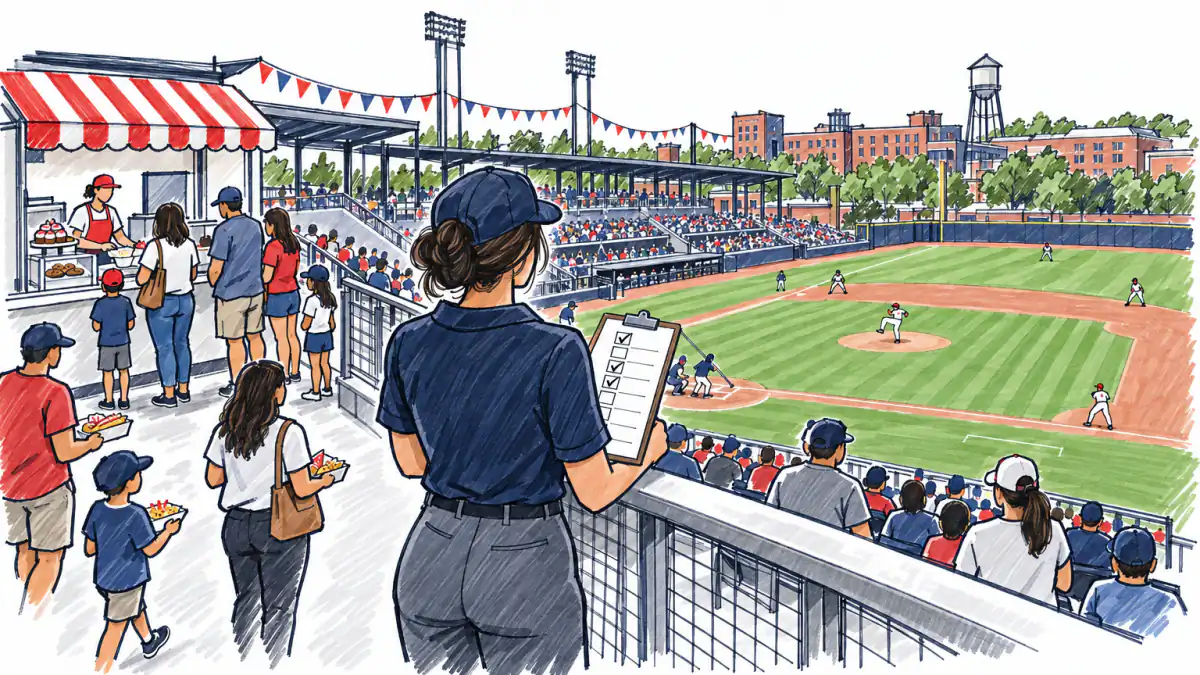
Example: a soft-serve stand in a ballpark, as a one-page concept
The concept below is an example by our method, filled from a real idea check of October 15, 2026, on the Durham stand above. The check ran 14 search queriesex and read 17 sources.ex
| Element | Example by our method |
|---|---|
| What you sell | Soft-serve cones, treats only, from a franchise stand |
| Who buys | Fans on the concourse during home games |
| The need | Top demand phrase: “soft serve franchise,”ex read from search-interest trends, so no volume is quoted.ex Market size for the category: $26.1 billion in 2024.ex |
| Why you | Assumption: “a cone in the time between two pitches, at a price below the stadium’s dessert stands.” The check found 3 complaints about priceex and 1 about speed.ex |
| Who else serves them | 0 direct competitors.ex Indirect ones by share of search visibility: 16 Handles 60%ex, Stadium On Wheels 32%ex, Wonders Ice Cream 4%ex, Slices Concession 4%.ex |
| How it earns | No figures yet. Ask the concessionaire for its share of sales, the stand fee and the home games a season. All three stay assumptions until quoted. |
| What it rests on | Game-day traffic: past ice cream stands in similar venues closed or struggled to make a profit.ex A local ice cream brand already serves the Durham Bulls’ stadium, and the concessionaire may prefer it.ex Food-safety rules add compliance cost and setup time.ex |
| Verdict | “Possible, with caveats,”ex score 62ex |
How to read the filled page:
- In our example, $26.1 billion is the whole category’s size; it says nothing about what one stand sells on game nights.
- Zero direct competitors and four indirect ones means fans already have places to buy a cold dessert.
- The money row is empty on purpose. A concession deal sets a stand’s economics, so the first number to get is the concessionaire’s quote.
The next step: ask the concessionaire for terms, and read the franchisor’s disclosure document before you sign. The FTC Franchise Rule requires a franchisor to give you its Franchise Disclosure Document at least 14 calendar days before you sign a binding agreement or pay any money.2
How to write and test yours in 5 steps
- State the business in one sentence: what, for whom, where. If it takes two sentences, the concept holds two businesses.
- Fill the seven rows. Mark every entry as a fact with its source or as an assumption.
- Test the buyer and the need before you build. Run interviews with the customer interview questions guide, put up a fake door test, or take pre-orders. A pre-order is a payment; an interview answer is an opinion.
- Run the numbers. Contribution a month is price times purchases a month times margin. Lifetime value (LTV) is that contribution times the months a customer stays. LTV divided by the cost to win a customer (CAC) is the LTV-to-CAC ratio; CAC divided by monthly contribution is payback in months. A ratio of 3:1 or higher is the commonly cited benchmark for healthy unit economics.3 If any input is an assumption, the result is one too.
- Name the first market step: the first channel and the first buyers you will reach. The full launch goes in a go-to-market plan. Then write the business plan.
The free check covers steps 2 to 4 from search data: demand, competitors, complaints, the unit math and the risks, with a verdict and a score.

Startup concept: what changes when you aim to scale
A startup concept is a business concept whose business model has to scale. Steve Blank wrote in 2010 that a startup is an organization formed to search for a repeatable and scalable business model.4 Eric Ries defines a startup as a human institution designed to create a new product or service under conditions of extreme uncertainty.5 Both put the business model under test, and the “What it rests on” row holds that test.
| Small business | Startup | |
|---|---|---|
| Goal | Steady income for the owner | Fast growth toward a large market |
| Business model | Known in the trade | Still being searched for |
| Growth | Adds staff and locations | Revenue meant to grow faster than costs |
| Funding | Own money, loans | Angels, venture capital |
| Risk | A known model | The model may never work |
In the US, “small business” also has a legal meaning. The SBA sets a size standard for each industry; it counts either employees or average annual receipts.6
A 2014 Fortune article estimated that 90% of startups fail.7 Across all new businesses, Bureau of Labor Statistics data show that about 22% of new private-sector establishments close within their first year and about 49% within five years.8 In a concept, the causes of failure sit in the last row, each with its test.
Funding runs from your own money and friends and family to angels, venture capital, loans and crowdfunding; how to start a business covers each one. Venture money is optional. Mailchimp grew without venture capital and was acquired by Intuit in 2021 for about $12 billion.9
An investor reading a startup concept looks at the team, the risk against the reward, and whether the model scales.
Next step
Paste your idea into the free check and copy what it returns into the seven rows.
FAQ
How long should a business concept be?
On one page, give each of seven fields a line or two. If a field needs more, the detail belongs in the business plan.
What is a startup concept?
A business concept for a company that means to scale. The company is still searching for a repeatable and scalable business model, so the concept lists what that search has to prove.
Can you protect a business concept?
Copyright does not cover it: 17 U.S.C. § 102(b) excludes any idea, procedure, process, system, method of operation, concept, principle or discovery.10 Protect the details with a nondisclosure agreement or keep them as a trade secret. A patent covers only an invention.
How do I know my business concept is clear enough?
Show it to someone who has never heard of it. If they can name your buyer and say why that buyer would pay for what you sell, it is clear.
Sources
- paulgraham.com, 09/22/2026
- ftc.gov, 08/16/2026
- superwork.co, 10/15/2026
- steveblank.com, 01/25/2010
- yourstory.com, 09/05/2019
- legacy.sba.gov, 07/30/2026
- en.wikipedia.org, 07/21/2002
- startbusinessbystate.com, 09/15/2026
- fortune.com, 09/13/2021
- uscode.house.gov, 10/17/2026
Check your idea for free
Describe your idea and the check collects demand, competitors, complaints and prices, with sources.