Pitch Deck Template: 10 Slides and Where Each Number Comes From

A pitch deck template is a ready slide order you fill with your own facts. This one has 10 slides: company, problem, solution, market, competition, business model, traction, risks, team and the ask. For each slide it says what to write and where the number comes from. Download the file, or see it filled for a real idea below.
The free idea check puts sourced numbers on your market slide, and on the competition and risk slides too.
The 10 slides and where each number comes from
The order follows Sequoia Capital’s published 10-slide template1 with two swaps. Traction and risks take the places of why now and vision, and the financials move into the ask and an appendix.
| # | Slide | What it must say | Evidence |
|---|---|---|---|
| 1 | Company | One sentence: what you sell, to whom, where | Your own words |
| 2 | Problem | The customer’s pain, counted | Complaint counts from reviews, with where you found them |
| 3 | Solution | What the customer gets and how it removes the pain | A demo, a photo, a dated pilot result |
| 4 | Market | One figure with its year, source and scope. See TAM, SAM and SOM and size the market bottom up | A named report, or your own bottom-up count |
| 5 | Competition | Named direct competitors and how you differ. Find your direct competitors | Each competitor’s share of search visibility |
| 6 | Business model | Price, who pays, how often, margin per sale. See unit economics | Your price list; costs from quotes or marked «assumption» |
| 7 | Traction | Revenue, users or a waitlist, or «demand unproven» plus the test. Test demand before you launch | Your own dated data |
| 8 | Risks | Top risks, likelihood and impact on a 1–3 scale, the test that retires each. See business risks before launch | The check’s risk list, or your own scored list |
| 9 | Team | Who does what, and the one gap the money will hire for | Names and past roles |
| 10 | The ask | Amount, use of funds, the milestone it buys, one financial summary line | Use-of-funds split, marked «assumption» if it has no source |
For a sales deck, drop slides 8 to 10. From an angel round to Series A the order stays the same. Slide 7 changes: an angel deck can show a demand test, and a later round shows revenue.
The file
The file holds the same 10 slides. Each slide has three parts: the heading, a one-line prompt of what to write, and an evidence line naming where the number comes from.
Here is slide 4 as it appears in the file:
- Heading: Market
- Prompt: One figure with its year, source and scope
- Evidence: A named report, or your own bottom-up count
The other nine slides follow the same pattern, with the text from the table above. The file is free. You sign up to download it. If you skip the sign-up, copy the table into any slide editor: one row per slide, the evidence column as the line under each heading.
The evidence rule for every slide
Five rules decide what goes on a slide. For the full build and delivery, see how to build and present the pitch.
- Every number carries a source line: the source with its year, or the word «assumption». A number with neither is cut.
- The market slide shows one figure with its source and year, and states what that figure covers and what it leaves out. With no search-demand data, the slide says «demand unproven» and names the test that would prove it. A guess never goes on it.
- The competition slide names direct competitors, each with its share of search visibility as the check measures it. A quadrant you drew yourself is no evidence.
- The risks slide lists the top risks, each scored for likelihood and impact on the check’s 1–3 scale, with the test that would retire it.
- The ask states the amount and the milestone that money reaches. A use-of-funds split with no source is marked «assumption».
Investor-facing guides set the same minimum for the market slide: a named source and the filtering logic2.

The template filled from a real idea check
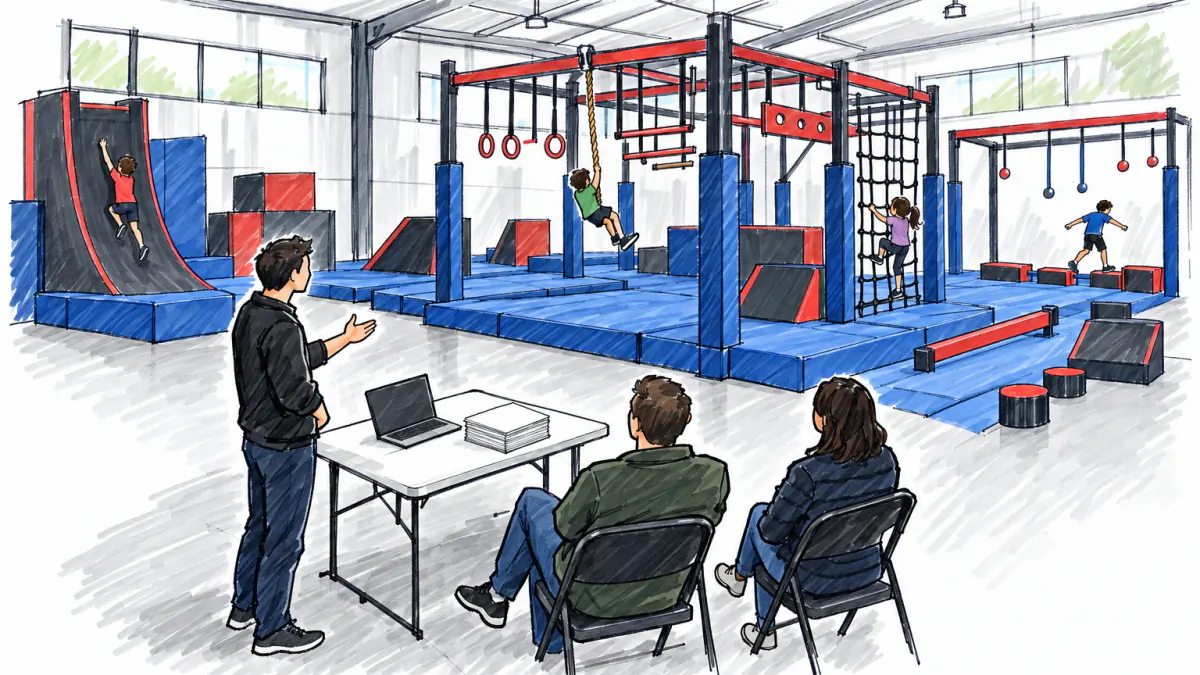
The idea in the example: a kids’ ninja warrior obstacle gym in a leased warehouse in suburban Denver, pitching local angels for $400k, with parents paying for monthly classes and birthday parties (example by our method)ex. The check ran 17 search queriesex across 31 sourcesex. It returned «Possible, with caveats»ex with a score of 61ex. Read that verdict before you book a single angel meeting.
| # | In the example (by our method) |
|---|---|
| 1 | The idea as checkedex |
| 2 | Complaints: price 3ex, quality 2ex, service and support 2ex |
| 4 | $1.0bn, 2024, ibisworld.comex, labeled with the source’s own scope. It is no Denver figure |
| 5 | 8 direct competitorsex, with the shares below |
| 6 | Your price here; any figure marked «assumption» |
| 7 | Demand source: noneex, so the slide reads «demand unproven» and names the test |
| 8 | See the risks below |
| 9 | Your names and roles here |
| 10 | $400kex; your use-of-funds split, marked «assumption» |
Search visibility share of direct competitors, in the example:
| Competitor | Share |
|---|---|
| Ninja Nation Centennial | 45%ex |
| YMCA of Metro Denver NinjaZone | 13%ex |
| Ninja Intensity | 12%ex |
| Flow Vault | 11%ex |
| The EDGE Ziplines & Adventures | 5%ex |
Slide 8 in the example carries three risks:
- Likelihood 3, impact 3: Ninja Intensity already covers most of the offer, so parents may choose it by defaultex.
- Likelihood 2, impact 3: two Denver ninja venues have already closed, so a leased warehouse may not carry its rentex.
- Likelihood 2, impact 2: no search-volume data exists for this market, so demand size is unprovenex.
Slide 5 measures search visibility. The top risk on slide 8 measures overlap in the offer. The deck shows both as they are.
Mistakes that sink a template deck
| Mistake | Fix | Rule |
|---|---|---|
| A growth figure with no source line | Add the source and year, or mark it «assumption» | 1 |
| A market figure with no scope | State what the figure covers and what it leaves out | 2 |
| A quadrant with your logo top right and no names | Named competitors with visibility shares | 3 |
| Risks left off the deck | Top risks, scored 1–3, each with a test | 4 |
| An ask with no use of funds | Amount, split or «assumption», milestone | 5 |
Templates that feed the deck
- Unit economics and financial model template for slides 6 and 10
- Competitor table template for slide 5
- Business plan outline for the appendix
Fill slides 4, 5 and 8 from a check
Describe your idea in one sentence in the free check on our home page. The check returns three slide inputs, each with its source line:
- Slide 4: a market figure with its source, year and scope, or «demand unproven» when no search-demand data exists
- Slide 5: named direct competitors, each with its share of search visibility
- Slide 8: the top risks, scored for likelihood and impact on a 1–3 scale
Slides 6, 9 and 10 stay yours to fill: price, team and the ask. The filled example above shows what the output looks like. Check your idea free.
FAQ
How many slides should a pitch deck have?
Should a pitch deck include financials?
Put one summary line on slide 10 and the full model in an appendix. Investors spend a median 3.9 seconds on the financials slide4. To prepare the appendix, build the financial model.
What do I put on the traction slide if I have no customers yet?
Write «demand unproven» and name the test that will prove it, as the example doesex. Start with test demand before you launch.
Is the template free?
Yes. You sign up to download the file, and the slides stay readable on this page. For comparison, OGS Capital puts DIY tools and templates at about $0 to $200, and agency-led custom decks at the low thousands up to $10,000 or more5.
Sources
- roundfunded.com, 09/03/2026
- whitepage.studio, 06/04/2026
- slideegg.com, 07/24/2026
- valueaddvc.com, 09/04/2026
- ogscapital.com, 03/11/2026
Check your idea for free
Describe your idea and the check collects demand, competitors, complaints and prices, with sources.