


Business plan: what it is, what goes in it, and a worked example

A business plan is a formal written document that sets out the goals of a business, the methods for reaching them, and the time frame1. In the SBA's traditional format there are nine sections: executive summary, company description, market analysis, organization and management, service or product line, marketing and sales, funding request, financial projections, and appendix2. Lenders and investors read it to decide whether to fund you. You read it first, to test the idea before you spend money.
Why you need a business plan
A plan puts on paper your product and your buyer, the money each sale brings in, and the startup cash you need. Write it before you sign a lease or order equipment. An outline with an empty competitor section or no operations section is a list of the work you have not done yet.
Three readers ask for one. A lender reads the funding request and the financial projections, and the SBA’s guidance lists what each of those sections must contain3. An investor reads the market and competition sections to judge the size of the opportunity. You read it before the first dollar goes out. If you have an idea and no numbers yet, start with a business concept and build the plan on top of it.
How a plan gets used:
- Feasibility: check that one sale covers its own cost before you commit money.
- Market: size the buyer group and name the competitors you will take customers from.
- Milestones: set dates and numbers to measure progress against.
- Funding: back a loan application or an investor meeting.
- Recruiting: show a partner or first hire what the business is and where it is going.
- Refocusing: re-test an existing business before you open a new location or launch a product, or before you apply for a loan.
Two formats: traditional and lean
Most business plans, as the SBA sorts them, follow a traditional format or a lean startup format3.
| Traditional | Lean startup | |
|---|---|---|
| What it holds | Nine sections plus a five-year forecast3 | Nine canvas components4 |
| Main reader | Lenders, investors, partners | You and your team |
| Detail | Prose and financial statements | A few lines per component |
| Choose it when | You apply for a loan or raise money | You are still testing the idea |
Lean components are key partnerships, key activities, key resources, value proposition, customer relationships, customer segments, channels, cost structure and revenue streams4. Add one block the canvas lacks: your key assumptions and how you will test each one. “Customers will pay this price” stays an assumption until a customer pays it.
Choose the traditional format if a lender or investor will read the plan, or if you must pay for a lease, equipment and staff before your first sale. Choose lean if you are deciding whether to pursue the idea at all. Canvas components map onto the nine traditional sections, so a lean plan expands into a full one when you need funding.
What goes in a business plan: the nine sections
For each section, the table gives one line on what to write. A full walkthrough is in the guide on how to write a business plan.
| Section | What to write | Who reads it closely |
|---|---|---|
| Executive summary | Mission, offer, target market, your edge, team, key financials, the ask, goals tied to a number. Write it last | Every reader, first |
| Company description | Legal structure, owners and their stakes, the problem you solve, proof of your edge | Lenders, partners |
| Market analysis | Market size, number of buyers, average spend, competitors and their shares, the gap you fill | Investors |
| Organization and management | Org chart, résumés, key suppliers, dependence on any single platform | Lenders, investors |
| Service or product line | What it is, pricing, lifecycle, IP filings, supply and fulfillment | Investors |
| Marketing and sales | Channels, price, cost to acquire a customer (CAC), how a sale closes | Investors, you |
| Funding request | Amount, debt or equity, terms, time period, use of funds, future plans such as an exit3 | Lenders, investors |
| Financial projections | Five-year forecast, monthly or quarterly in year one3 | Lenders |
| Appendix | Licenses, leases, contracts, credit history, résumés, detailed market data | Lenders, on request |
For the market section, estimate your market size with TAM, SAM and SOM and run a competitor analysis; you can close it with a SWOT table. Split the competitor part in two: a quantitative piece (who holds what share of buyer attention) and a qualitative one (what buyers complain about). Show the gap without implying there is no market.
The business plan outline puts these nine headings in a file you can fill in.
The numbers: projections and funding

Financial projections: time spans, unit economics, break-even
For the financial outlook, the SBA asks for the next five years and wants the first year projected by month or quarter3. NerdWallet sets the floor at three years of estimates for sales and expenses, and for the resulting profit, broken down by month or quarter5. If the business already runs, add income statements, balance sheets and cash-flow statements for the last three to five years3.
Your forecast rests on unit economics: what one customer brings in and what it costs to win that customer. Our check computes it with the four formulas below. These inputs come from our dog-wash example in the next section: a price of $16.50 per visitex, 2 visits a monthex, a 12-month customer lifetimeex, a margin of 0.35ex and a CAC of $30ex.
| Quantity | Formula | Example by our method |
|---|---|---|
| Contribution a month per customer | price × visits a month × margin | 16.50 × 2 × 0.35 = $11.55 |
| LTV | price × visits a month × lifetime months × margin | 16.50 × 2 × 12 × 0.35 = $138.60ex |
| LTV to CAC | LTV ÷ CAC | 138.60 ÷ 30 = 4.62ex |
| Payback, months | CAC ÷ contribution a month | 30 ÷ 11.55 = 2.6ex |
That $11.55 is an arithmetic step on the footnoted inputs. Of all the inputs, the margin is the weakest. The check’s own risk list says the unit economics are an estimate from a general category and were never measured in this market, so local margins could be lowerex. A plan that carries such a number labels it as an assumption and says how it will be measured. You can swap in your own inputs in the unit economics calculator.
SBA guidance gives break-even as fixed costs ÷ (price − variable costs) = break-even point in units3. Our example has no fixed-cost figure (rent, equipment, insurance), so no break-even is computed here. Your plan needs one: total the monthly fixed costs, then divide. The break-even point and financial model pages carry the full method.
Check each projection line against a source or a comparable business. Where you have neither, mark the line as an assumption and add a low case next to it.
The funding request
Here is the SBA’s checklist for this section: the amount you need, whether you want debt or equity, the terms, the length of time the request covers, a detailed use of funds, and your future financial plans, such as an exit3. Tie every requested dollar to a line in the projections. If the request covers 18 months (an assumption for illustration), the projections show cash for those 18 months. A pitch deck carries the same ask in slide form.
Work in this order:
- Outline the nine sections.
- Write the text, then build the numbers.
- Stress-test the numbers with a low case before anyone else reads them.
Where the money comes from
Funding routes the SBA lists6:
- self-funding (bootstrapping);
- venture capital;
- crowdfunding;
- bank loans;
- SBA-guaranteed loans;
- Small Business Investment Companies (SBIC);
- Small Business Innovation Research (SBIR) and Small Business Technology Transfer (STTR) programs.
Each route has its own eligibility rules on the SBA’s site.
Worked example: a dog-wash plan, section by section
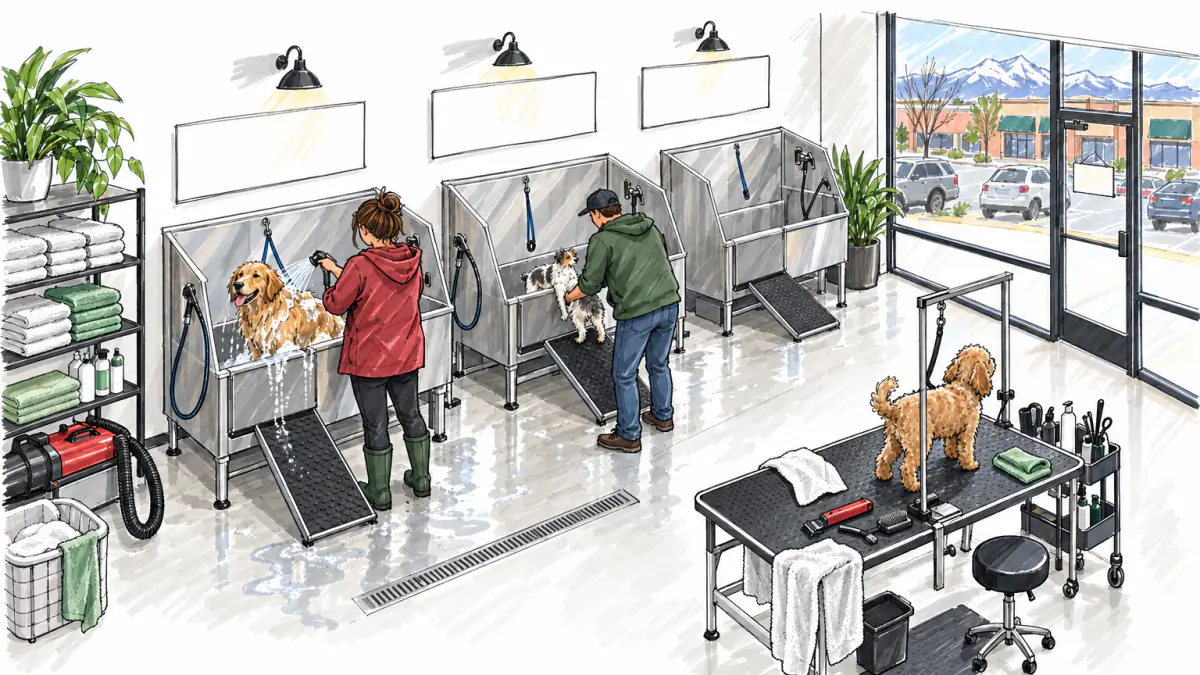
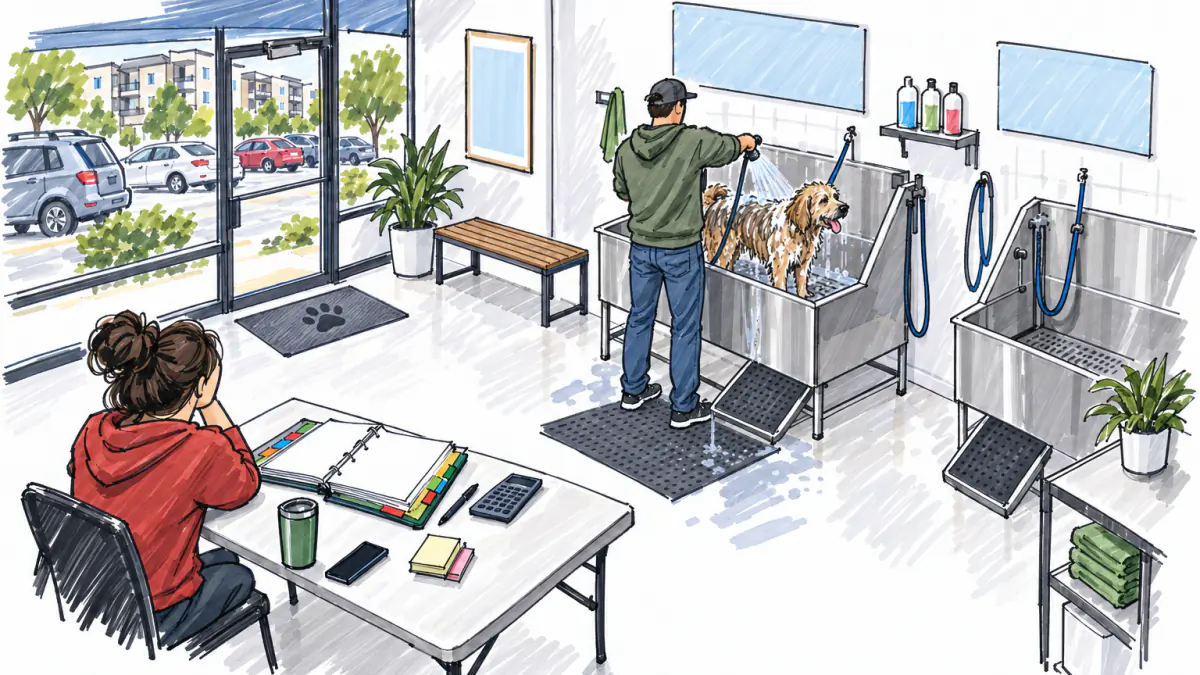
Our example idea: a self-service dog wash with grooming stations in a strip-mall unit in suburban Denver, for dog owners in apartments or condos who have no yard or tubex. Our method’s check gave it the verdict “Possible, with caveats”ex and a score of 63 out of 100ex.
Four plan sections come straight from the check’s report.
| Plan section | What the check supplies | Figure (example by our method) |
|---|---|---|
| Market analysis | Published market size | TAM USD 2.19 billion, 2025, Mordor Intelligenceex |
| Competitor analysis | Direct competitors with visibility shares | 9 direct competitorsex; top share 33%ex |
| Marketing and sales | CAC and complaint themes | CAC $30ex; 3 complaints on Qualityex, 3 on Availability, minimum orderex |
| Financial projections | The unit block | LTV $138.60ex, LTV to CAC 4.62ex, payback 2.6 monthsex |
The competitor part of the market section lists the top five by visibility share (example by our method):
| Competitor | Visibility share, % |
|---|---|
| Petco | 33ex |
| Lily’s Baths and Biscuits | 19ex |
| Pet Station | 14ex |
| Autowash | 14ex |
| Dingo’s Natural Pet Food, Self-Wash & Grooming | 8ex |
The complaint counts give the offer its angle (example by our method): Quality 3ex, Availability, minimum order 3ex, Convenience 1ex, Other 1ex, Price 1ex. The marketing section answers the two themes with 3 complaints each first.
Where a number has no source, the plan says so. No measured demand source turned up in the check (example by our method)ex. So the plan marks demand as an assumption until it is measured, for example with a pre-launch waitlist or a count of weekend visits at a competitor.
The risks and mitigations paragraph takes the check’s four scored risks (example by our method). First, Autowash already covers about 75% of the concept in the same area, so buyers may pick the existing option (likelihood 3, impact 3)ex; the plan answers with a feature Autowash lacks. Second, customers complain about availability and minimum orders and no competitor addresses it, but hourly stations alone may not close that gap (likelihood 2, impact 2)ex; the plan tests booking and walk-in hours before launch. Third, the unit economics are a category estimate (likelihood 2, impact 3)ex; the plan replaces the margin with quotes from suppliers. Fourth, the business needs a license before opening, which delays the first customer and costs money (likelihood 2, impact 2)ex; the plan puts the license on the timeline and in the funding request. The full method for this paragraph is on business risks.
The check leaves you to write the funding request and the organization and management section, and to set your fixed costs. Those stay yours to write.
How this was made: the check ran 17 search queriesex and read 24 sourcesex (example by our method). Every figure in this section comes from its report; the arithmetic in the unit table is ours.
Run the same check on your idea

Six questions before you write
- Who buys, and how many of them you can reach.
- Which problem they pay to solve today, and what they complain about.
- Who else sells it, and what share of buyer attention each competitor holds.
- What one sale earns after its direct costs.
- What you need before the first customer: money, a license, a lease, people.
- What could close the business in its first year.
The idea check answers questions 1 to 4 and drafts a scored risk list for question 6. Question 5 stays yours.
Common mistakes and the fix
- Optimistic projections: base each line on a source or a comparable business, and add a low case.
- Market figures with no source: footnote every number; where none exists, write that it is an assumption.
- Summary written first: write it last, from the finished sections.
- Padding: cut any paragraph that answers no question a lender or investor asks.
- “No competition”: name the direct competitors and their shares, as the example does with 9 of them.
- Writing alone: SCORE mentors and Small Business Development Centers offer free or low-cost counseling7.
FAQ
What is a business plan, in one sentence?
It is a formal written document with the goals of a business, the methods for reaching them, and the time frame1.
How long should a business plan be?
Do I need a business plan to get a loan?
If you apply for a bank or SBA-guaranteed loan, prepare the traditional format. The funding request names the amount you need, debt or equity, and the terms, period and use of the money3; the projections show how you will repay it.
What’s the difference between a traditional and a lean plan?
How many years of projections do I need?
Where can I get free help writing one?
SCORE and Small Business Development Centers offer free or low-cost counseling through the SBA’s partner network7.
Sources
- en.wikipedia.org, 06/22/2002
- sbdcnet.org, 04/28/2026
- sba.gov, 09/08/2026
- sba.gov, 11/30/2023
- nerdwallet.com, 07/19/2017
- legacy.sba.gov, 11/13/2024
- sba.gov, 09/10/2026
Check your idea for free
Describe your idea and the check collects demand, competitors, complaints and prices, with sources.


Comments 3 comments
Julia Hart Charlotte
Clear and short, saved it for my next pitch.
Anna Price Columbus
The dog-wash example made the funding request click for me: show where each dollar goes.
Tom Walker Austin
The lean format was all I needed for a first bank meeting. Good to know when the full nine sections are worth the time.
Have a question or a view on the article? Ask Fox.