Product Roadmap Template: What Goes on a Roadmap, Types and How to Build One

A product roadmap is a one-page plan of what you will build and the order you build it in, with the reason for that order. Each item names the outcome it serves, the evidence behind it, the metric that shows it worked and a rough horizon: now, next, later or a quarter. The template below has ten fields. Fill them in the order given and you have a first roadmap in one sitting.
Before you fill the Now column, see what the market says about your idea.
What a product roadmap is and who reads it

What goes on a roadmap
A roadmap holds items. Each item names the outcome it should change, the evidence that this outcome is worth chasing, the metric you will read, and the horizon. A list of features with dates is a release schedule. A list of tasks is a backlog. The roadmap sits above both of them and explains why things come in that order.
What each reader gets from a roadmap
| Reader | The question it answers | What they must not read into it |
|---|---|---|
| Founder or executive | Which objective gets the team’s time now | A delivery contract |
| Engineering | Why this work comes before that work | A sprint plan |
| Sales and support | What to tell a customer who asks | A date to promise |
| Investor or board | Whether the order follows the evidence | A revenue forecast |
One test shows whether your roadmap works. If stakeholders keep pinging you for status, they do not trust the page you sent. Atlassian describes the pattern: trust erodes, and the next status request comes because the last page was unreliable1.
Roadmap, vision, strategy, plan and backlog
Roman Pichler’s product strategy model has four elements: product vision, product strategy, product roadmap and product backlog2. The table below adds the delivery plan between the roadmap and the backlog, because that is where dated project plans live. The example lines come from the espresso-van case worked through later on this page.
| Document | The question it answers | Horizon | Example line |
|---|---|---|---|
| Vision | Why the product exists | Years | Every Atlanta shoot day has coffee the crew does not leave set for |
| Strategy | Which bets win the market | Several quarters | Win production coordinators with day-rate bookings on location |
| Roadmap | In what order you test and ship the bets | Now, next, later | Now: test whether coordinators book at the day rate |
| Delivery plan | Who does what by which date | Weeks | Call coordinators from this month’s shoot list |
| Backlog | What the team builds next | Current and next sprint | Booking form with call time and crew size |
If you need dated delivery, use a 90-day project roadmap or the project roadmap template. If an investor asked for the full document, see how to write a business plan.
The product roadmap template: ten fields and the order to fill them
Fill the fields top to bottom. The outcome and its evidence come before the item, so an item without a reason cannot get in. When the evidence field says «assumption», the item enters the roadmap as a test of that assumption, and building waits until the test passes. We set this filling order for this template.
| # | Field | What to write | Example line |
|---|---|---|---|
| 1 | Objective | The result the product must reach this period, in one line | Prove that Atlanta productions book a coffee van at a day rate |
| 2 | Outcome | What will be different for the user once the item ships | Coordinators rebook within the month |
| 3 | Evidence | A source you can link, or the word «assumption» | Assumption: no measured demand yet |
| 4 | Risk it resolves | The risk from your idea check and its probability × impact score | Falling shoot volume may leave the van idle |
| 5 | Item | The initiative, named by what it does | Booking-volume test with coordinators |
| 6 | Type | Test or build | Test |
| 7 | Leading metric | A signal you can read within weeks | Quote requests per week |
| 8 | Lagging metric | The result itself, read after the fact | Paid bookings per month |
| 9 | Horizon | Now, next, later, or a quarter in a timeline view | Now |
| 10 | Owner | One name: the person who reports the metric | The founder |
Leading indicators predict a future outcome, and lagging indicators measure a past one3. Every item gets one of each, so a review can act on the leading signal before the lagging number arrives.
The downloadable .xlsx template on this page has two sheets. «Now-Next-Later» holds the ten fields as columns, plus Probability (1 to 3), Impact (1 to 3), a Risk score that multiplies them, a Suggested horizon, a Pass line and a Review date. The suggested horizon applies this template’s thresholds: a score of 6 to 9 suggests Now, 3 to 5 Next, 1 to 2 Later. Type and Horizon are drop-downs, so a row takes only test or build, and only now, next or later. «Timeline» lists the same items by quarter, with a Depends on column and a Status.
The worked example’s rows are marked «example». In the booking-volume row, P3 × I3 = 9, so the sheet suggests Nowex. Set the pass line and review date before the test starts, then overwrite the example rows.
Types of product roadmaps by format and by audience
Pick the format first, then cut one view per audience from it. The format depends on who reads it and how far ahead it looks, and also on item size, from features through initiatives up to objectives.
| Format | The axis | Use it when | Avoid it when |
|---|---|---|---|
| Timeline | Dates or quarters | Fixed dependencies: a launch event, a contract | The scope is still a guess |
| Now-next-later | Certainty | You are pre-launch or evidence changes monthly | A partner needs a firm date |
| Feature | Features grouped by release | The release is committed and its scope is known | The outcome is unproven |
| Outcome or theme | The outcomes you will move | Teams own problems and pick solutions | Nobody has agreed on metrics |
| Release or external | «Planned» and «exploring», at quarter precision | Customers and prospects read it | You would be tempted to give a day |
Janna Bastow, co-founder of ProdPad, created the now-next-later format as an alternative to timeline roadmaps that make promises product teams can’t keep4. The external roadmap is the one format where a date hurts you in public. Pendo cautions that deadlines on a customer-facing roadmap risk upsetting customers5. Give a quarter, or the labels «planned» and «exploring».
A feature roadmap fits a release whose scope is signed off. Before the outcome is proven, it locks you into features that may not move anything; use now-next-later until the evidence is in.
Agile roadmaps
An agile roadmap follows the value the Agile Manifesto set out in 2001: responding to change over following a plan6. Productboard’s guide says an agile roadmap looks only two to three months ahead7. You revise it as evidence arrives and keep it apart from the sprint plan, which holds the work.
One view per audience
| Audience | Show | Leave out |
|---|---|---|
| Executives | Objectives, themes and quarters | Feature lists |
| Development team | Outcomes and initiatives; the sprint plan holds the work that maps back to them | Commitments the team has not sized |
| Sales and support | What is planned and what is exploring, in customer language | Code names and internal dates |
| Customers | Problems you plan to solve, at quarter precision | Specific days |
How to build a product roadmap in six steps
Each step fills named fields of the template. The worked example further down shows the filled draft.

1. Write the objective
Fills field 1. Work backward: vision, then the objective for this period, then the themes under it. Write the objective as a result the business can see, such as «prove that productions book at a day rate». A feature name in this field means you skipped a level.
2. Gather the evidence
Fills field 3. Sources include interviews, reviews, search demand and your idea check. Use customer interview questions, find customer pains in reviews and check demand before launch. Anything you cannot link is written as «assumption», and that word decides the item’s type in field 6.
3. Turn outputs into outcomes
Fills field 2 and fields 7–8. An approval is not an outcome. Neither is a purchase order or a sprint task; neither is a feature you have shipped. The test: write down what will be different for the user once the item ships. In the espresso-van case, the output is «buy a second espresso machine» and the outcome is «coordinators rebook within the month». Then pick one leading and one lagging metric for that outcome.
4. Prioritize
Fills fields 4 and 9. After launch, when you have users to count, score items with RICE: (Reach × Impact × Confidence) ÷ Effort, created by Sean McBride at Intercom in 20168. Before launch you have no reach to count, so order items by risk, as the next section explains.
Before an item goes on the roadmap, check which objective it serves and what the evidence is, then confirm it has an owner and fits this period’s capacity. An item with a blank answer stays off.
5. Choose the format and the views
Fills fields 6 and 9. Set both by rule, row by row:
| If the row shows | Type (field 6) | Horizon (field 9) |
|---|---|---|
| Evidence is «assumption», risk score 6 to 9 | Test | Now |
| Evidence is «assumption», risk score 3 to 5 | Test | Next |
| Risk score 1 to 2 | Test or build | Later |
| Linked evidence, or a Now test that passed its pass line | Build | Next, or Now if capacity allows |
| A test that failed its pass line | None | Off the roadmap, with the reason noted |
In the example, the estimated unit economics score P2 × I3 = 6, so measuring them is a Now testex. The licence risk scores P2 × I2 = 4, so it waits in Nextex. Override a suggested horizon only for a fixed external date, such as a launch event or a contract, and put that item on the «Timeline» sheet with what it depends on. Then cut one view per audience from the same rows: objectives and quarters for executives, «planned» and «exploring» for customers.
6. Share it and set a review date
Fills field 10. Pendo suggests periodic reviews of the roadmap, for example quarterly9. Before launch, also review it each time a Now test finishes, because a passed test moves an item and a failed one removes it.
How we order a pre-launch roadmap
Our method rests on four rules. They turn an idea check into a first roadmap.
- Every item carries outcome, evidence, metric, horizon and owner. Evidence is a source or the word «assumption». An assumption becomes a test with a pass line (what you measure and the result that passes it), and it goes in Now.
- Before launch, order by risk. The check scores each risk for probability and impact, each on a scale of 1 to 3, and you multiply the two. The placement thresholds are an assumption of this template: a product of 6 to 9 goes in Now as a test that resolves the risk, 3 to 5 goes in Next, 1 to 2 goes in Later. They are not a constant of the check. See business risks before launch for scoring in depth.
- Unit economics gate the Later column. The check computes LTV = price × purchases per month × lifetime in months × margin, then LTV ÷ CAC, then payback in months = CAC ÷ (price × purchases per month × margin). While these rest on a category estimate, measuring them is a Now item, however good they look. Run your own numbers in the unit economics calculator.
- When the check finds no measured demand, the first Now item is a demand test.
Worked example for an espresso van on Atlanta film sets
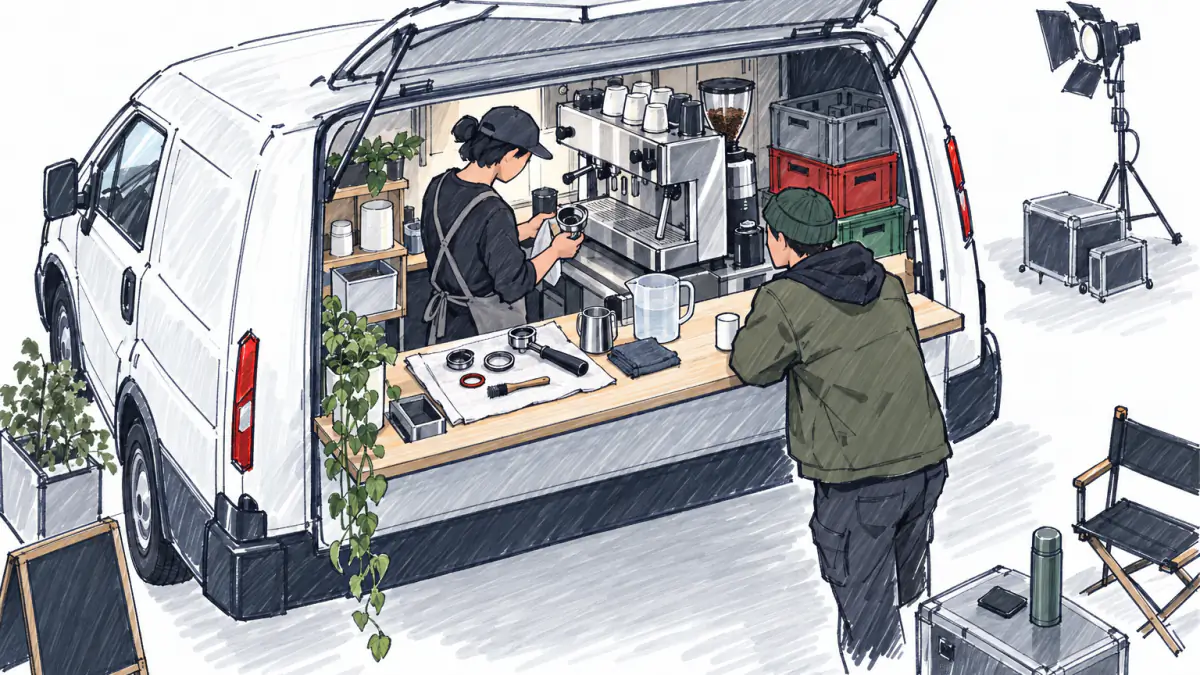
Our example idea is a converted espresso van booked for film and TV shoots around Atlanta, with production coordinators paying day rates to keep cast and crew caffeinatedex. Run by our method, the check returned «Possible, with caveats»ex with a score of 53ex, drawn from 17 search queriesex and 23 sourcesex. Nothing is built yet, so this is a pre-product roadmap and every Now item is a test.
The check’s TAM is $2.6 billion for 2024, from georgia.org (example by our method)ex. That figure is what film and TV productions spent in Georgia in fiscal year 202410, so coffee service is a small share of it.
| Horizon | Item | Outcome | Evidence (example by our method) | Metric |
|---|---|---|---|---|
| Now 1 | Demand test with production coordinators | Coordinators ask for a quote | Demand source: noneex | Quote requests per week |
| Now 2 | Booking-volume test | The van fills days between productions | Risk P3 × I3 = 9: shoot volume keeps falling, the van may sit idleex; the check assumes 4 bookings a monthex | Paid bookings per month |
| Now 3 | Offer test against BRO COFFEE | Coordinators book you for a named reason | Risk P3 × I3 = 9: BRO COFFEE already serves most of this offerex; complaint themes: Convenience 2ex, Reliability and trust 1ex, Speed 1ex, Quality 1ex | Quotes that turn into bookings |
| Now 4 | Replace the estimated price, margin and CAC with real ones | Unit economics measured in Atlanta | Risk P2 × I3 = 6: the numbers are a food-service category estimateex | Margin per booking, cost per booked coordinator |
| Next | Licence and food-safety compliance per site | The van can work any shoot site | Risk P2 × I2 = 4: a licence and food safety on each siteex; county health permit11 | Sites cleared before the shoot date |
| Later | A second van or new cities | Template example row, not a check finding | Opens after Now 4 passes | Set when it opens |
In Georgia, the permit application for a mobile food unit goes to the county health department where the unit’s base of operation is located11. That is a one-time task per base, which is why it sits in Next behind the tests that decide whether the van runs at all.
The check counted 10 direct competitors (example by our method)ex. Their visibility shares, an example by our method: Longshot Coffee 21%ex, Refuge Coffee Co. 15%ex, BRO COFFEE 14%ex, Sequel Coffee Co. 14%ex and Goodhart Coffee Catering 7%ex. Visibility share measures search presence and says nothing about offer overlap. BRO COFFEE trails Longshot on visibility, and the risk names BRO COFFEE because its offer is the closest match. A competitor analysis gives you the full set before you write the offer test.
Now 4 is where a good-looking estimate gets tested. In this example by our method, with a day rate of $900ex, 4 bookings a monthex, a 10-month lifetimeex and a 12% marginex, LTV is 900 × 4 × 10 × 0.12 = $4,320ex. With a CAC of $500ex, the same example by our method gives LTV to CAC of 8.64ex and payback of 500 ÷ (900 × 4 × 0.12) = 1.2 monthsex. Those numbers rest on a category estimate, so measuring them stays in Now, and the second van waits in Later.
Run the same check on your idea and fill your Now column from its risks.
How the roadmap changes from MVP to a mature product
| Aspect | MVP | Mature product |
|---|---|---|
| Horizon | Now, next, later; Now covers weeks | Quarters, plus a timeline view for dependencies |
| Item type | Mostly tests | Mostly builds, with tests for new bets |
| Update frequency | After every finished test | On a fixed review cadence |
| Dependencies | Few, mostly external: permits, suppliers | Many, across teams |
| Goal | Prove the outcome exists | Move metrics you already measure |
At the MVP stage, the roadmap is a test queue. Once the Now tests give you measured unit economics, carry them into a financial model and switch the mature parts of the roadmap to quarters.
Mistakes that make a roadmap useless
| Mistake | Fix |
|---|---|
| A good-looking estimate skips Now | Keep measuring it in Now until real bookings replace it, as in the example’s risk on estimated unit economics |
| Vanity metrics such as page views | Pair each item’s leading metric with a lagging one tied to the outcome |
| No room for maintenance | Add a maintenance and tech-debt lane with the capacity share you reserve; the share is yours to set |
| Dates on the external roadmap | Use quarters or «planned» and «exploring» |
| One view for everyone | Cut a view per audience from the same items |
| No review date | Put the next review in the owner’s calendar; a stale roadmap draws status requests |
Who owns the roadmap and how to present it
Productboard says the roadmap usually belongs to a product leader (a Chief Product Officer or VP of Product) or a product manager; where titles don’t exist, it belongs to whoever does the product work12. In a startup that is usually the founder. The owner’s job is to decide what stays off the roadmap, and every rejected item needs a reason the owner can state.
For a roadmap review, use this order:
- The objective.
- What changed since the last review: tests passed, tests failed, items moved.
- The Now column.
- The decisions you need from the room.
Below the roadmap, initiatives break into epics and epics into stories in the delivery tool. When something big changes between reviews, record a short walkthrough and send it with the updated view. For investors, the executive view goes into your pitch deck as one slide of objectives and quarters.
Roadmap software or a spreadsheet
The choice depends on how many audience views you need, how often items change, whether items must link to the delivery tool, and who may see what. Start in the .xlsx template: «Now-Next-Later» holds the whole method in one row per item, and «Timeline» holds the dated items with their dependencies and status. A spreadsheet is enough while one owner edits it and every reader can see every row.
Move to software when any one of these is true:
- One list of items has to feed two or more audience views, and you copy rows between sheets.
- Each item must link to tickets in the delivery tool, so its status updates without you.
- Customers need to see the external roadmap and nothing else.
Dedicated roadmap tools such as ProdPad, Productboard and Jira Product Discovery are built for that move. If your team already tracks its work in Jira, Jira Product Discovery keeps roadmap items next to those tickets. When you compare tools, check three things: several views cut from one list of items, a link from each item to the delivery tool, and sharing set per view. Carry the ten fields over as custom fields, and Probability, Impact and the risk score as number fields, so the method survives the switch.
Where to go next
Your Now column usually holds three kinds of tests. Run a demand test for the demand item and score the rest with business risks before launch. Then enter your price and margin, plus CAC, in the unit economics calculator. To get the risks and estimates the example started from, run the check on your own idea.
FAQ
What should a product roadmap include?
Objective, outcome, evidence, the risk the item resolves, the item, its type (test or build), a leading metric, a lagging metric, a horizon and an owner. Those are the ten fields of the template above.
What is the difference between a product roadmap and a product strategy?
The strategy names the bets that should win the market. The roadmap sets the order in which you test and ship those bets.
Why do you need a product roadmap?
It answers a different question for each reader: executives see which objective gets time, engineers see why work is ordered, sales sees what to tell customers, and investors see whether the order follows the evidence.
What is an agile roadmap?
A roadmap with a horizon of weeks to a few months, revised as evidence arrives and kept separate from the sprint plan. Productboard puts the horizon at two to three months7.
What is a product development roadmap?
The development team’s view of the product roadmap. It holds outcomes and initiatives; the sprint plan holds the work that maps back to them.
What are the main types of product roadmaps?
Timeline (dates), now-next-later (certainty), feature (releases), outcome or theme (outcomes you move) and release or external (planned versus exploring, at quarter precision).
How do you create a product roadmap?
Write the objective and gather evidence. Turn outputs into outcomes with metrics, then prioritize: by RICE after launch, by risk before it. Pick the format and views, share the roadmap and set a review date.
When is a feature roadmap the wrong choice?
Before the outcome is proven. Use now-next-later until tests confirm the outcome, then switch the committed release to a feature view.
Sources
- atlassian.com, 04/06/2026
- romanpichler.com, 05/11/2026
- whatfix.com, 08/06/2024
- prodpad.com, 06/29/2026
- pendo.io, 11/03/2025
- agilemanifesto.org, 10/02/2026
- productboard.com, 11/19/2019
- whichframework.org, 12/30/2024
- pendo.io, 08/08/2019
- georgia.org, 08/14/2024
- dph.georgia.gov, 08/11/2026
- productboard.com, 01/23/2025
Check your idea for free
Describe your idea and the check collects demand, competitors, complaints and prices, with sources.