Lean Canvas: Template, the 9 Boxes in Fill Order and a Real Example

A lean canvas is a one-page business model for an idea you have not proven yet. Its nine boxes are Problem, Customer Segments, Unique Value Proposition, Solution, Channels, Revenue Streams, Cost Structure, Key Metrics and Unfair Advantage1. Ash Maurya published it in August 2010 as an adaptation of the Business Model Canvas2, and he says a first canvas should take under 20 minutes3. Begin with customers and their problem, and treat each box as an assumption until a figure backs it.

The short version
- What it is: one page that lists the assumptions an idea rests on, in nine boxes.
- Who fills it, and when: a founder or a product team, before the first build and again after every test.
- The fill order: customers and problem, value proposition, solution, channels, revenue, costs, metrics, unfair advantage last.
- Every box is an assumption until a figure backs it.
This page’s template includes the nine boxes, the three sub-fields, a prompt question per box and the attribution line. The Lean Canvas is licensed under Creative Commons Attribution-ShareAlike 3.0, so any derived template must credit Ash Maurya and the Business Model Canvas4.
What a lean canvas is
A lean canvas puts a business idea on one page, so you can see which parts you know and which parts you are guessing. The nine boxes are Problem, Customer Segments, Unique Value Proposition, Solution, Channels, Revenue Streams, Cost Structure, Key Metrics and Unfair Advantage1. Each box holds a few short lines, written as statements you can test.
The current template splits three boxes with a sub-field5:
- Existing Alternatives sits under Problem and records how customers solve the problem today.
- Early Adopters sits under Customer Segments and names the subset you target first.
- High-Level Concept sits under Unique Value Proposition and states the idea as an X-for-Y analogy.
That is why some templates show 12 fields while the canvas still has nine boxes. Count each sub-field as part of its parent: nine boxes, three of them split.
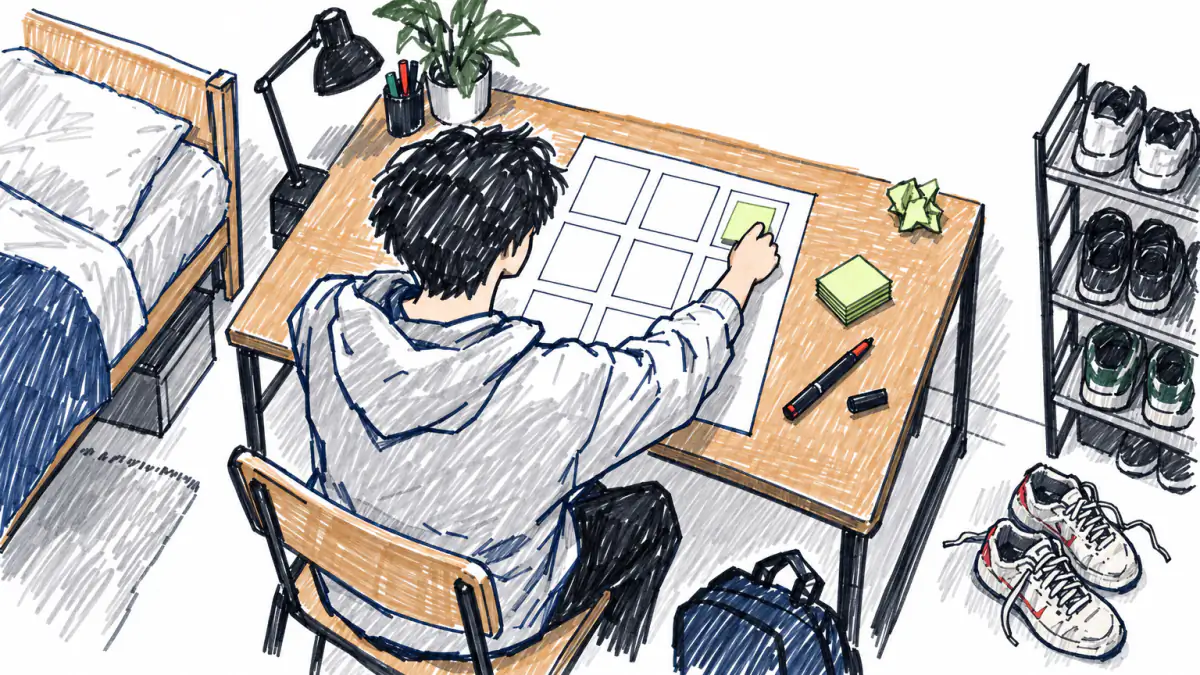
In the standard layout, Problem, Unique Value Proposition and Customer Segments run the full height of the page. Solution sits above Key Metrics, and Unfair Advantage sits above Channels. Cost Structure and Revenue Streams split the bottom row. Our reading is that the tall boxes get the most room because you rewrite them most as you learn. The bottom row holds the money: if revenue cannot cover cost, the boxes above it need another pass.
Who uses a lean canvas, and when
The canvas fits anyone who has to describe a business before the evidence exists:
- founders before the first build, deciding whether an idea earns a prototype;
- product teams inside a company, scoping a new product next to the one that already sells;
- intrapreneurs pitching an internal venture to a budget holder;
- accelerator and classroom cohorts, where a mentor reads many ideas in one sitting.
Sketch the canvas before you spend money on building. Rewrite it after every customer test, because each test moves at least one box. Start a fresh canvas when you switch customer segment, since a new segment changes most of the boxes at once.
Three operating rules keep the canvas useful:
- Timebox the first pass. Maurya’s guidance is less than 20 minutes for the initial canvas3. Leave a box blank before you stall on it.
- Fill separately, then reconcile. Maurya advises each team member to make their own canvas first and then merge them into one, to avoid groupthink3.
- Date every version. After a test you compare versions, and the date shows which assumption changed and when.

How to fill in a lean canvas, box by box
Maurya says there is no right place to start: begin with the box you understand best and build out from there3. If you cannot decide, his recommended order starts with Customer Segments3. The order we use, and the one the template numbers, is:
- Customer Segments, with Early Adopters
- Problem, with Existing Alternatives
- Unique Value Proposition, with High-Level Concept
- Solution
- Channels
- Revenue Streams
- Cost Structure
- Key Metrics
- Unfair Advantage
Customers and problem come first because every other box answers to them. Unfair Advantage comes last because you need the rest of the canvas to judge what a rival could copy.
Customers and problem
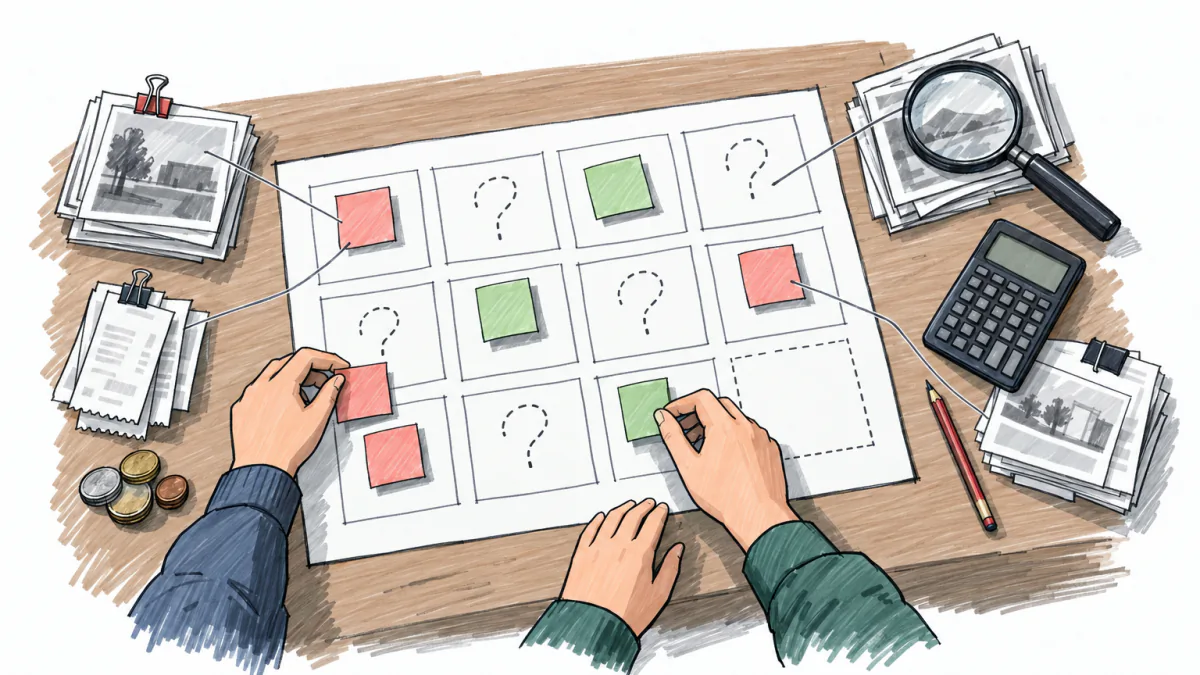
Name the segment by a situation you can find and reach, such as “students in campus dorms who own several pairs of sneakers”. Early Adopters is the narrowest slice of that segment that feels the problem now. In Problem, write the pains in the customer’s words, ranked the way they would rank them. Pull them from reviews and complaints where you can: find customer pains in reviews. Existing Alternatives lists what people do about the problem today, including workarounds or simply living with it. To build that list, find your competitors first.
Value proposition and solution
The Unique Value Proposition is one sentence that tells a stranger why your offer beats the thing they use now. High-Level Concept compresses it into an analogy. Solution comes after both: the smallest set of features that answers each listed problem, one feature per problem. If a feature answers no problem on the canvas, it waits.
Channels, revenue and costs
Channels says how you reach the segment: name the first channel you can test this month. Revenue Streams holds the price, how often a customer pays and how long they stay. Cost Structure holds two kinds of cost. Variable costs are the cost to win a customer and the cost to serve one, which the margin captures. Fixed costs are what you pay whether anyone orders or not, such as rent, equipment, software and salaries. Add the fixed costs up to get your monthly burn. Divide it by the margin one customer brings in each month to see how many active customers you need to break even.
Key metrics and unfair advantage
Key Metrics are the few numbers that tell you whether the model works. Before you have revenue, track the steps a customer takes. Activation is the first action that delivers value, such as a first completed order. Retention shows whether that customer comes back, such as a second order within a set window. Once prices and costs are on the canvas, add two unit ratios, LTV to CAC and payback, which the method section below explains. Leave out followers and visits. Unfair Advantage gets the last minute of the sketch, and “none yet” is a valid entry.
| Box | Question it answers | A good entry | The common mistake |
|---|---|---|---|
| Customer Segments | Who has the problem? | A situation you can reach | “Everyone who wears shoes” |
| Early Adopters | Who needs it first? | The narrowest group in pain now | A copy of the segment |
| Problem | What hurts? | Pains in the customer’s words | Your solution stated as a lack |
| Existing Alternatives | What do they use today? | Named rivals and workarounds | “No competition” |
| Unique Value Proposition | Why you? | One sentence, one promise | A feature list |
| High-Level Concept | What is it like? | An X-for-Y line | A slogan |
| Solution | What do you build first? | One feature per problem | A full roadmap |
| Channels | How will they find you? | A named channel you can test | “Social media” |
| Revenue Streams | Who pays, how much, how often? | Price, frequency, lifetime | A price with no frequency |
| Cost Structure | What does a customer cost you? | Acquisition cost and margin | Pricing questions |
| Key Metrics | How do you know it works? | Unit ratios | Followers and visits |
| Unfair Advantage | What can’t be copied or bought? | “None yet” or a tested edge | Something money can buy |
Boxes people mix up
Each box answers one question, and most mix-ups put the same idea in two boxes. The table shows the five pairs we see confused most, worded on the sneaker idea from the example below.
| Pair | The rule | Wrong entry | The fix |
|---|---|---|---|
| Problem vs. UVP | Problem is the pain; UVP is your promise | Problem: “No locker pickup for sneakers” | Problem: “Cleaning a pair takes a trip to a shop” |
| Solution vs. UVP | Solution is what you build; UVP is why it wins | UVP: “Lockers, an app, a studio” | UVP: “Clean pairs back without leaving campus” |
| Revenue vs. Cost | Revenue is what they pay you; Cost is what you pay | Cost: “Charge per pair or monthly?” | Move pricing to Revenue; list acquisition and service cost |
| UVP vs. Unfair Advantage | UVP attracts; the advantage protects | Unfair Advantage: “Free pickup” | Unfair Advantage: “none yet” |
| Segments vs. Channels | Segment is who; channel is the path | Channels: “students” | Channels: “lockers at gyms and campuses” |
Problem vs. unique value proposition
Write the problem first, then write the UVP as the promise that answers it. A quick check: if the same noun appears in both boxes, the solution has leaked into the problem.
Before: Problem reads “There are no sneaker lockers at the gym”, and UVP reads “Free pickup lockers”. The locker sits in both boxes, and the problem is the absence of your product.
After: Problem reads “Getting a pair cleaned means a separate trip to a shop”. UVP reads “Drop your pair at the gym or on campus and get it back clean”. The pain is the customer’s; the promise is yours.
From feature to outcome
Climb one rung at a time until the line describes the customer’s result:
- feature: free pickup lockers at gyms and campuses;
- benefit: you drop shoes off where you already go;
- outcome: your pairs come back clean with no extra trip.
Put the outcome rung in the UVP and the feature rung in Solution; the wording itself is covered in positioning and the value proposition.
Unfair advantage, the box you fill last
Maurya quotes Jason Cohen’s test: a real unfair advantage is something that cannot be easily copied or bought3. Put every candidate through it. Ask whether a competitor with more money could buy the same thing, or copy it once they see it working.
Entries that can pass the test:
- insider knowledge or a license a rival cannot get;
- an existing community or audience that already trusts you;
- network effects, where each new user makes the product more useful to the others, as with a social network such as Facebook;
- data that only your operation collects.
Entries that fail: a low price, free delivery, a feature, a good team, hard work, being first. Each one can be matched with money or time.
You fill it last because the test depends on the other eight boxes: you cannot judge what a rival could copy until you know your segment and your costs to reach and serve it. An honest “none yet” shows where the idea is exposed. In the example by our method, the check found that a rival already offers about 60% of the idea and may copy the locker pickupex, so the box stays empty for now.
Lean Canvas vs. Business Model Canvas
Alexander Osterwalder and Yves Pigneur published the Business Model Canvas in Business Model Generation in 20106. Maurya shared the Lean Canvas, his adaptation of it, in August 20102. Both put a business on one page. They are built for different amounts of uncertainty.
| Axis | Lean Canvas | Business Model Canvas |
|---|---|---|
| Purpose | Find the riskiest assumptions in an idea | Describe how a business creates and delivers value |
| Stage | Before the product has proven demand | A running business, or a plan with known parts |
| Risk it targets | Customer, problem, demand, unit costs | How operations, partners and resources fit together |
| Who fills it | A founder or a small product team | Managers and strategy teams |
Which one to use
Run three lines:
- Stage: an idea points to the Lean Canvas; a running business points to the Business Model Canvas.
- Certainty: if most boxes would read “assumption”, use the Lean Canvas; if most are known, use the Business Model Canvas.
- Audience: for an internal or early-investor reader, use the Lean Canvas; for partners and operators of an existing business, use the Business Model Canvas.
Choose the Lean Canvas if the idea is unproven and you are the one testing it. Choose the Business Model Canvas if the business runs and you are explaining or redesigning how it works. When a lender asks for a full document, take either canvas as the outline and write a business plan.
A lean canvas filled from a real idea check
We ran one idea through our check on October 15, 2026. In the example by our method, the idea reads: “Sneaker cleaning and restoration service with free pickup lockers at gyms and campuses in Atlanta: sneaker collectors and students paying $30–$80 per pair”ex. The verdict in the example is Worth buildingex, with a score of 68ex. The check used 17 search queriesex and 24 sourcesex (example by our method).
The grid follows our fill order. Every figure in it is an example by our method with its footnote. The two sub-fields the check does not cover are marked as assumptions.
| Box | Entry (example by our method) |
|---|---|
| Customer Segments | Sneaker collectors and students in Atlantaex |
| Early Adopters | Assumption: students who live on campus and train at a campus gym, because the lockers sit where they already go |
| Problem | Complaint themes: Quality 3ex, Reliability and trust 3ex, Service and support 3ex, Availability and minimum order 1ex |
| Existing Alternatives | 5 direct competitors countedex. Listed by visibility share: Fresh Clean Kicks (direct) 42%ex, The WashRoom Laundry Service (indirect) 27%ex, JS Cleaners (indirect) 7%ex, William Coit Sneaker Cleaning Atlanta (direct) 5%ex, TheCobblers (indirect) 5%ex |
| Unique Value Proposition | Cleaning and restoration with free pickup lockers at gyms and campusesex |
| High-Level Concept | Assumption: “a laundry locker for sneakers” |
| Solution | Cleaning and restoration per pair, priced in a $30–$80 band, with lockers at gyms and campusesex |
| Channels | Top demand phrase “sneaker cleaning”ex, measured in search trendsex; the lockers themselves |
| Revenue Streams | $35 per orderex, 1.5 orders a monthex, 12 months of lifetimeex, LTV $220.50ex |
| Cost Structure | CAC $30ex, margin 35%ex |
| Key Metrics | LTV to CAC 7.35ex, payback about 1.6 monthsex |
| Unfair Advantage | None yet: a rival offers about 60% of the idea and may copy the locker pickupex |
Two notes on how to read the canvas. The count of 5 direct competitors and the five-name list are separate results of the check; the list labels two of its names direct and the other three indirect. In our example, $35 is the price per order the check assumed inside the idea’s $30–$80 band; it is not an average of real orders.
Market context sits outside the boxes. In the example by our method, the check’s TAM figure is USD 1.2 billion for 2024, taken from a linkedin.com sourceex. To size your own, estimate the market size.
What to test first
The check’s risks point at the boxes with the weakest evidence (example by our method):
- Channels: search interest for sneaker cleaning dropped 13% over the year, and the locker model depends on steady volumeex.
- Problem and Solution: complaints about service quality and trust show buyers have been let down before, and a service that repeats them loses repeat ordersex.
- Channels and Customer Segments: only three east-side drop-off points exist in Atlanta, so pickup coverage for west-side buyers is weakex.
The same check works on your idea: check your own idea for free.
How our check fills the boxes
This is our method in the open: which result of the check goes into which box, the formulas behind the money boxes, and what we write when a box has no evidence.
| Canvas box | What the check gives it | If the check has nothing |
|---|---|---|
| Problem | Complaint themes with counts | Assumption |
| Existing Alternatives | Competitors, direct or indirect, with visibility share | Assumption |
| Customer Segments | The segments named in the idea | Always filled |
| Early Adopters | Not in the check | Assumption |
| Unique Value Proposition | The idea’s differentiator | Always filled |
| High-Level Concept | Not in the check | Assumption |
| Solution | The idea text | Always filled |
| Channels | Top demand phrase and where demand was measured | Assumption |
| Revenue Streams | Price, purchases per month, lifetime, LTV | Always filled |
| Cost Structure | CAC, margin | Always filled |
| Key Metrics | LTV to CAC, payback in months | Always filled |
| Unfair Advantage | The risks: a copyable edge means “none yet” | None yet |
The check applies three formulas. In the example by our method they give:
- LTV = price × purchases per month × lifetime in months × margin, so $35 × 1.5 × 12 × 0.35 = $220.50ex.
- LTV to CAC = LTV ÷ CAC, so 220.5 ÷ 30 = 7.35ex.
- Payback in months is CAC divided by monthly margin (price times purchases per month times margin): $30 divided by $18.375 gives about 1.6 monthsex.
We print no benchmark threshold for these ratios, because we have no source for one. Run your own inputs in the unit economics calculator.
Our rules:
- Every box holds a sourced figure or the word “assumption”.
- Fill in the creator’s fallback order, starting with Customer Segments.
- Unfair Advantage reads “none yet” until an entry passes the “cannot be easily copied or bought” test.
- Key Metrics come from the unit formulas, not from audience counts such as followers.
- Test first the box with the weakest evidence. Falling demand points to Channels, a copyable edge to UVP and Unfair Advantage, complaint themes to Problem and Solution.
Where the lean canvas comes from
Lean started in manufacturing: its methods were pioneered in the Toyota Production System7. Osterwalder and Pigneur’s Business Model Canvas came out in 20106, and Maurya shared the Lean Canvas in August 20102. His book Running Lean began as blog posts in 2009, was self-published in 2011 (the PDF in January 2011), was released by O’Reilly in 2012 and is now in its third edition, from 20228. Eric Ries published The Lean Startup in 20117.
Common mistakes
Each mistake comes with its fix:
- The solution written into the UVP. Fix: the UVP states the customer’s result; features go to Solution.
- Pricing questions under Cost Structure. Fix: price and frequency go to Revenue Streams; Cost holds acquisition and service cost.
- One canvas for every segment. Fix: one canvas per segment, because each segment brings a different problem and a different way to reach and charge it.
- Features in the UVP. Fix: climb the feature, benefit, outcome ladder and keep the outcome.
- Vanity counts in Key Metrics. Fix: LTV to CAC and payback, computed from the money boxes.
- An unfair advantage that money can buy. Fix: run the copy-or-buy test, and write “none yet” if nothing passes.
- The canvas treated as a finished plan. Fix: date it, test the weakest box, rewrite.
For the risks a canvas does not show, such as licensing, leases and seasonality, see business risks before launch.
After the canvas, test the riskiest box
Mark each box by its evidence: a sourced figure or a customer quote, and leave it unmarked if there is neither. Test the weakest box first. A Problem or Early Adopters box with no quotes calls for interviews, and these customer interview questions cover them. A Channels box with no numbers calls for a small paid or landing-page test: test demand in a week. In the sneaker example by our method, the first test goes to Channels, because search interest fell 13% over the yearex. Then rewrite the canvas with the result and date it.
FAQ
Who created the lean canvas, and when?
What are the 9 boxes, and why do some templates show 12?
The boxes are Problem, Customer Segments, Unique Value Proposition, Solution, Channels, Revenue Streams, Cost Structure, Key Metrics and Unfair Advantage1. Existing Alternatives and Early Adopters are sub-fields, and so is High-Level Concept; each sits inside one box5. Templates that draw the sub-fields as separate cells show 12.
How is a lean canvas different from a business model canvas?
The Lean Canvas fits an idea nobody has proven yet, and it targets the risk that the customers or the demand do not exist. The Business Model Canvas describes how a running business creates and delivers value. Use the checklist above to pick.
What’s the difference between the problem and the unique value proposition?
The problem is the customer’s pain in their own words. The UVP is your one-sentence promise that answers it. Write the problem first, and keep your product’s name out of it.
How long does it take to fill in a lean canvas?
Maurya says the first canvas should take less than 20 minutes3. Rewrites after each test take longer, because each one needs the test’s result.
Can I use the lean canvas template for free in my own work?
Yes, under its license. The Lean Canvas is licensed under Creative Commons Attribution-ShareAlike 3.0, so your copy has to keep the attribution to Ash Maurya and the Business Model Canvas4.
Who should use a lean canvas instead of a business plan?
A founder or product team testing an unproven idea. Once the canvas boxes hold figures and a lender or partner asks for a full document, use the canvas as the outline for the plan.
Sources
- study.com, 12/08/2022
- ashmaurya.com, 02/22/2024
- ashmaurya.com, 02/22/2024
- thetractionstage.com, 10/09/2025
- crv.com, 05/25/2026
- wiley-vch.de, 10/09/2026
- fh-wedel.de, 08/08/2026
- ashmaurya.com, 10/03/2026
Check your idea for free
Describe your idea and the check collects demand, competitors, complaints and prices, with sources.