Value Proposition Examples: 8 Brands Taken Apart, and How to Write Yours

A value proposition is one or two lines written for one customer group: it names the problem you solve and why that group should choose you over what it uses now. A USP is the single part of it no competitor can claim. A positioning statement is the internal version that also names your category and your main alternative. Below, eight brands are taken apart into those parts, followed by a fill-in template and a worked example built from a real idea check.
Check your idea for free to get the pains and rivals your value proposition needs, with the numbers attached.
What a value proposition is, and how a USP and a positioning statement differ
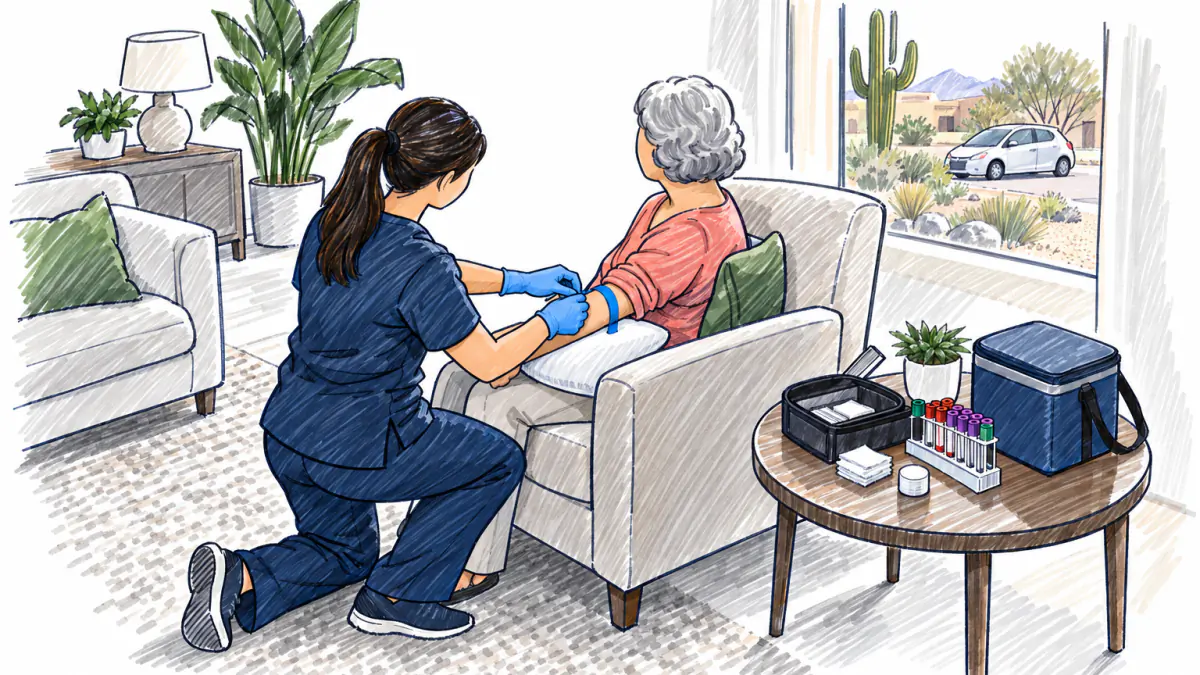
A value proposition is the promise the customer reads: who you serve, which problem you solve, and why your way beats the one they use now. Put it in your homepage headline and subhead, then reuse it in your ads and the first line of a sales call. Example line, by our method and taken from the worked example below: “Home blood draw in Scottsdale, from your doctor’s order to the lab.”
A unique selling proposition is narrower. The term comes from Rosser Reeves of the Ted Bates agency, who set it out in his 1961 book Reality in Advertising1. A USP is the one claim inside your value proposition that no rival can make. You can share a value proposition with competitors: three delivery apps can all promise dinner at your door. You cannot share a USP. Example: Hiut Denim’s “We make jeans. That’s it.”2 is a line that no brand selling shirts and jackets can copy.
A positioning statement is internal: it guides your team and the people you work with, such as your agency and investors. It fixes the target customer, the need, the category, the benefit, the alternative and the difference, so every headline and ad starts from the same base. The common template comes from Geoffrey Moore’s Crossing the Chasm3. For the term itself, see positioning.
When two offers carry the same value proposition, the buyer compares prices. A USP gives the buyer a reason to pay your price instead of the lower one.
| Term | What it answers | Public or internal | Example |
|---|---|---|---|
| Value proposition | Why this customer should buy from you | Public | “Home blood draw in Scottsdale, from your doctor’s order to the lab” (example by our method) |
| USP | What only you can claim | Public | “We make jeans. That’s it.”2 |
| Positioning statement | Who, which need, which category, against what | Internal | “For (customer) who (need), (product) is a (category) that (benefit)”3 |
| Slogan or mission | What you believe or how you sound | Public | Hypothetical: “Care should come to you” |
8 value proposition examples, taken apart
Each breakdown names five parts: the customer, the pain, the benefit, the proof and the alternative the customer uses today. Lines in quotation marks with a footnote were checked against a source in October 2026. Lines marked “paraphrase” are our wording of the brand’s pitch, not its copy: brand copy changes and we quote only what we checked, so open the brand’s homepage and set its current line beside the breakdown.
1. Hiut Denim: one product, one town
Quoted line: “We make jeans. That’s it.”2 The company makes its jeans in Cardigan, Wales2, for buyers who want jeans from a maker that does nothing else, rather than from a fashion brand where jeans are one line among many. A named town and a single job serve as the proof. What you can take: a narrow claim can be the whole USP, as long as it is true and a rival with a wider range cannot say it.
2. Patagonia Worn Wear: a program as proof
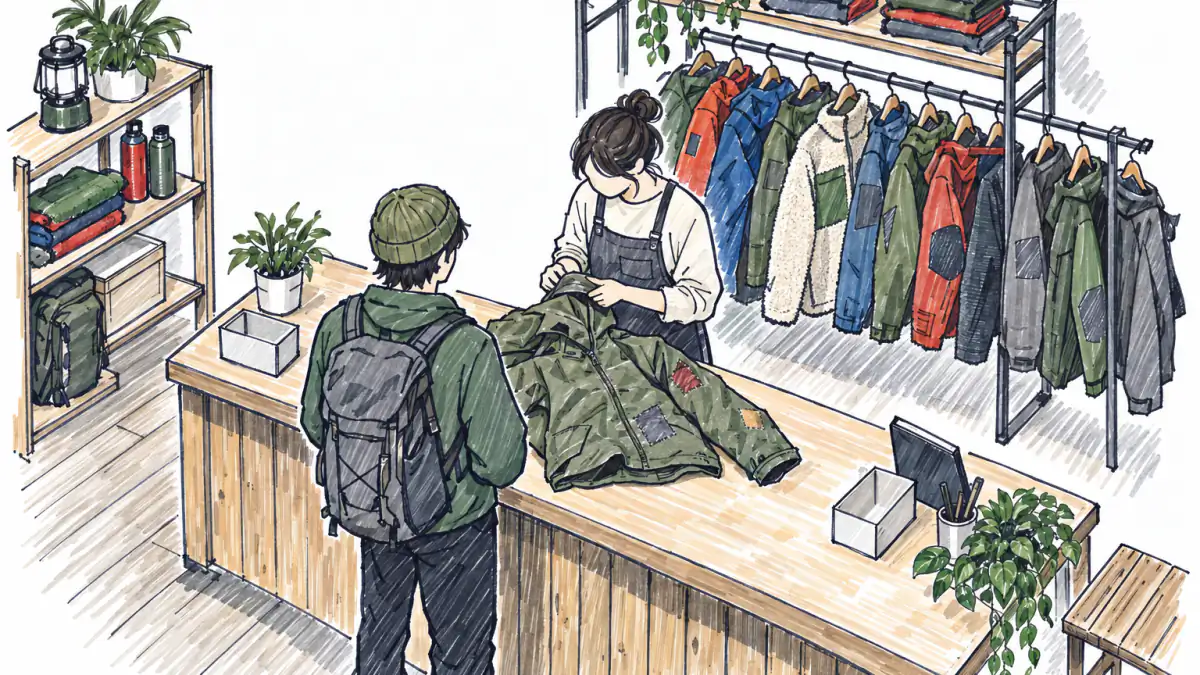
Quoted line: “Worn Wear allows you to trade in eligible Patagonia® gear for credit and buy quality, used Patagonia gear that has more life to live.”4 The customer already owns or wants Patagonia gear. The pain is gear that sits unused, or a new jacket priced above what the buyer wants to pay. The benefit is credit for old gear and a used option. The proof is the program itself: a trade-in and resale channel a buyer can use today. What you can take: a working program proves a promise that a slogan only states.
3. Billie: a named unfairness
Billie’s marketing drew attention to the “pink tax”, described in a Federal Trade Commission complaint as “the practice of charging a premium for razors marketed to women that are substantially similar to razors marketed to men”5. Women buying razors pay more for the same product, and the pink razor on the store shelf is what they would otherwise pick. What you can take: when the customer already feels a price unfairness, naming it makes the alternative explicit, and your offer becomes the way out.
4. Kit: an audience in the name of the category
ConvertKit renamed itself Kit and now calls itself “the email-first operating system for creators who mean business”6. The customer is a creator who earns from an audience. The benefit is a platform built around email. The alternative is a general marketing suite built for many kinds of business. What you can take: picking one audience narrows the line, and “who mean business” filters out hobbyists the product does not target.
5. DoorDash: a saved trip
Paraphrase, not DoorDash’s own copy: “Food and everyday items from stores near you, delivered.” The customer would rather not leave home or the office to shop. The pain is the trip: driving, parking, waiting in line. The benefit is the order arriving where the customer already is. The alternative is cooking or picking up. The proof the line needs is a delivery estimate shown before checkout, which the buyer can hold the order to. What you can take: the benefit is time saved, and time is easier to believe when you show it as a number. Read DoorDash’s current homepage headline and mark which of these parts it names.
6. Uber: trust when a stranger arrives
Paraphrase: “A ride when you need one, from your phone.” The customer either has no car close by or has no place to park one. The pain is waiting for a cab with no idea when it comes or who drives it. The alternative is a street hail or a call to a taxi company. The proof the line needs is the driver’s name and car before pickup. What you can take: when your service sends a person to the customer, the proof has to answer trust before it answers speed.
7. Canva for teams: a skill gap removed
Paraphrase, not Canva’s own copy: “Design together, without a design team.” The customer is a team with no designer that still has to make slides and posts, not only documents. The pain is waiting for a designer or learning professional software. The benefit is a finished design made by the person who needs it. The alternative is an agency or a pro tool. The proof the line needs is a ready template the team can edit in its first session, so the buyer sees the skill gap close before paying. What you can take: here the alternative is a missing skill, and the line names which step it removes.
8. Shugarman’s Bath: a local home service
Paraphrase of the pitch a one-crew bath remodeler makes, not Shugarman’s Bath’s own copy: “A new bathroom from one local remodeling crew.” The customer is a homeowner within the company’s service area. The pain is coordinating several trades and a project that runs late. The benefit is one crew and one point of contact from demolition to the last tile. The alternative is hiring separate contractors. The line needs licensed installers and local reviews as proof, backed by a written schedule. Each one is something a homeowner can check before signing: look up the license with the state and read the reviews on the company’s map listing. What you can take: a local service wins on proof of trust, which makes it the closest parallel to the worked example below.
Eight brands in one table
| Brand | Customer | Pain removed | Alternative | Line |
|---|---|---|---|---|
| Hiut Denim | Jeans buyers who want a maker | Jeans as a side line | Fashion brands | Quoted |
| Patagonia | Patagonia owners | Unused gear | Buying new | Quoted |
| Billie | Women buying razors | The “pink tax” | Pink razors | Quoted (FTC) |
| Kit | Creators | Tools built for others | General suites | Quoted |
| DoorDash | People at home | The trip | Cooking, pickup | Paraphrase |
| Uber | Riders | Waiting, unknown driver | Taxi | Paraphrase |
| Canva teams | Teams with no designer | The skill gap | Agency, pro tools | Paraphrase |
| Shugarman’s Bath | Local homeowners | Many trades | Separate contractors | Paraphrase |
The five parts of a value proposition
A finished line carries five parts: the customer, the pain, the benefit, the alternative and the proof. Drop one and the buyer has a question the line does not answer.

The customer
Write one value proposition per segment. If you serve two groups, write a line for each and lead with the segment that your most-named pain points at. Three prompts help: start with which customers and which need, then set your price against their current option. The full method is in target audience analysis.
The pain
Rank the pains on two measures: how often customers mention each one and how much it costs them. The most-named pain leads the headline. The second becomes the supporting line. Use the customer’s words: the phrase people type into search beats your trade term.
The benefit, or the promise
A brand promise is the benefit part alone; a proof part turns it into a value proposition. Check two things: the buyer sees the result within one purchase, and you can deliver it on your busiest day.
The alternative and the category
The alternative is what the customer does today: a named rival or the old way, and sometimes nothing at all. The category is the shelf the buyer puts you on, such as “razor brand” or “email platform”. Your choice of difference also places you in one of the value disciplines Michael Treacy and Fred Wiersema described in Harvard Business Review in 1993: operational excellence and product leadership, with customer intimacy as the third7.
The proof, or the reason to believe
Proof is what the buyer can check: a place, a program, a license, a number, a review. Each doubt a buyer has needs one proof line. An invented credential fails the first time a customer asks to see it.
Where the Value Proposition Canvas fits
Alexander Osterwalder’s Value Proposition Canvas has two sides. The Customer Profile lists the customer’s jobs, along with their pains and gains. The Value Map lists your products and services, then the pain relievers and gain creators behind them8. Use it to list everything; use the five parts above to cut that list down to one line.
How to write yours in five steps

Step 1. Name one customer
Pick one segment for this line. If your idea names two, draft two lines now and decide which leads after step 2.
Step 2. Lead with the most-named pain, in the customer’s words
Read reviews of your rivals and sort complaints by theme. Count each theme. The top theme leads; the next one supports. Take the headline phrase from what people search, not from your industry’s vocabulary. The full method is in finding customer pains in reviews.
Step 3. Name the alternative
List your rivals and rank them by search visibility. Open the top competitor’s homepage and copy its first-screen headline into your notes. If customers mostly use an old way instead of a rival, that old way is your alternative. See how to find and read competitors and the competitor table template.
Step 4. Pick the one claim a rival cannot make
Write down three possible differences and put each one through the competitor test. A difference stays only if the direct rival with the largest visibility share does not already claim it on its first screen. If that rival does claim it, the point belongs in your value proposition, not in your USP.
Step 5. Add the proof that answers the buyer’s doubt
For every doubt a buyer raises, note the proof you can show today. Then read the full line as the buyer and check that it answers three questions: why this offer, why from you, why now. End the step with a finished line you could put on a page tomorrow.
The template
Steve Blank’s format is “We help X do Y by doing Z”9. Our expanded version keeps every part in a slot:
For (one customer) who (most-named pain, in their words), (your product) is a (category) that (benefit). Unlike (the alternative), we (the one claim a rival cannot make), and you can check it by (proof).
Before you publish, check the five parts:
- One customer, named.
- The pain in the words customers search.
- A benefit the buyer sees within one purchase.
- An alternative you beat on one claim the top rival does not make.
- Proof the buyer can verify.
Price, deadline, guarantee and bonus belong to the offer around the line; see how to build an offer.
Turn it into a positioning statement
The positioning statement uses the same parts and adds the category and the alternative in full. The three below are reconstructed in the template, not the brands’ own text.
| Brand | Positioning statement (reconstructed in the template, not the brand’s text) |
|---|---|
| Hiut Denim | For people who want jeans from a dedicated maker, Hiut Denim is a jeans company that makes only jeans, in Cardigan, Wales. Unlike fashion brands, it makes nothing else. |
| Kit | For creators who run a business on email, Kit is an email platform built email-first. Unlike general marketing suites, it is made for creators. |
| Billie | For women who buy razors, Billie is a razor brand that removes the “pink tax”. Unlike razors marketed to women at a premium, it prices against that markup. |
The step-by-step method is in positioning and USP, step by step.
Test it before you spend
Put the line on a one-page site or a small ad before you print signs or fund a campaign. Run two lines that differ in one part, such as the pain or the proof, and keep the one that gets more clicks or sign-ups. The setup is in the demand test.
Worked example: a home blood draw service in Scottsdale
The check behind this example does not write value propositions; we drafted every line below by our method from the check’s fields, and each line is an example by our method.
What the check found
All figures in this example come from our method. The idea was a “mobile phlebotomy service drawing blood at patients’ homes in suburban Scottsdale, Arizona: homebound seniors and busy professionals ordered labs by their doctor”ex. The check returned “Possible, with caveats”ex with a score of 57ex, after running 17 search queriesex and reading 22 sourcesex. It found a published market size of $412.8 million for 2025, from emergenresearch.comex.
The customer, the pain and the words
The top demand phrase was “home blood draw”, from search trend data (example by our method)exex. So the headline says “home blood draw”, not “mobile phlebotomy”.
The most-named pain theme was “Reliability and trust”, with 3 complaints, and the next was “Availability, minimum order”, with 1 (example by our method)exex. The check also flags a risk: trust complaints already exist, and a new provider has to prove its draws and results arrive as promised (example by our method)ex. Trust leads; availability supports.
- Headline: “Home blood draw in Scottsdale, from your doctor’s order to the lab.”
- Subhead: “A phlebotomist comes to your home, and you get a confirmation when your sample reaches the lab.” The confirmation is an assumption: a service feature chosen because it answers the most-named pain.
- Proof line: only what the business can show, such as the license the state requires, the partner lab by name, and reviews once they exist. The check flags that a medical license is required; that delays launch and adds cost (example by our method)ex. Confirm the exact requirement with Arizona before you put a credential on the page.
The idea names two segments, so the method gives two lines. The check does not split complaints by segment, so which segment leads is an assumption.
| Segment | Line (example by our method) |
|---|---|
| Homebound seniors (leads, by assumption) | “Your doctor ordered labs. We draw at home, and your family hears when the sample reaches the lab.” Family notice is an assumption. |
| Busy professionals | “Home blood draw before your workday, no waiting room.” Early slots are an assumption. |
The alternative and the competitor test
The check counted 7 direct competitors (example by our method)ex. Its top risk is that a close competitor already offers most of this service, so a new entrant may be undercut on price or reach in Scottsdale (example by our method)ex.
| Rival | Type | Visibility share (example by our method) |
|---|---|---|
| OptiVena | Direct | 27%ex |
| Getlabs | Direct | 11%ex |
| Central Clinical Labs | Direct | 11%ex |
| Unique Lab Services | Direct | 10%ex |
| Labcorp OnDemand | Indirect | 11%ex |
The USP candidate is the lab-arrival confirmation. It passes only if OptiVena, the direct rival that holds a 27% share in our example, does not already make that claim on its first screen. The check holds rivals’ names and shares, not their copy, so you open the rival’s homepage and read it yourself. The competitor analysis tool lists the rivals for your own idea.
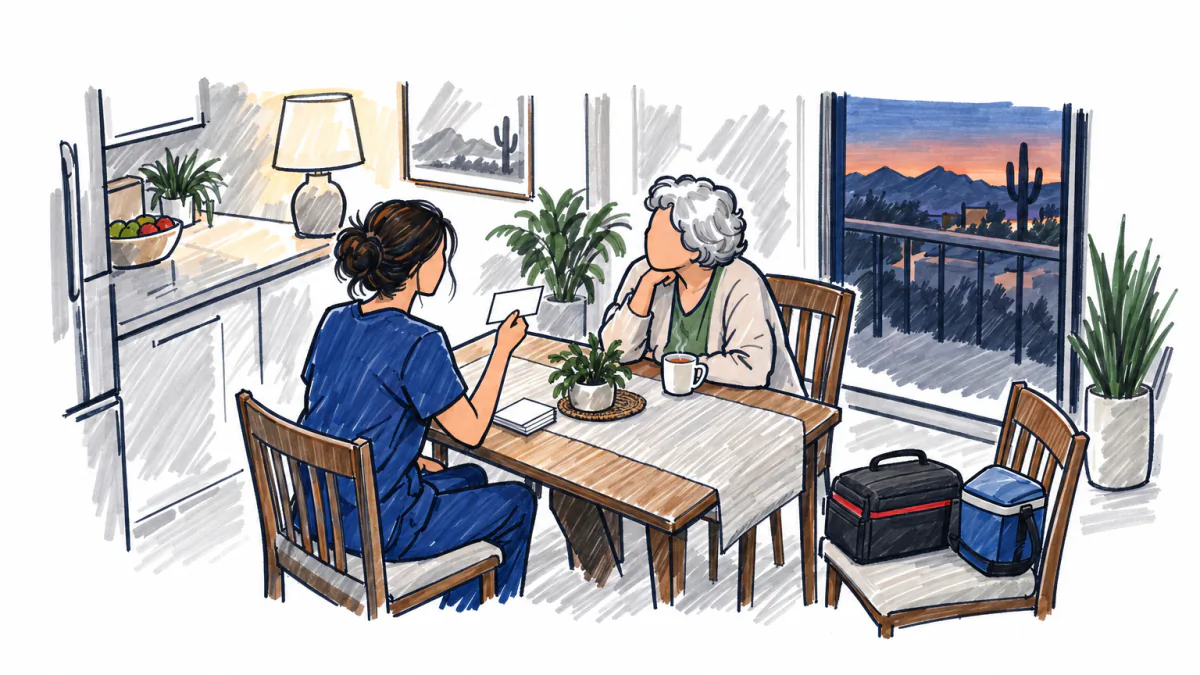
Positioning statement (internal, example by our method): “For homebound seniors and busy professionals in suburban Scottsdale with doctor-ordered lab work, (Name) is a home blood draw service that comes to the patient and confirms when the sample arrives at the lab. Unlike a drive to a patient service center and a wait, the draw happens at home.” The alternative here is the old way. The statement makes no claim about any rival’s service.
The money check
A promise stays only if the numbers still pay back. The check uses three formulas:
- LTV = price × purchases a month × customer life in months × margin.
- LTV / CAC = LTV ÷ CAC.
- Payback in months = CAC ÷ (price × purchases a month × margin).
In the example by our method, the price is $70 a visitex, 1.5 visits a monthex, a 6-month customer lifeex, a 45% marginex and a $60 CACex. That gives an LTV of $283.50ex, an LTV to CAC of 4.72ex and payback in 1.3 months, from $60 ÷ $47.25 (example by our method)ex.
The check also flags flat search demand, so the buyer pool may grow slowly (example by our method)ex. With slow volume, fast payback carries the business. In our example, promising a lower price than the 27% rival would cut the margin first. Before you write “cheaper” into the headline, rerun your own numbers in the unit economics calculator.
Mistakes that make a value proposition generic
| Mistake | Fix |
|---|---|
| Feature-speak: “Certified phlebotomists, modern equipment” | Lead with the result: “Home blood draw, from your doctor’s order to the lab” |
| “We offer high-quality products” | Replace “quality” with something a buyer can check: a place, a program, a time |
| A mission line used as the value proposition | Keep the mission for the About page; the headline names customer and pain |
| Two segments in one line | Write one line per segment and lead with the one the pain points at |
| A promise with no proof | Add one proof line per buyer doubt, or drop the promise |
| A price promise the numbers cannot carry | Run payback at the lower price before you publish it |
Before and after, in our own wording: “We offer high-quality care with a personal touch” becomes “A phlebotomist draws your blood at home, and you hear when the sample reaches the lab.” The second line states the service, the place, and a result the patient can check.
FAQ
What is the difference between a value proposition and a USP?
A value proposition is the full promise: customer, pain, benefit, proof. A USP is the one claim inside it that no competitor can make. Competitors can share a value proposition, never a USP.
What is a positioning statement, and do customers see it?
It is an internal statement naming customer, need, category, benefit, alternative and difference. Customers do not read it. Your team writes headlines and ads from it, and sales scripts as well.
What are some positioning statement examples?
See the Hiut Denim and Kit and Billie statements above, reconstructed in Geoffrey Moore’s template; the home blood draw statement sits in the worked example. None of them is a brand’s own text.
Can one business have more than one value proposition?
Yes, one per customer segment. The worked example covers two segments, homebound seniors and busy professionals; each gets its own line, and one proof backs both.
Where do I find the customer pains for my value proposition?
In reviews of your rivals and your category. Group complaints by theme and count each theme; then lead with the most-named one. The method is in finding customer pains in reviews.
What is the value proposition canvas?
Alexander Osterwalder’s tool with a Customer Profile (jobs, pains, gains) and a Value Map (products and services, pain relievers, gain creators). It lists inputs; the five parts above turn them into one line.
Can a USP change over time?
Yes: rewrite it whenever the audience or the product changes. ConvertKit renamed itself Kit and now leads with creators. Rerun the competitor test each time a top rival changes its headline.
How do I test a value proposition before I spend on it?
Put two versions on a simple landing page or small ad, change one part between them, and keep the line that gets more sign-ups. Do this before printing or a full campaign.
When your line is drafted, check your idea for free to get the pains and rivals behind it, or see packaging your offer for the page and offer around it.
Sources
- linkedin.com, 12/11/2018
- visitwales.com, 01/01/2000
- bdow.com, 04/23/2020
- wornwear.patagonia.com, 06/03/2026
- ftc.gov, 07/05/2026
- kit.com, 08/04/2026
- hbr.org, 10/01/2026
- mooncamp.com, 10/02/2024
- steveblank.com, 09/22/2011
Check your idea for free
Describe your idea and the check collects demand, competitors, complaints and prices, with sources.