Pricing Strategy: 14 Types, How to Choose One, and How to Set Your Price

A pricing strategy is the rule you use to set a price and to change it later. It decides where the price sits between your full cost (the floor) and the value buyers see (the ceiling), and how it moves against competitors over time. You usually start from one of five core strategies (cost-plus, competitive, value-based, penetration, skimming) and add tactics such as bundles or psychological prices. You pick by your goal, check the unit economics, then test.

- The five core strategies are cost-plus, competitive, value-based, penetration and skimming. Nine tactics and models sit on top of them (the full table).
- Your price lives in a corridor: full unit cost is the floor, the buyer's value is the ceiling, and competitors' prices form a band in between (six steps).
- Pick the strategy from your goal and market position. Margin points to skimming or value-based, fast growth to penetration, a crowded market to competitive (how to choose).
- Run a unit check and a price test before you publish. A ratio that looks too good is a sign that an input is wrong (worked example).
Key takeaways:
What a pricing strategy is, and why it moves profit
A pricing strategy fixes where your price sits and which events make it move. Cost-plus ties the price to your costs. Competitive pricing ties it to rivals, and value-based pricing ties it to the buyer. Penetration and skimming add time: penetration starts low and rises, while skimming starts high and falls.
Four terms get mixed up, and each is a separate decision:
- Pricing strategy: the rule for setting and changing the price, such as “launch high, cut when rivals arrive.”
- Pricing model: how you charge, such as per unit, per seat, per month or a share of the customer’s revenue.
- Pricing tactic: a device applied to a price, for example a 9 ending or a bundle; a decoy tier is another.
- Price point: the number on the tag or in the contract.
You can keep a strategy and change the model. A co-hosting service that takes a share of each booking (a model) can still price competitively or by value (a strategy).
Price has a direct line to profit. Marn and Rosiello reported in Harvard Business Review in 1992 that a 1% price improvement at constant volume raised operating profit by 11.1% on average1. The mechanism is arithmetic. For our example, take a business with $100 of revenue and $10 of operating profit (assumption). In our example, a 1% price rise at the same volume adds $1, all of it profit: a 10% gain. In our example, a 1% discount removes the same $1.
The 14 pricing strategies at a glance
The first table holds the five core strategies. Each one sets the basic position of your price. The second holds nine tactics and models you add on top. Every name links to its section.
The core five:
| Strategy | What it does | Use it when | Main risk |
|---|---|---|---|
| Cost-plus | Adds a markup to full unit cost | Costs are clear; buyers compare on cost | Ignores what buyers would pay |
| Competitive | Sets price against rivals’ prices | Many sellers, similar offers | Copies prices without the costs behind them |
| Value-based | Prices from the buyer’s gain over the next-best option | Your offer differs in ways buyers pay for | Needs research; a wrong guess loses sales |
| Penetration | Launches below the market to win customers | You need a base fast and can fund a loss period | Customers leave when the price rises |
| Skimming | Launches high, then cuts in steps | New product, eager buyers, few rivals | Early demand runs out sooner than planned |
Tactics and models:
| Strategy | What it does | Use it when | Main risk |
|---|---|---|---|
| Dynamic | Moves price with demand, time or capacity | Capacity is fixed and perishable, or jobs are quoted | Backlash; state price-gouging laws |
| Differential | Charges segments, regions or times differently | Segments differ in what they will pay | Resale between segments; federal limits on goods |
| Premium | Stays above the market for good | Quality or brand can carry the gap | Buyers leave if the gap is not visible |
| Economy | Stays at the low end on low costs | Lean cost base; price-shopping buyers | Thin margin, no room for mistakes |
| Psychological | Uses 9 endings, anchors, decoys | Consumer offers, retail | Can read as cheap or manipulative |
| Freemium | Free core tier, paid upgrades | Cost per extra user near zero | Free users who never pay |
| Bundle | Sells items together at one price | Items are used together | Padding with low-value items |
| High-low | Regular price plus frequent promotions | Traffic-driven retail | “Was $X” claims must meet FTC rules |
| Subscription and usage | Charges per period, seat or unit used | Value builds over time or with use | Churn; bill shock |
The five core pricing strategies
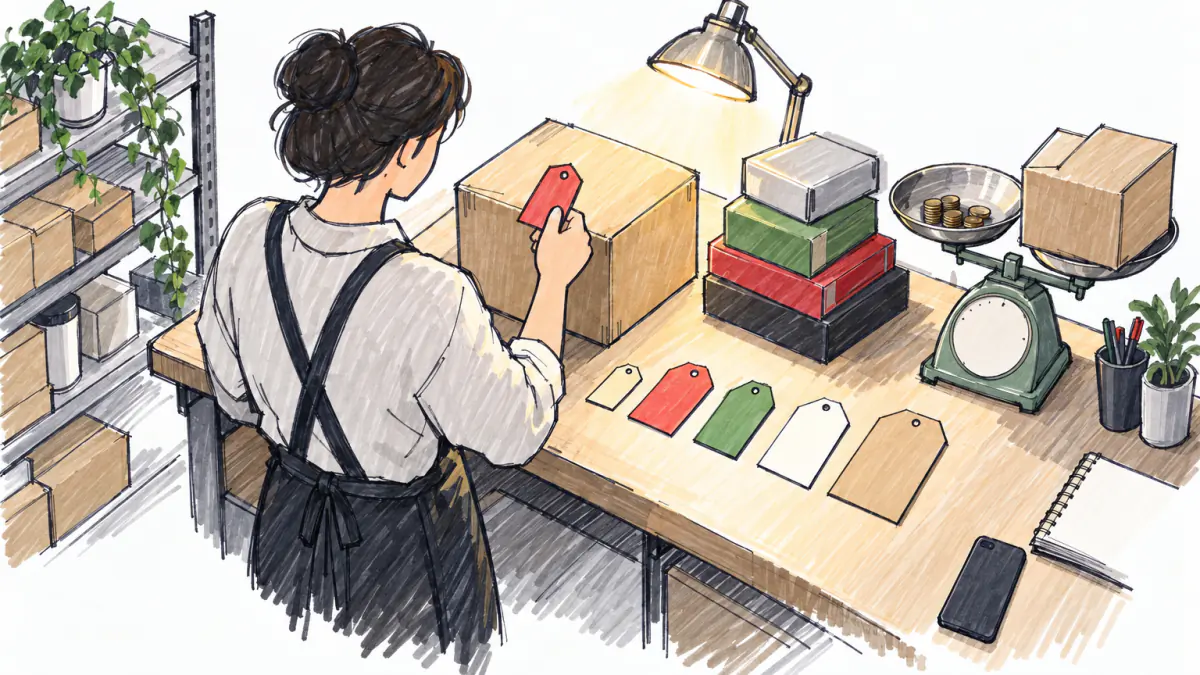
The five core strategies differ in what anchors the price. Read them as positions in one price corridor. Cost-plus sits on the floor: your full unit cost. Competitive sits in the band: rivals’ prices for the same unit. Value-based sits near the ceiling: the buyer’s gain over the next-best option. Penetration and skimming are moves over time. Penetration starts below the band and rises to it. Skimming starts at the ceiling and steps down. Each strategy covers only one part of the corridor, so check the floor, the band and the ceiling before you pick a point.
Cost-plus pricing
Cost-plus pricing adds a fixed percentage to your full cost per unit. It is the simplest strategy to compute, and it has one trap: two formulas that look alike.
Start with full cost. For one unit, add up:
- materials or the direct cost of delivery;
- labor, including contractors;
- a share of overhead (rent, insurance, accounting);
- software and tools;
- your own pay, at the rate you would pay someone to do your job.
Leaving out your own pay is the most common gap. A price that covers everything except you is a price below the floor.
Then apply one of two formulas:
| Method | Formula | $10 cost (assumption), 30% |
|---|---|---|
| Markup on cost | price = cost × (1 + markup) | $13.00 |
| Margin on price | price = cost ÷ (1 − margin) | $14.29 |
Markup is a percentage of cost. Margin is a percentage of price. In our example, a 30% markup on a $10 cost gives a $13 price that leaves $3, a 23% margin on the price. In our example, if your plan calls for a 30% margin and you apply a 30% markup, you earn 23%. That gap repeats on every unit you sell.
Cost-plus fits low-value items with costs buyers can see: contract manufacturing, wholesale, and government work billed on cost. It fails when marginal cost is near zero, which is the case for software and other digital products. A markup on almost nothing gives almost nothing and ignores what the product saves the buyer. It also moves the wrong way: when your costs fall, your price falls with them, even if buyers would pay the same.
Competitive pricing
Competitive pricing sets your price against the prices of direct rivals for the same unit of sale. It has three postures:
| Posture | What you do | Fits when | Weak point |
|---|---|---|---|
| Cooperative | Match the market and follow its moves | Many sellers, similar offers | Your margin depends on rivals’ choices |
| Aggressive | Price under rivals to take share | Your costs are lower than theirs | Price wars cut everyone’s margin |
| Dismissive | Ignore rivals and set your own price | You lead, or your offer has no close match | You misjudge the gap and lose buyers |
Collect prices before you pick a posture. Use a five-column table and fill one row per direct competitor:
| Name | Offer | Price | Unit of price | What is included |
|---|---|---|---|---|
| The rival | What they sell | The number | Per month, per job, per booking | Setup, support, extras |
The last two columns carry most of the information. A rival charging less per month may bill setup separately or leave out support. Compare only prices quoted for the same unit, and adjust for what is included. If you do not have the competitor list yet, start with how to find your competitors or run a competitor analysis. The free check your idea for free tool lists your competitors with their share of visibility.
Cooperative pricing means watching rivals’ prices. It never means agreeing on them. Under Section 1 of the Sherman Act, horizontal price-fixing agreements between competitors are illegal per se2. A shared rate card in a local trade group falls on the wrong side of that line.
Before you go dismissive, check three things. Can buyers name what you do that rivals do not? Would they notice if you raised your price by a step? Do you have enough demand at your price to stay busy? If any answer is no, start with a cooperative price and raise it when the evidence arrives.
Value-based pricing
Value-based pricing sets the price from what your offer is worth to the buyer compared with the next-best option. There are two paths, one for one-off goods and services and one for subscriptions.
For goods and services, start from a comparable product:
- Name the closest alternative a buyer would choose if you did not exist.
- Write down its price.
- List every way your offer differs from it.
- Put a dollar value on each difference: add it where you are better, subtract it where you are worse.
- Add the values to the alternative’s price. The sum is your ceiling.
- Set your price below the ceiling, so the buyer keeps part of the gain.
In our example (assumption), the alternative costs $200. In our example, yours saves the buyer two hours they value at $40 an hour (plus $80) but offers no weekend support (minus $30). In our example, the ceiling comes to about $250, and a price of $220 to $230 gives the buyer a reason to switch.
The dollar value of a difference starts from a pain the buyer already has. Read reviews of the alternatives to find which differences buyers mention unprompted (customer pain points from reviews).
For subscriptions, pick a value metric: the unit you charge by, so the bill grows as the customer gets more value. Bookings handled are one example; contacts stored and invoices sent are others. List several candidate metrics, then ask customers which one tracks the benefit they feel. A metric that grows with the customer’s own revenue keeps price and value in step.
Different buyers see different value, so build a persona grid. A hypothetical grid looks like this:
| Profile A: time-poor owner | Profile B: hands-on owner | |
|---|---|---|
| Valued features | Full service, no calls | Control, reports |
| Willingness to pay | Higher | Lower |
| LTV | Longer stay if service holds | Shorter; may take over the work |
| CAC | Reached through referrals | Reached through search and forums |
The grid tells you which profile your price should be built for. For the research behind it, see target audience analysis.
Penetration pricing
Penetration pricing sets the price below the competitor band to win customers fast, then raises it. Captive-product pricing (razor-and-blades) is a different strategy: the base item stays cheap for good, and the profit comes from refills or consumables bought later. If you never plan to raise the base price, you are running captive-product pricing, and your unit check has to include the consumables.
Set the raise trigger before launch: the price goes up when you reach your customer-base goal, for example a number of accounts or a share of the local market. Write that number down on day one, or the low price stays by default.
The risk sits at the raise. Customers who came for the price leave first when it rises. Loyalty has to come from something the low price paid for: habit, switching costs, a service they now rely on.
A low price brings volume only if your buyers are price-sensitive and you can serve the extra load at a cost below your planned final price. A low price will not rescue an offer that buyers do not want.
Price skimming
Price skimming launches at the top of the corridor, sells to buyers who want the product first, then steps down to reach the next group. Apple launched the original 8GB iPhone at $599 on June 29, 2007; about ten weeks later, on September 5, 2007, it cut the price to $3993.
Lower the price when one of two things happens:
- you reach the profit target you set for the launch price;
- demand at the current price drops, or a rival launches a close substitute.
Skimming bets on how long early demand lasts. If eager buyers run out in weeks and you planned for months, the early margin ends up in unsold stock or idle capacity. The cut costs you too: buyers who paid the launch price see the drop and remember it at your next launch.
Other pricing strategies and tactics

Dynamic pricing
Dynamic pricing changes the price with demand, time, and remaining capacity. It fits fixed, perishable capacity: rental nights, appointment slots, seats. It also fits quote-based services, where every job gets its own price. It fits subscriptions poorly, because customers expect the same bill each month.
There is one US limit to check. A majority of states have price-gouging statutes that curb price increases on certain critical goods and services, including gasoline, during declared emergencies4. If your algorithm raises prices when demand spikes, check whether your state’s law covers your category and set a cap for emergency declarations.
Differential pricing
Differential pricing charges segments different prices for the same offer, and can also vary it by place and time. Pricing by segment means rates for students and nonprofits, or for small businesses. By place means regional prices that follow local purchasing power. Currency belongs here too: ProfitWell data show revenue per customer about 30% higher when the price uses the buyer’s local currency symbol5. By time means off-peak rates and early-bird prices.
Two conditions make it work: segments differ in what they will pay, and a buyer in a cheaper segment cannot resell to a buyer in a dearer one. There is a federal limit for goods. The FTC states that a seller charging competing buyers different prices for the same commodity may violate the Robinson–Patman Act, which applies to goods of like grade and quality6. If you sell products to retailers who compete with each other, price differences need a cost or market basis you can document.
Premium pricing
Premium pricing keeps your price permanently above the market as part of your position. Skimming is a temporary launch price that falls. A premium brand that cuts its price signals that the gap was never real, so premium needs a visible reason that lasts: materials, service levels, a guarantee. If buyers cannot name the reason, they compare on price and you lose.
Economy pricing
Economy pricing stays at the low end of the market and earns its margin through low costs: fewer features, plain packaging, little marketing spend. Dollar Shave Club built a mail-order razor business on low prices, and Unilever bought it in 2016 for a reported $1 billion in cash; the terms were not officially disclosed7. Economy works only if your cost base is lower than your rivals’. Matching a low price on a normal cost base is penetration pricing with no end date.
Psychological pricing
Psychological pricing uses how buyers read numbers. Charm endings have the most research behind them: Anderson and Simester ran three field experiments and found that a $9 ending raised demand in each8. Anchoring shows a higher reference price first, such as a top tier or a list price, so the next price reads as moderate. A decoy tier is an option priced to make the tier next to it look like the better deal.
One trade-off is an assumption we have not verified: in business software, a 9 ending may read as a discount product and pull in buyers who leave sooner. Test it on your own conversion and retention numbers before you adopt it.
Freemium
Freemium gives a limited product free for an unlimited time and charges for upgrades. A free trial gives the full product for a limited time. Freemium is an acquisition model, and it pays only under three preconditions:
- the cost of serving one more free user is close to zero;
- a clear upgrade trigger exists, such as a usage limit or a feature that teams need;
- the free audience is large enough that a small paying share covers the cost of everyone else.
Bundle pricing
Bundle pricing sells several items for one price below the sum of their separate prices. The pro is a higher order value, and buyers accept items they would not pick alone. The downside: buyers lose sight of each item’s price, which makes comparing and later unbundling harder. Do not pad a bundle with low-value items to inflate the “you save” figure. Buyers spot it, and the whole bundle reads as filler.
High-low pricing and loss leaders
High-low pricing sets a regular price and runs frequent promotions below it. A loss leader is an item sold below cost to bring in buyers who also purchase other items.
The “was $X, now $Y” line has a federal rule. Under the FTC Guides Against Deceptive Pricing, a former-price comparison holds only if the product was openly and actively offered at that price, in good faith, for a reasonably substantial period9. A price set high for a week so it can be “cut” fails that test.
Subscription and usage-based pricing
Subscriptions charge per period. Usage-based pricing charges per unit consumed. Most software and service companies pick one of five models:
| Model | You charge for | Main risk |
|---|---|---|
| Flat rate | The whole product, one price | Light users overpay and leave |
| Tiered | Packages at rising prices | Too many tiers stall the choice |
| Per seat | Each user | Customers share logins |
| Usage-based | Units consumed | Bills swing month to month |
| Hybrid | A base fee plus usage | Harder to explain in one line |
A share of the customer’s revenue, as in the worked example below, is a usage model with the customer’s own sales as the unit.
How to choose a pricing strategy
No strategy wins in general. The right one follows from your goal and your market position. Start with the goal:
| Your goal | Strategy | Best for | Pitfall |
|---|---|---|---|
| Highest margin per unit | Skimming or value-based | New or clearly different offers | Overestimating what buyers will pay |
| Fast customer growth | Penetration | Markets with network effects or switching costs | No plan for the raise |
| Stable sales in a crowded market | Competitive | Similar offers, many sellers | Rivals set your margin |
| Simple, defensible pricing | Cost-plus | Contract work, wholesale | Value you never capture |
| A lasting high-end position | Premium | Brands with a visible quality gap | A gap buyers cannot see |
| Volume from price shoppers | Economy | Lean cost structures | Margin too thin for mistakes |
Then check the market position:
| Your market | Start from |
|---|---|
| Many sellers with similar offers | Competitive |
| Your offer is clearly different | Value-based |
| A new category | Skimming (eager early buyers) or penetration (a race for share) |
Choose competitive pricing if buyers already compare your offer with rivals’ offers line by line. Choose value-based if you can name, in dollars, what you do better. Choose penetration only if you have the cash to run below the band and a trigger for the raise.
Before you commit, answer four questions:
- Does the price cover full unit cost, including your pay?
- Does it match the value buyers see, based on what they told you?
- Does it fit your positioning? A premium promise at an economy price confuses buyers.
- Can you hold it if a competitor cuts?
Strategies change over a product’s life. One common path: skimming at launch, then competitive pricing when rivals arrive. Another: penetration at launch, then value-based pricing once you have the customer base and the service has proved itself.
How to set your price in six steps
Your price sits in a corridor. The floor is your full unit cost. The ceiling is the buyer’s value. The competitor band lies somewhere between them, and your strategy picks the point.
| Zone | Where it sits | Strategy that lands there |
|---|---|---|
| Ceiling | Buyer’s value | Skimming at launch; value-based or premium below it |
| Competitor band | Rivals’ prices for the same unit | Competitive |
| Below the band, for a set time | Between band and floor | Penetration |
| Floor | Full unit cost | Below it only as a loss leader |
The six steps:
- Find the floor. Add up full cost per unit, including a share of overhead and your own pay. Price below it only as a planned loss leader with a set end date. To see how many units it takes to cover fixed costs, work out your break-even point.
- Find the ceiling. Take the closest alternative’s price and add or subtract the dollar value of each difference, as in the value-based steps above.
- Map the competitor band. Fill the five-column price table for direct rivals and note the lowest and highest prices for the same unit.
- Pick a point and name the strategy. Inside the band is competitive, toward the ceiling is value-based or premium, below the band for a set time is penetration, and at the ceiling then down is skimming. For the per-product arithmetic, see how to calculate a price.
- Run the unit check. Enter the price, purchases per month, margin, customer lifetime and acquisition cost in the unit economics calculator. It is preset with the worked example below. The formula is in the next section.
- Test, then check the law. Run one of three tests: send real quotes at two price points, split traffic between two prices on a landing page (a demand test), or ask price questions in interviews (customer interview questions). Three prompts that work in interviews:
- “What do you pay now for this, and to whom?”
- “At what price would this be too expensive to consider?”
- “At what price would it be so cheap you would doubt the quality?”
Then check four US rules before you publish:
- no price agreement with competitors (Sherman Act, per se illegal2);
- no different prices on the same goods to competing business buyers without a documented basis (Robinson–Patman6);
- “was $X” claims only for prices you offered openly for a substantial period (FTC Guides9);
- an emergency cap on dynamic prices where your state’s price-gouging law applies4.
Add the licenses your trade needs. In the worked example, the check flagged a license requirement before the first booking (example by our methodex).
Our method in the open, and a worked example
Our idea check closes every price with the corridor from the six steps above and the same unit check. Here are the rules and formulas as our code applies them.
The unit check
| Variable | Meaning | Formula |
|---|---|---|
| Price | What one purchase brings | Input |
| Purchases per month | Purchases per customer a month | Input |
| Margin | Share of price left after the cost of serving | Input, 0 to 1 |
| Lifetime, months | How long a customer stays | Input |
| CAC | Cost to win one customer | Input |
| Monthly contribution | Money a customer leaves each month | Price × purchases per month × margin |
| LTV | Money a customer leaves in total | Monthly contribution × lifetime |
| LTV/CAC | Return on acquisition | LTV ÷ CAC |
| Payback, months | Time to earn back CAC | CAC ÷ monthly contribution |
Our thresholds: an LTV/CAC of 3 or more holds, 1 to 3 is thin, and under 1 loses money on every customer. This is our own money criterion, used in our concept method. It is a working rule, not a market statistic.
The reading rule: a ratio far above 3, or a payback under a month, is a flag on the inputs. The first input to test is CAC. For background on these terms, see unit economics explained.
The worked example: co-hosting in Scottsdale
The idea in our example: a Scottsdale, Arizona co-hosting service that runs listings and guest messaging, plus pricing, for second-home owners; absentee hosts pay 15–20% of bookingsex. Pricing is both what this service sells and its own pricing question.
Our system checked it on October 14, 2026. In the example by our method, the verdict was “Possible, with caveats”ex with a score of 57ex, built from 17 search queriesex and 23 sourcesex. The check found no demand data: the demand source is “none” (example by our methodex).
Competitors. The check found 9 direct competitors (example by our methodex). Their shares of visibility, example by our method:
| Competitor | Type | Visibility share |
|---|---|---|
| Tuckedin | Direct | 21%ex |
| SkyRun Vacation Rentals Phoenix | Direct | 19%ex |
| Guesty | Indirect | 19%ex |
| The CT Brothers | Direct | 10%ex |
| Park Place Properties | Direct | 8%ex |
Complaints. In the example by our method, the check grouped buyer complaints by theme: Price 3ex, Quality 3ex, Other 2ex, Service and support 1ex.
Unit check. The inputs, example by our method: a price of $830ex per purchase, 1 purchase per monthex, a margin of 0.3ex, a lifetime of 10 monthsex and a CAC of $30ex. The arithmetic, example by our method:
- Monthly contribution in our example: $830 × 1 × 0.3 = $249.
- LTV: $249 × 10 = $2,490ex.
- LTV/CAC: $2,490 ÷ $30 = 83ex.
- Payback: $30 ÷ $249, about 0.1 monthex.
To run the same numbers with your own inputs, use the unit economics calculator or the unit economics and financial model template.
Risks. The check listed four, example by our method:
- Tuckedin already covers most of the offer, so buyers may pick the incumbent and the idea never wins a first bookingex.
- Only 3 price complaints were found, and one of them is an anecdote rather than a market gap, so they may not support a price-led offerex.
- A business license is required to operate, which adds setup time and cost before the first bookingex.
- Market size is unknown because no search-volume data exists, so the revenue ceiling cannot be estimated from demandex.
More on reading these: business risks before launch.
The pricing reading of the example
The competitor band is the 15–20% share of bookings that absentee hosts pay (example by our methodex). With 9 direct competitorsex and a leader at 21% visibilityex (example by our method), the market fits the “many sellers, similar offers” row. Cooperative competitive pricing inside the band fits. In our example, a penetration price below 15% would give margin away in a market where the leader already covers most of the offer.
Price is a weak wedge here. The check found 3 price complaints (example by our methodex), and its own risk says that is too thin for a price-led offer. The difference has to come from service, priced at the band, not below it. Value-based logic can still move the founder up the band: if the service raises an owner’s booking revenue, a share of bookings captures part of that gain without a price change. The pricing model already does value-based work.
The ratio of 83 (example by our methodex) sits far above our threshold of 3. By the reading rule, that sends the founder to test the $30 CAC (example by our methodex) first: run a paid campaign or a referral push and record the real cost of one signed owner.
The ceiling cannot come from market size, because the check found no demand data (example by our methodex). An owner-side estimate is the next step, and the market size calculator works from your own inputs.
The license risk becomes step 6. The City of Scottsdale requires an annual city license for each property rented for under 30 days, and a valid Arizona transaction privilege tax (TPT) license for each rental property10. Those sit with the owner, so onboarding a new owner includes license paperwork the co-host may help with. Arizona generally requires a real estate license to manage real property owned by someone else. The Arizona Department of Real Estate has confirmed that, under A.R.S. 32-2121(A)(15), you need no license to arrange or accept short-term rental reservations on another’s behalf, or to solicit them11. Check which side of that line your service scope falls on before you set the price.
Pricing mistakes to avoid
- Calling a markup a margin. Use price = cost ÷ (1 − margin) when your plan is stated in margin. In our example, a 30% markup gives a 23% margin.
- Pricing below the floor by accident. List full cost with your own pay before you look at rivals.
- Copying a leader’s price without its costs. A leader with a larger volume can run at a price that leaves you under water. Check your floor against their price before you match it.
- Publishing an untested price. Send two price points in real quotes or split a landing page before you print a rate card.
- Trusting a unit check that looks too good. When LTV/CAC runs far above 3, measure CAC with real spend before you scale.
FAQ
What are the 5 main pricing strategies?
Cost-plus (cost plus a markup), competitive (priced against rivals), value-based (priced from the buyer’s gain), penetration (launch low, raise later) and skimming (launch high, cut later).
Which pricing strategy is best?
Your goal and market decide it. Choose competitive if many sellers offer similar products, value-based if you can put a dollar figure on your difference, penetration if you need customers fast and can fund the low period, and skimming for a new product with eager early buyers.
What is the simplest pricing strategy?
Cost-plus: price = cost × (1 + markup). Its main risk is that it ignores what buyers would pay, so it leaves money on the table when your offer is worth more than its cost.
What is the difference between penetration pricing and price skimming?
Penetration starts below the market and rises once you reach a customer-base goal. Skimming starts at the top and falls when the profit goal is met or demand drops.
Can you combine pricing strategies?
Yes. A typical business pairs a core strategy with tactics (competitive pricing plus a bundle) and switches strategies over time (skimming at launch, competitive once rivals arrive).
Sources
- scispace.com, 10/09/2026
- supreme.justia.com, 02/28/2006
- en.wikipedia.org, 10/11/2007
- congress.gov, 05/05/2026
- learn.profitwell.com, 01/23/2023
- ftc.gov, 06/11/2013
- bbc.com, 07/20/2016
- econpapers.repec.org, 10/02/2026
- ecfr.gov, 08/10/2026
- scottsdaleaz.gov, 07/31/2026
- asreb.com, 07/02/2021
Check your idea for free
Describe your idea and the check collects demand, competitors, complaints and prices, with sources.