


How to Find Your Target Audience: 7 Steps, a Persona Card and a Worked Example

To find your target audience, write down the problem your product solves, then make a first guess at who has it. Name who has the problem and where they are, then say what makes them need a fix now. Then test that guess against evidence: what those people search for, what they complain about in reviews, who already sells to them, and whether the group is big enough and pays back what it costs to reach. Whatever survives becomes a working persona, and you confirm it with a small demand test before you spend.

- Start from the problem your product solves
- Write your first guess in three lines
- Collect evidence: searches and complaints, then rivals
- Talk to people who have the problem
- Cut by who they are, then by why they buy
- Check that the group is big enough and pays
- Write a working persona, then test it
The seven steps, each ending in one line you write down:
What a target audience is, and what it is not
A target audience is the group of people you sell to first. Define it narrowly enough that you can name where they gather and what makes them buy. Dictionaries call it the people a product or message is aimed at. The founder’s version adds a test that definition can fail.
Three terms get mixed up. Each example in this table comes from the worked example further down.
| term | what it is | how wide | example |
|---|---|---|---|
| Target market | everyone who buys in the category | widest | meal delivery, a $5.4 billion category in 2024 per emergenresearch.com (example by our method)ex |
| Target audience | the slice you sell to first | narrow | shift-working nurses near Houston hospital districts |
| Buyer persona | one profile of a typical member, each field tagged with its evidence | one person | the persona card in the worked example |
Market sizing has its own method: size the market around your audience.
The gap is common. In HubSpot’s annual survey of over 1,200 marketers, just 42% knew the basic demographic information of their target audience1.
Knowing the audience settles four decisions: the message you write, the channel you pay for, the price you can ask and the feature you build first.
How to find your target audience in 7 steps
Each step ends in one written output. By step 7 those outputs add up to a persona with its evidence attached.

Start from the problem your product solves
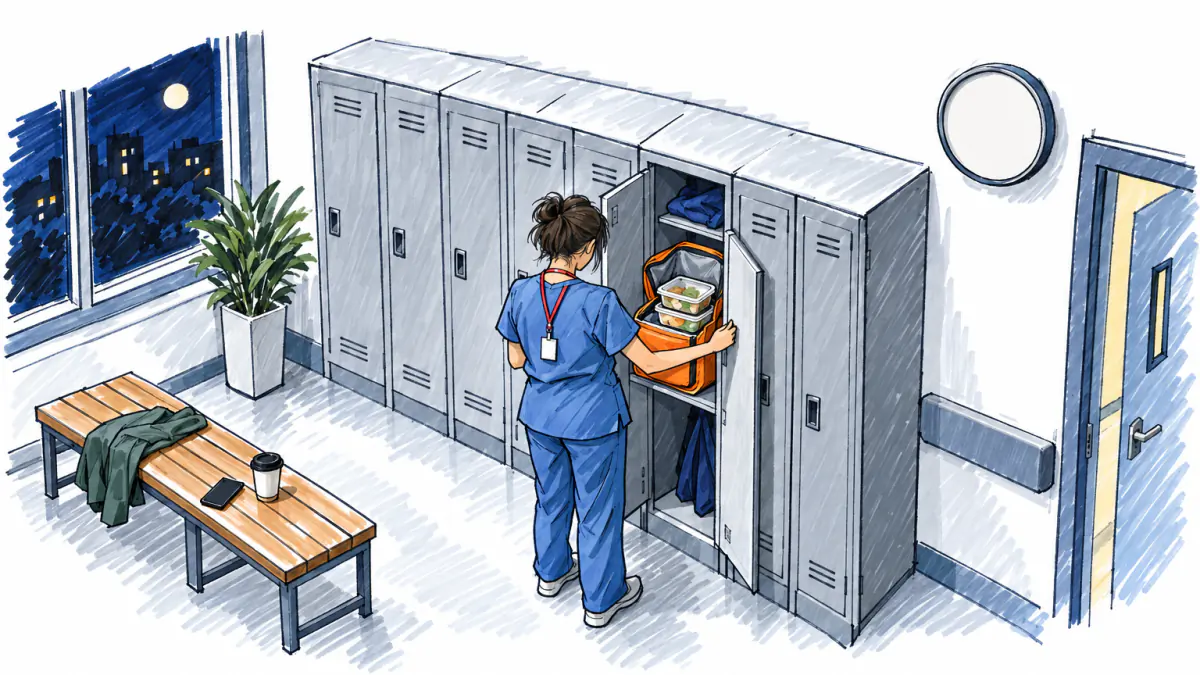
List what your product does. For each feature, write the benefit it gives, then name who needs that benefit enough to pay for it. Locker drop-off is a feature. A ready meal you collect between shifts is the benefit. People whose work hours rule out a regular dinner need it.
Before you name anyone, write four answers: the problem you solve, what people use instead today, what that workaround costs them, and the moment the problem hurts most.
Write down: one sentence of the form «[benefit] for people who [problem]».
Write your first guess in three lines
Our concept test asks for three lines:
- A group or role: a job, a life stage, a type of business.
- A place or market: a city, a district, a platform, an industry.
- A trigger: the event that makes them need a fix now.
To pass, a description must let you find ten such people this week. «Busy professionals / anywhere in the US / want to eat better» fails on every line. «Night-shift nurses / Houston hospital districts / no meal break they can plan» passes. If one line is vague, narrow it before you research anything.
Write down: the three lines.
Collect evidence from searches, complaints and rivals
Each kind of evidence proves something different, and every later line of your persona points to one of them or gets marked «assumption».
- Searches show the need is voiced. Google Keyword Planner is free with a Google Ads account, and accounts with no active ad spend see search volume as broad ranges2. A range is enough to tell zero from some.
- Complaints show the gap. Read reviews of the products your audience uses now and count the themes. The routine: how to pull customer pains from reviews.
- Rivals show who already has your audience. For each one, note whom they talk to and what they promise. Then read what their customers complain about. The Meta Ad Library, a public searchable database, holds every active ad on Meta’s products, Facebook and Instagram among them3. It shows the wording rivals pay to run. The full routine: find who already sells to them.
If you already have a site, analytics adds a fourth source. The GA4 Demographic details report shows language, interests, location, age and gender, and the demographic and interest data come from activating Google signals4. That gives you demographics and interest categories. Motives and opinions come from step 4.
Write down: next to each of your three lines, the evidence that supports it, or the word «assumption».
Talk to people who have the problem
If you have no customers yet, find prospects where step 3 surfaced them: in review threads, and in the forums and groups where they complain. Ask a handful of them for a short call.
Ask about past behavior. Opinions about the future produce polite yeses, and «would you buy this» is the worst offender. Questions about what happened produce facts:
- When did this problem last come up for you?
- What did you do about it?
- How much money or time did that cost you?
- What have you tried that did not work?
- Who else had a say in the decision?
The rest is in the full list of customer interview questions.
Write down: the words people used for the problem and what they pay to solve it today.
Cut by who they are, then by why they buy
Three kinds of criteria describe an audience:
- Demographic: who they are (age, job, income, location).
- Psychographic: how they live. The standard measure is AIO. The A and I stand for activities and interests, the O for opinions. Wells and Tigert studied lifestyles this way in 1971 and wrote AIO statements to measure them5.
- Behavioral: what they did (searched, bought, switched, canceled).
Keep lifestyle in the psychographic column, even where a guide files it under demographics.
Values belong in the profile too. A Q2 2024 Sprout Pulse Survey found that more than 40% of consumers will unfollow brands whose values don’t align with their beliefs6.
For every criterion, ask: would it change what you say, or where you say it? If it does not, drop it. «College-educated women» rarely changes what you write to a nurse. «Works nights» changes the delivery window and the headline. It also changes the hour your ad runs.
Write down: the criteria that change your message, and the ones you dropped.
Check that the group is big enough and pays
Count the group from public data first. For US geography, the Census Bureau’s American Community Survey publishes 1-year estimates for larger areas, from metro areas and counties down to individual places. Smaller areas, including ZIP Code Tabulation Areas, are covered by the 5-year estimates, and both are on data.census.gov7. If no public source counts your group, call the audience «unsized» and write that on the persona card.

Then check that one customer pays back the cost of reaching them. Our check uses three formulas:
- LTV = price × purchases a month × margin × customer life in months
- LTV/CAC = LTV ÷ CAC
- Payback in months = CAC ÷ (price × purchases a month × margin)
Our rule: an LTV/CAC of 3 or more passes, 1 to 3 is thin, under 1 does not pay. A 3:1 ratio is the widely cited benchmark, popularized by David Skok8. For your own inputs, run your own numbers in the unit economics calculator.
Write down: the group’s count or «unsized», and the LTV/CAC with its inputs.
Write a working persona, then test it
A working persona is a table: each field gets a value backed by evidence and a status of «confirmed» or «assumption». Map each trait to one decision: the trigger to the headline, the place to the ad targeting, the top complaint to the promise. Add a negative line saying who it is not for, so your ads stay off people who click and never buy.
A persona made only of assumptions is a guess. Its next step is interviews; ads come later.
End the persona with one demand test and a pass line you write before it starts, for example a landing page aimed only at this audience and the sign-up rate you need to continue. The method: test demand before you spend. Start from the persona template.
Write down: the filled card and the pass line.
Worked example: meal prep for shift-working nurses in Houston
We ran our idea check on «Meal-prep delivery for shift-working nurses near hospital districts in Houston: weekly boxes of ready meals delivered to hospital lockers» (example by our method)ex. The figures below come from the check run on October 11, 2026.
The three lines. Group: shift-working nurses. Place: hospital districts in Houston. Trigger: shifts that leave no regular meal time. The trigger is our reading of «shift-working» and stays an assumption. All three lines are specific, so the guess passes.
The market is not the audience. In the example, the category is worth $5.4 billion in 2024, per emergenresearch.com (example by our method)ex. The check measured no search demand for the nurse segment: the demand source in the example is «none»ex. By our rule, that makes the audience a hypothesis. With no confirmed public count of Houston nurses, the slice stays unsized.
The cut has to be where the incumbent is not. The check found 8 direct competitors (example by our method)ex. Here are the five leaders by their share of the search visibility the check measured among them:
| direct competitor | visibility share, % (example by our method) |
|---|---|
| Houston Meal Prep | 42ex |
| Factor | 13ex |
| Snap Kitchen | 11ex |
| Home Chef | 11ex |
| ProMeals | 7ex |
The top risk in the example, scored 3 for probability and 3 for impact, says Houston Meal Prep already offers about 60% of the idea and holds 42% of search visibility, so early buyers may switch to an incumbent they already know (example by our method)ex. What remains to own is the locker delivery and the shift timing. The persona is built on those two traits.
The complaints are thin. In the example, reviews gave 3 complaints on qualityex and 2 on service and supportex. Reliability and trust drew 1ex. Single-digit counts become interview questions; they prove nothing yet.
It pays on paper. The check assumed a price per order of $14.49ex, 4 purchases a monthex, a 12% marginex, a customer life of 10 monthsex and a CAC of $20ex (example by our method). The arithmetic, also example by our method:
- monthly contribution in our example, assuming a 12% margin: 14.49 × 4 × 0.12 = $6.96
- LTV: 14.49 × 4 × 0.12 × 10 = $69.55ex
- LTV/CAC: 69.55 ÷ 20 = 3.48ex
- payback: 20 ÷ 6.96 = 2.9 monthsex
In our example, 3.48 clears the line of 3, a threshold we set as an assumption. Risk 4 limits that reading: the unit economics are a food-service category estimate, not measured in Houston, so the margin may come in lower (example by our method)ex. The 12% margin in our example is an assumption; replace it once you measure your own.
The persona card (example by our method):
| field | value | evidence | status |
|---|---|---|---|
| Group | shift-working nurses | no measured search demandex | assumption |
| Place | hospital districts in Houston | the idea itselfex | assumption |
| Trigger | shifts with no regular meal time | our reading of «shift-working» | assumption |
| Current options | 8 direct rivals, leader at 42% visibility | competitor scanexex | confirmed |
| Pains to probe | quality, service, reliability | 3, 2 and 1 complaintsexexex | confirmed, thin |
| What to own | locker delivery, shift timing | top riskex | confirmed |
| Price per order | $14.49 | category estimateex | assumption |
| Size | unsized | no confirmed public count | assumption |
| Not for | households ordering family dinners | our cut away from the leader | assumption |
The verdict. The example scored «Possible, with caveats»ex at 62 (example by our method)ex. Two more risks stand. In the example, two meal delivery companies closed recently, so repeat orders at this price are in doubt (probability 2, impact 3)ex. Food safety rules for prepared meals delivered into lockers add compliance cost and possible delays (probability 2, impact 2)ex. Check the risks before launch before you commit money.
The next step is the demand test from step 7, aimed at nurses near the hospital districts, with the pass line set before launch. A broad meal-delivery ad would measure the market instead of the audience. To get the same report on your own idea, start the check.
Types of target audiences and four ways to target them
Audiences are grouped by what you segment on. The same people can sit in several types at once.
| type | you segment by | it tells you |
|---|---|---|
| Demographic | age, job, income, location | who they are |
| Purchase intention | what they searched, compared or bought | how close they are to buying |
| Interests | topics they follow | what holds their attention |
| Subculture | a shared identity: a profession, a hobby, a scene | which group they belong to |
| Lifestyle | activities, interests, opinions | how they live |
Kotler’s Principles of Marketing describes four targeting strategies: undifferentiated, differentiated, concentrated and micromarketing9. The trade-offs:
| strategy | whom it targets | trade-off |
|---|---|---|
| Undifferentiated (mass) | the whole market with one offer | widest reach; the message fits no one closely |
| Differentiated (segmented) | several segments, an offer for each | closer fit; a separate message and budget per segment |
| Concentrated (niche) | one segment | one message and one budget; you depend on one group |
| Micromarketing | individuals or one locality | closest fit; the most work per customer |
For a first product, choose concentrated if your three lines pass. Move to differentiated after one segment clears the size and pay check. More on the underlying idea: market segmentation.
Target audience examples (one profile shape, four businesses)
Each profile uses the same five parts: demographics, psychographics, challenges, preferred channels, preferred content. They carry no figures, because none of these businesses was checked.
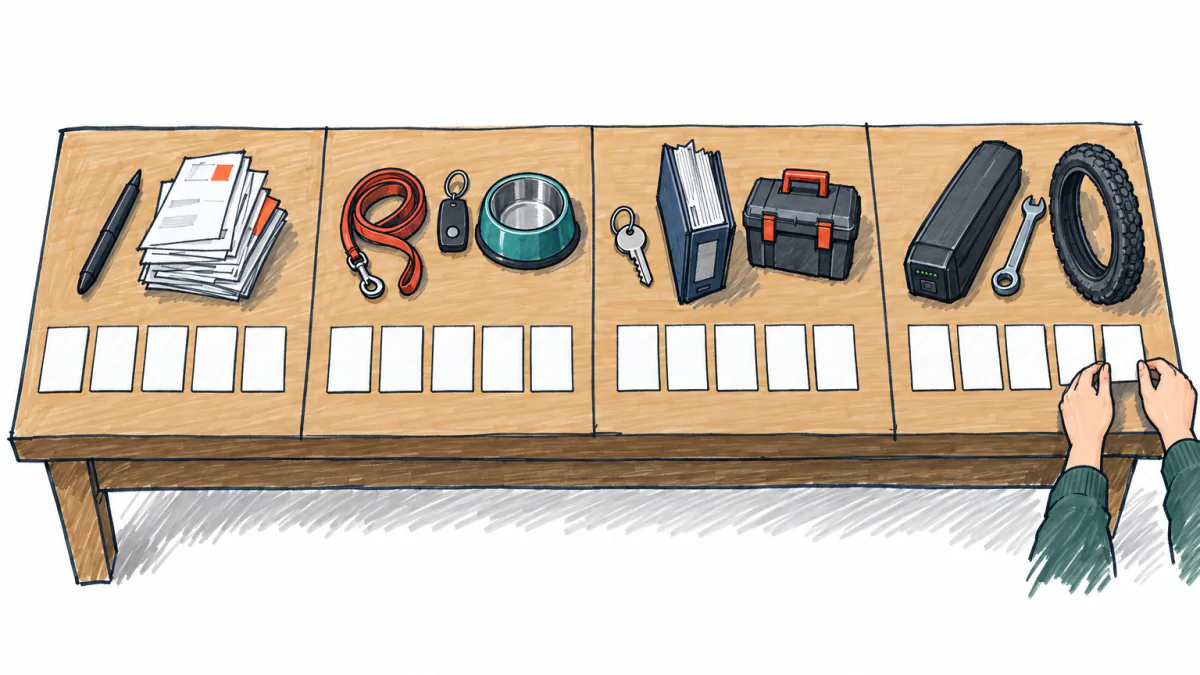
Bookkeeping app for freelance designers. Demographics: self-employed designers who bill clients directly. Psychographics: guard their time and dislike admin. Challenges: late invoices and quarterly tax estimates. Channels: design communities and portfolio sites. Content: short tutorials and invoice templates.
Dog walking in a high-rise district. Demographics: renters in apartment towers who work office hours. Psychographics: treat the dog as family and want proof of care. Challenges: nobody home at midday, building access rules. Channels: building newsletters and neighborhood groups. Content: photos from each walk and route maps.
Online course for first-time landlords. Demographics: owners of a single rental unit, often inherited or bought on the side as an investment. Psychographics: cautious, afraid of legal mistakes. Challenges: screening tenants, handling repairs. Channels: on a landlord forum they read long, detailed answers; on short video they want one tip per clip. Content: checklists and lease walk-throughs.
E-bike repair in a college town. Demographics: students and staff who ride an e-bike to campus every day. Psychographics: price-conscious, unwilling to lose a day of transport. Challenges: battery faults and waits for parts. Channels: campus boards and local forums. Content: a same-day repair offer and a public price list.
Where to reach them
Reach your audience where step 3 found them. Use the search phrases they type, and go to the review sites and communities where they already describe the problem. Then cross-check against published platform-use data. Pew Research Center’s Social Media Fact Sheet reports platform use by US adults broken down by age and other factors; its latest survey covered 5,022 adults from February 5 to June 18, 202510. Use it to confirm a channel your evidence surfaced. Do not use it to pick one by age alone.
In the example, the hospital lockers are where the audience works, so the delivery point is also a place to test a message. That is an assumption until a test shows it.
When to re-check your audience
Re-run steps 3 to 6 when one of these happens:
- you add a sales or ad channel;
- the complaint themes in reviews change;
- your cost to acquire a customer rises;
- a new rival takes a share of search visibility.
Mistakes that send you to the wrong audience
| mistake | fix |
|---|---|
| Defining the audience by demographics only | add the trigger and one behavior |
| A persona with no evidence behind it | tag every field «confirmed» or «assumption» |
| Picking channels by age stereotype | start where they complained, then check survey data |
| Quoting a channel-specific figure as a general one | carry the figure with its channel, sample and year |
| Treating the market’s size as the audience’s size | size the slice separately, or write «unsized» |
How we built this example
The check ran 17 search queriesex and read 26 sourcesex on the idea (example by our method). It reports measured demand phrases (or «none»), a sourced market size, each direct competitor’s share of search visibility, complaint themes from reviews, a unit-economics estimate, risks scored 1 to 3 and a scored verdict.
We did not change the check’s figures. We added the three-line test, the persona statuses, the trigger line and the negative line. The trigger and the negative line are our reading, and the card marks both as assumptions.
FAQ
How do I find my target audience if I have no customers yet?
Find prospects in the review threads where they already complain, and in the forums and groups that your search and review research turned up. Ask them about past behavior: the last time the problem came up, what they did, what it cost.
How narrow should a target audience be?
Narrow enough that each of your three lines (group, place, trigger) lets you find ten such people this week. It is too narrow when you cannot find ten such people or the LTV/CAC falls under 1.
Can a business have more than one target audience?
Yes. Write one persona per audience, each with its own demand test. Start with the audience that passes the size and pay check, and add the second after the first one pays.
How often should I revisit my target audience?
Re-check it on a trigger: a new channel, a change in complaint themes, a rising cost to acquire a customer, or a new rival gaining search visibility.
Sources
- blog.hubspot.com, 06/03/2025
- digitalmarketingagency.sg, 06/24/2026
- transparency.meta.com, 08/24/2023
- support.google.com, 10/11/2026
- files.eric.ed.gov, 09/15/2025
- sproutsocial.com, 03/27/2024
- census.gov, 09/11/2025
- stealthagents.com, 06/30/2026
- slideshare.net, 01/02/2025
- pewresearch.org, 11/20/2025
Check your idea for free
Describe your idea and the check collects demand, competitors, complaints and prices, with sources.


Comments 4 comments
Mike Doran Phoenix
Talking to five people who had the problem taught me more than a month of surveys.
Sara Lind Portland
A persona card I could download and fill in would be handy.
Dan Reyes San Diego
The nurses example was close to my case, since I sell to night-shift workers too. The segment-size check stopped me from going too narrow.
Julia Hart Charlotte
My first guess was busy parents. Cutting by why they buy left one group: parents of kids with food allergies.
Have a question or a view on the article? Ask Fox.