Jobs to Be Done: What It Means, How to Use It, and Examples

Jobs to be done reads demand this way: people hire a product to make progress in a specific circumstance, and fire it when something else does better. Clayton Christensen defines a job as "a problem or opportunity that somebody is trying to solve"1. Tony Ulwick's outcome-driven innovation breaks each job into measurable desired outcomes2. Christensen's view shows you what you compete with; Ulwick's helps you pick the unmet outcome worth building for.
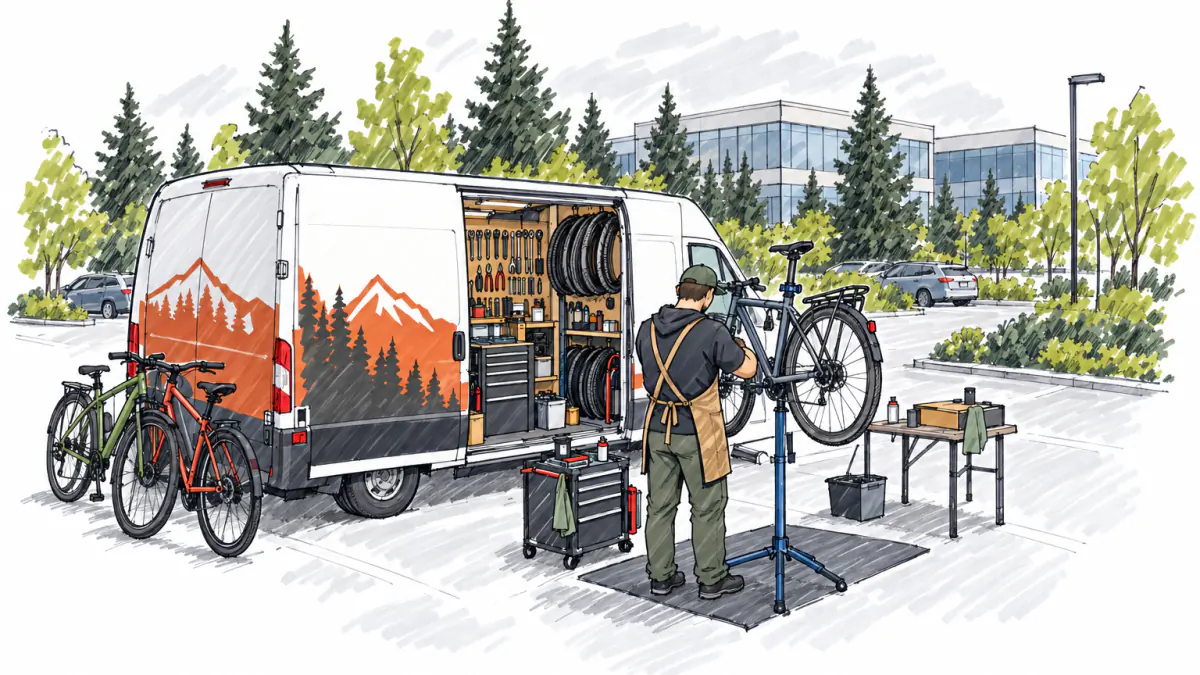
First the check lists the direct and indirect alternatives already serving the job, then it tests whether the idea pays.
What jobs to be done means
“A ‘job to be done’ is a problem or opportunity that somebody is trying to solve.” Clayton Christensen, as quoted by HBS Online1
Write a job in parts: who is trying to make progress, in what circumstance, and what progress they want. The product is absent from that sentence. A commuter who wants to ride home on a bike that brakes and shifts cleanly has a job. A tune-up is one of several things that commuter could hire for it.
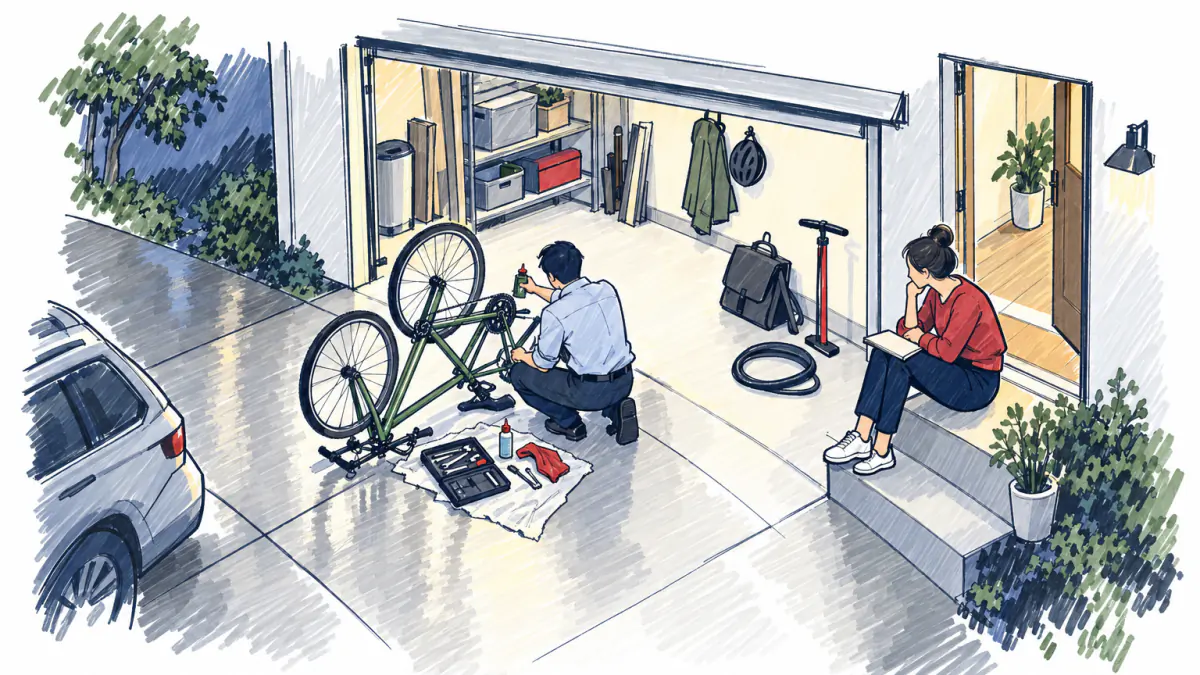
Customers hire and fire products. They hire one when it gets the job done in their circumstance. They fire it when the circumstance changes, or when an alternative does the job for less money, less effort or less risk. A commuter who changes jobs and now works across town fires the shop near home. The same commuter fires a mobile mechanic who misses the ride home one time too many.
Count workarounds as alternatives too. Fixing the bike yourself and putting the tune-up off are choices people make all the time, and a list of companies in your category leaves both out.
Two lineages use the name.
Christensen’s school studies circumstances and the forces that push people to switch, mostly through interviews. Harvard Business Review published “Know Your Customers’ ‘Jobs to Be Done’” by Christensen, Taddy Hall, Karen Dillon and David Duncan in its September 2016 issue3, and Christensen’s book Competing Against Luck came out the same year4.
Ulwick’s school, outcome-driven innovation, is older as a formal method. Ulwick received the first of his patents on the process in 1999, Harvard Business Review introduced it in 2002, and his 2005 book expanded it4. This school breaks a job into steps and desired outcomes, then scores the outcomes with customer surveys.
You can use both on one idea. This guide does: it takes the forces from the first school and the outcome tools from the second, including the job map and the market canvas.

The theory in four ideas

Progress
People buy to get from a current state to a better one. The job is defined by that progress, so it outlives any single product. Listening to music you chose while you move around has been done with portable radios, cassette players, MP3 players and phones. The job stayed and the hired products changed. If you define your market by the product, you miss the next product that takes the job.
Circumstance and the struggling moment
The circumstance is where and when the job comes up, along with the constraints the person faces there and then. The same person has different jobs in different circumstances. A rider fixing a flat at home on a Sunday and the same rider at an office park on a weekday morning, with a meeting to get to, want different things from a repair.
A struggling moment comes when the current solution fails the job so badly that the person starts looking for another. That is when people notice alternatives, so it is the moment to study. In interviews, ask about the last time it happened, with the date, the place and what they did next.
The four forces
Bob Moesta’s diagram names four forces of progress: the push of the current situation, the pull of the new solution, the anxiety of the new solution and the habit of the present5. The first two move a person toward switching. The last two hold them where they are.
| force | direction | what a bike commuter might say (example by our method) |
|---|---|---|
| push of the situation | toward switching | “The shop keeps my bike for days and I have to take the bus.” |
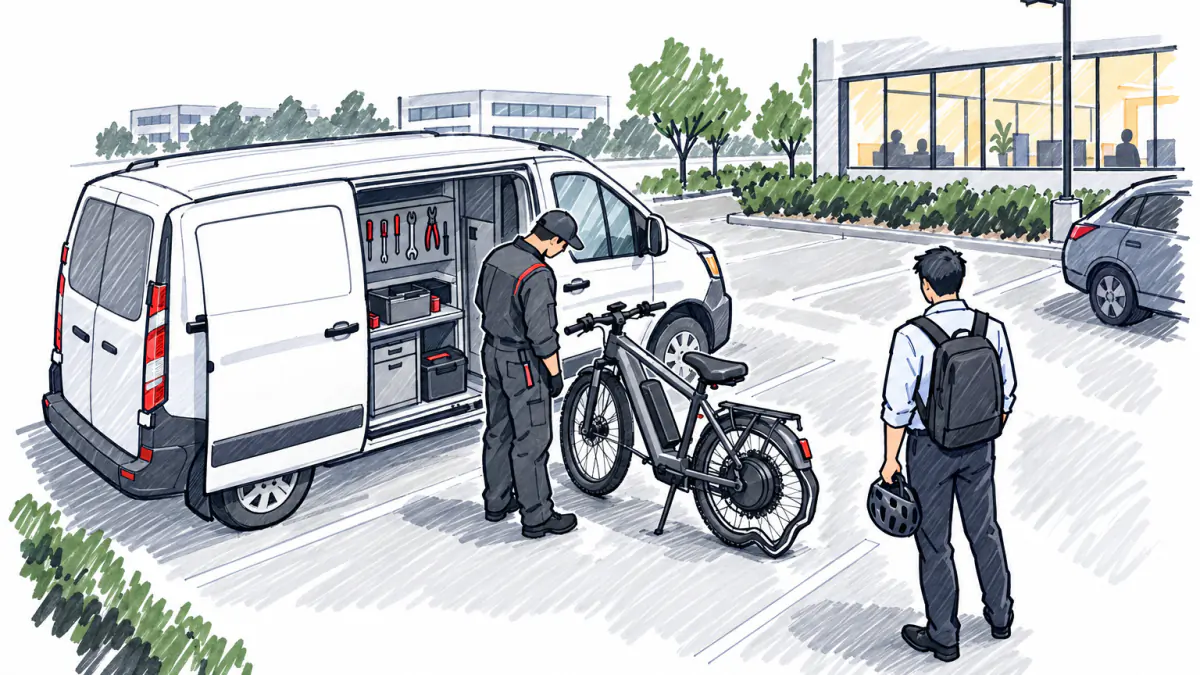
| pull of the new solution | toward switching | “The tune-up happens in the parking lot while I work.” |
| anxiety of the new solution | away from switching | “What if the van can’t finish the repair, or the price changes?” |
| habit of the present | away from switching | “I always drop it at the shop on Saturday.” |
A person switches when the push of the problem and the pull of the new solution beat their anxiety about the new one and their habit with the old one. Write all four down for your idea. A plan that adds pull and does nothing about anxiety leaves half of the balance untouched. For the van, a fixed price quoted before the work starts answers the anxiety line in the table.
Functional, emotional and social sides
Ulwick’s framework puts emotional and social jobs next to the core functional job6. For the commuter, the functional job is keeping the bike safe to ride. Emotionally, they want to stop worrying about the brakes on the ride home. Socially, they don’t want to walk into a client meeting late with grease on their hands.
Ask about all three sides in interviews. When two options do the functional job equally well, the emotional and social sides often decide which one gets hired.
Jobs to be done examples: six cases in one format
The six cases below share one format, so you can compare them row by row. The first five are illustrations written to show the format; they are not documented company studies. The sixth is the bike van from the worked example later in this guide.
| who | circumstance | job | also hired for it |
|---|---|---|---|
| a driver with a long commute | early morning, one hand free | stay fed and alert until lunch | coffee, a breakfast bar, a banana, a podcast |
| an employee who wants a promotion | full-time job, free evenings | earn a credential that moves me up without quitting | evening college, an online course, employer training, staying put |
| a small-business owner | end of the month | know whether I can make payroll next month | a spreadsheet, an accountant, a bank app, gut feel |
| a parent | weeknight, after work | get a dinner the kids will eat on the table before bedtime | a meal kit, takeout, a frozen meal, leftovers |
| a runner | outdoors, hands busy | listen to music I choose while I move | radio, a phone playlist, silence |
| a bike commuter at an office park | workday, bike parked outside | keep my bike safe to ride without taking time out of my workday | a bike shop, doing it yourself, an existing mobile mechanic, skipping maintenance |
Three patterns show up once the cases sit in one table.
The last column crosses categories. The meal kit competes with leftovers. The online course competes with staying put. If you list only companies in your own category, you leave out most of what customers hire.
Doing nothing appears in almost every row. “Skipping maintenance” and “staying put” are real competitors with a price of zero, and your offer has to beat them on the outcomes the person cares about.
The job is more stable than the products. The runner’s job existed before phones and will exist after them. That stability is why job statements stay useful for years while feature lists go stale.
Same category, different job
As an illustration, take two gyms on one street. One serves members training for a race on a set date: they hire a coach and a plan, then leave after the race. The other serves people who want a regular social hour: they hire group classes and familiar faces, and they stay. The category matches but the jobs differ, so the first gym fits a fixed-length program paid up front and the second a monthly membership built to keep cancellations low. A founder who copies the other gym’s pricing copies a model built for someone else’s job.
Who has the job: customer roles, job types and the job map
Ulwick’s framework names three types of customer: the job executor, the purchase decision maker (the buyer) and the product lifecycle support team6. Each holds a different job, and they can be different people.
| role | the job it holds | in the van case (example by our method) |
|---|---|---|
| job executor | the core functional job | the commuter who rides the bike |
| purchase decision maker | the financial outcomes of buying | the commuter who pays; an employer paying as a perk is an assumption the check did not test |
| product lifecycle support team | setting up, maintaining and supporting the solution | the mechanic, and the office manager who books the van’s visits |
The same source names five job types: the core functional job, related jobs, emotional and social jobs, consumption chain jobs, and the buyer’s financial desired outcomes6. Here is how each applies to the van:
- The core functional job: keep the bike safe to ride.
- Related jobs: jobs done next to the core one, such as getting to work on time or keeping a laptop dry on the ride.
- Emotional and social jobs: feeling safe on the ride home and looking reliable at work.
- Consumption chain jobs: the jobs of using the service, such as booking a slot, leaving the bike, paying and picking it up.
- The buyer’s financial outcomes: a predictable price and no surprise bill for parts.
If you sell to more than one role, for example to commuters and to the office parks that host the van, split your work by role. A target audience analysis then asks what each segment wants done, rather than how old its members are.
The job map
Strategyn’s job map uses eight universal steps: define, locate, prepare, confirm, execute, monitor, modify and conclude. A job covers some or all of them, and the company’s worksheet advises writing one step per universal step7. Here is the commuter’s map, as an example by our method:
- Define: notice the bike needs attention, such as squealing brakes.
- Locate: find a mechanic and a free slot.
- Prepare: get the bike to wherever the work happens.
- Confirm: agree on what will be done and at what price.
- Execute: the repair itself.
- Monitor: know whether the work is on schedule.
- Modify: deal with a missing part or extra work found mid-repair.
- Conclude: pay for the work and ride the bike home.
The van removes most of the prepare step, because the bike never leaves the parking lot. It puts pressure on the modify step, because a van carries fewer parts than a shop. A job map shows you where an idea helps and where it creates a new struggle.

What a full set of needs lets you do
Put the roles, the five job types, the eight-step map and the ranked outcome statements in one document. That document then drives four decisions, each tied to a specific piece of it:
- Segment customers by which outcomes they find unmet. For the van, commuters who rate “ready before the ride home” as poorly served form one segment.
- Position your product on the outcome you serve better than the alternatives. The van’s case rests on the prepare step.
- Find portfolio gaps: steps of the map that no product covers. For the van, check whether any alternative tells the rider the work is on schedule.
- Set a price against the buyer’s financial outcomes, not a competitor’s price list. A fixed price quoted before the work answers “no surprise bill for parts”.
Desired outcomes: the statement format and how to rank them
A desired outcome statement in Ulwick’s method has four parts: a direction of improvement, a performance metric (usually time or likelihood), an object of control and a contextual clarifier2. It describes how the customer measures success at a step of the job. It names no solution.
Take one statement apart: “Minimize the time it takes to get the bike to a mechanic during a workday.”
- Direction: minimize.
- Metric: the time it takes.
- Object of control: getting the bike to a mechanic.
- Clarifier: during a workday.
Three writing rules keep statements usable:
- No solution words. “Van”, “app” and “same-day booking” stay out, since a later product may solve the outcome another way.
- One outcome per statement. “Fast and cheap” is two statements.
- The clarifier is always there. Without “during a workday”, the weekend rider and the office commuter blur into one.
Five statements for the van, as an example by our method:
| outcome statement | what it guards against |
|---|---|
| Minimize the time the bike is out of use for a tune-up | days without the bike |
| Minimize the time spent getting the bike to a mechanic | a trip across town before or after work |
| Increase the likelihood the bike is ready before the ride home | being stranded at the office |
| Minimize the likelihood a repair cannot be finished on site | the van lacking a tool or a part |
| Minimize uncertainty about the final price | a surprise bill at pickup |
The fourth statement comes straight from the check’s risk list: a van may not carry the tools for every repair, so some jobs will still need a shop (example by our method)ex.
Five statements are a start. According to Strategyn’s template, a well-run session surfaces 50 to 150 desired outcomes, covering the core job and the jobs that surround it8.
How to rank outcomes
- Capture. Collect statements from interviews and from complaints in reviews; you can find the outcomes customers complain about in your niche before you talk to anyone.
- Rate. Ask customers to rate each outcome for importance and for how satisfied they are with what they use today.
- Score. Ulwick’s opportunity score is importance plus the gap between importance and satisfaction, with the gap set to zero when satisfaction exceeds importance9: importance + max(importance − satisfaction, 0).
A worked case, with ratings that are an assumption on a 1-to-10 scale: an outcome rated 9 for importance and 4 for satisfaction scores 9 + 5 = 14, and an outcome rated 9 and 9 scores 9 + 0 = 9. Satisfaction above importance never lowers the score. Build for the outcomes at the top: important to customers and poorly served today.
The market definition canvas, filled in
Strategyn defines a market as a group of people plus the job they are trying to get done. Its market definition canvas has two fields: the job executor, a group of people, and the job to be done, the job they are trying to get done10. The canvas asks of the first field: “Who’s using the product to get a job done?”10
| canvas field | what goes in it | the van, example by our method |
|---|---|---|
| job executor | a group of people | bike commuters who work at office parks in Portland, Oregon |
| job to be done | the job they are trying to get done | keep my bike safe to ride without taking time out of my workday |
Run three tests on the filled canvas. Can you find the executor, knowing where they work and how they get there? Does the job name no product? Does the market it defines include every alternative, from the bike shop to skipping maintenance, since all of them serve the same people doing the same job?
A canvas that reads “market: mobile bike repair” fails the second test. It describes a product category, and it hides the indirect competitors that hold most of the attention in the worked example below.
How to apply jobs to be done to your idea: 6 steps
Each step has an output and a “done when” line. The “done when” lines catch the three mistakes beginners make most: a product inside the job statement, a solution inside an outcome, and a missing circumstance.
1. Write the job hypothesis
Use three prompts to phrase it: “Help me…”, “Help me avoid…” and “I need to…”. Then rewrite the result as a verb with an object, set in its circumstance.
Output: one job statement.
Done when: someone who has never heard of your product understands it, and it contains no product or technology word.
2. Name the executor and the buyer
Fill the market definition canvas and the role table from the section above.
Output: the canvas and a list of roles, with the job each holds.
Done when: you can name a place where you will meet job executors this week, and you know whether the person who pays is the person who rides.
3. Map the job
Write one line for each of the eight universal steps.
Output: a job map.
Done when: every step has a line, or a written reason it does not apply.
4. Find what else gets hired for the job
Ask the people from step 2 four questions:
- What did you use the last time this job came up?
- What did you try before that, and why did you stop?
- What would you do if that option disappeared tomorrow?
- Which part of the job do you skip?
For the van, the answers fall into four groups: a bike shop, doing it yourself, a direct mobile rival and skipping maintenance. The check found one shop, Cycle Portland, with a 31% share of visibility (example by our method)ex, ahead of the direct mobile rival velofix at 16% (example by our method)ex. Go deeper with a competitor analysis, or see who already gets this job done with the free check.
Output: a list of direct and indirect alternatives that includes doing nothing.
Done when: the list contains at least one alternative outside your product category.
5. Capture and rank outcomes
Interview job executors about their last struggling moment; the full set of customer interview questions lives on its own page. Turn what you hear into four-part statements, then run the importance and satisfaction survey.
Output: outcome statements with opportunity scores.
Done when: every statement passes the four-part format, and none names a solution.
6. Check whether the job pays and how many people have it
The jobs lens tells you what people want done. That leaves whether serving the job makes money and how many people have it.
Output: unit economics and a demand estimate with a source.
Done when you can compute payback from your LTV and CAC, and you have either a sourced demand figure or a dated plan to get one.
Worked example: a mobile bike repair van, by our method
The idea, as entered in a check our system ran on October 11, 2026 (all figures here are examples by our method): “Mobile bike repair van visiting office parks in Portland, Oregon: bike commuters who pay for a tune-up done while they work”ex. The check ran 17 search queriesex, read 25 sourcesex and returned the verdict “Worth building”ex with a score of 65ex.
The idea text already states the job plainly: the circumstance is being at work, the job is keeping the bike ready to ride, and the constraint is not losing work time. Here is how each part of the report reads through the jobs lens.
| what the check measures | what it means in jobs terms |
|---|---|
| the idea text | the job hypothesis: who, in which circumstance, wants what done |
| the competitors, direct and indirect, with visibility share | what else gets hired for the job; “indirect” means a different solution to the same job |
| the complaint themes, with counts | struggling moments and underserved outcomes |
| the unit economics | whether getting this job done pays |
| the risks, scored for probability and impact | what could get the new solution fired |
| the demand source | what the jobs lens cannot tell you: how many people have the job |
The job and the real competition
Job statement, example by our method: “Keep my bike safe to ride without taking time out of my workday.”
The check counted 3 direct competitors (example by our method)ex. The visibility shares below show who holds attention for the job.
| competitor | type | share of visibility, example by our method |
|---|---|---|
| Cycle Portland | indirect | 31%ex |
| velofix | direct | 16%ex |
| River City Bicycles | indirect | 7%ex |
| Cyclepath PDX | indirect | 7%ex |
| Sellwood Cycle Repair | indirect | 5%ex |
Shops make up four of the five alternatives, and one shop holds the largest share. The job, rather than the product category, sets the field: a commuter choosing where to get a tune-up compares the van with the shop near home. Each shop asks the commuter to do the prepare step themselves. The van’s advantage sits in that one step of the job map, and the direct rival already offers it.
Struggling moments in the complaints
The check grouped complaints into three themes (examples by our method): “Service and support” with 2 mentionsex, “Reliability and trust” with 2ex and “Availability, minimum order” with 1ex. Counts this small can’t be ranked, so treat them as signals.
Each theme maps to a part of the lens. “Reliability and trust” is the anxiety force: will the work be done right, and will the bike be there at 5 p.m.? “Availability” points at the outcome “increase the likelihood the bike is ready before the ride home”. “Service and support” lands on the confirm and modify steps, where the customer agrees on price and scope and later changes them.
Whether the job pays
The check models the business with five inputs, each an example by our method: a price of $110 per tune-upex, 1.5 paid visits a month per customerex, a 35% marginex, a 12-month customer lifetimeex and a customer acquisition cost of $30ex.
The formulas the check applies:
- LTV = price × purchases a month × margin × lifetime in months
- LTV/CAC = LTV ÷ CAC
- payback in months = CAC ÷ (price × purchases a month × margin)
With the van’s inputs: 110 × 1.5 × 0.35 × 12 gives an LTV of $693 (example by our method)ex. Divided by the $30 CAC, that is an LTV/CAC of 23.1 (example by our method)ex. Each customer contributes 110 × 1.5 × 0.35 = $57.75 a month on these inputs, so payback takes about half a month (example by our method)ex.
The visit frequency is the check’s assumption, and LTV moves in proportion to it: halve the visits and LTV halves too. Put your own figure into the unit economics calculator, which uses the same formulas.
What could get it fired, and what stays unknown
The check scored four risks for probability and impact, each an example by our method:
- Probability 3, impact 3: velofix already offers about 80% of this service, so buyers may pick the closest existing optionex.
- Probability 2, impact 2: servicing e-bikes may raise insurance premiums and squeeze mobile repair marginsex.
- Probability 2, impact 2: a van may not carry the tools for all repairs, so some jobs still need a shopex.
- Probability 2, impact 3: there is no search-volume data for this market, so demand size is unknownex.
The demand source in the report is “none” (example by our method)ex. The jobs lens told you what commuters want done, what else they hire and where the struggle sits. It did not tell you how many commuters at Portland office parks have the job. Before you buy a van, test demand before you launch: sign-ups from two or three office parks give you a count that the job statement cannot.
The top risk also gives you a sharper question for interviews. If velofix already covers most of the service, ask commuters who know velofix which of the five outcome statements it leaves unmet. If none, the van has no opening.
Jobs to be done vs personas, user stories and journey maps
| tool | what it describes | who it describes | use it when |
|---|---|---|---|
| jobs to be done | the progress wanted in a circumstance | anyone with the job, across demographics | choosing what to build and seeing who you compete with |
| persona | a composite profile of a type of user | a segment defined by traits | writing messages and designing screens for a known segment |
| user story | one feature from the user’s side | a user of your product | writing and sizing the backlog |
| journey map | the steps and feelings of using your product or service | your existing customer | fixing friction in a flow that already exists |
If you have no product yet, start with jobs to be done; the other three assume you know what you are building. Add personas once you know which segment holds the underserved outcomes. Write user stories when the outcome statements tell you what the first version must improve.
Where jobs to be done falls short
It counts what, never how many. The van check shows this: the job is clear and the model is priced, but there is no demand data. You need a separate demand test.
It does not design the product. An outcome statement says “minimize uncertainty about the final price”. The form it takes, say a text-message quote or a price cap, is still design work.
Full outcome research is long. Phrasing and rating 50 to 150 outcomes per job8 takes weeks of interviews and a survey large enough to trust. A founder testing one idea rarely needs the full set.
The two schools disagree on method. Christensen’s school leans on interviews about circumstances and forces. Ulwick’s is a patented process that scores outcome statements gathered through surveys4. Choose interviews about struggling moments if you have an idea and no customers yet. Choose the outcome survey if you are entering an existing market and can reach enough of its customers to rate outcomes.
Statements drift toward solutions: teams write “a faster app” as an outcome and “use our van” as a job. The four-part format and the no-product rule stop that drift, but only when someone checks each statement against them.
Is the framework outdated? Its central claim, that people buy to make progress in a circumstance, does not depend on any technology. New tools, including AI tools, are new solutions hired for old jobs. What dates fast is a specific outcome list, because circumstances change; rerun the interviews when the circumstance changes.
What it does well is answer two questions with evidence: who you compete with, and which unmet outcome to own. The second feeds straight into positioning.
Books to read next
- Clayton Christensen and co-authors, Competing Against Luck (2016)4: the circumstance and forces school, built on interviews.
- Tony Ulwick, What Customers Want (2005)4: the book behind outcome-driven innovation, which scores opportunities using outcome statements.
- “Know Your Customers’ ‘Jobs to Be Done’”, Harvard Business Review, September 20163: the short form of Christensen’s argument.
Run your idea through the lens
Write your idea as a job, then check your idea for free: as in the van example, the check lists direct and indirect alternatives and complaint themes, then works out the unit economics. When one job and one underserved outcome stand out, build a concept around the job.
FAQ
What is jobs to be done in simple terms?
People hire products to make progress in a specific situation. Christensen defines a job as “a problem or opportunity that somebody is trying to solve”1. You study the job and the situation, then judge every product, including yours, by how well it gets the job done.
What is an example of a job to be done?
Take a bike commuter at an office park who wants to “keep my bike safe to ride without taking time out of my workday” (example by our method). A bike shop, a home toolkit, a mobile mechanic and skipping maintenance all compete for that job.
What is a desired outcome statement?
It is a sentence describing how a customer measures success at one step of a job. It has a direction, a metric, an object of control and a contextual clarifier2. Example by our method: “Minimize the time it takes to get the bike to a mechanic during a workday.”
How many desired outcomes does a job have?
Strategyn’s template says a well-run session surfaces 50 to 150 desired outcomes, covering the core job and the jobs that surround it8.
What is the JTBD market definition canvas?
A canvas that defines a market as a group of people plus the job they are trying to get done. It has two fields: the job executor and the job to be done10.
What is the difference between Christensen’s JTBD and Ulwick’s ODI?
Christensen’s school studies circumstances and the forces of switching, mostly through interviews. Ulwick’s outcome-driven innovation, patented from 19994, breaks a job into steps and outcome statements and ranks them with customer ratings.
Is jobs to be done outdated?
Its core claim relies on no technology, so it has not aged. Outcome lists do date when circumstances change. Its main limit is unrelated to age: it tells you what people want done, not how many of them there are.
Jobs to be done vs personas: which do I need?
Use jobs to be done first when you are choosing what to build. Add personas once you know which segment holds the underserved outcomes and you need to design messages or screens for it.
What mistakes do beginners make with JTBD?
They put a product in the job statement, put a solution in an outcome statement, or leave out the circumstance. The “done when” lines in the six steps above catch all three.
Sources
- online.hbs.edu, 05/19/2026
- scribd.com, 07/10/2025
- hbr.org, 09/01/2016
- en.wikipedia.org, 10/24/2011
- jobstobedone.org, 02/23/2012
- strategyn.com, 08/20/2026
- strategyn.com, 03/12/2026
- strategyn.com, 05/11/2026
- fullcast.com, 09/14/2026
- strategyn.com, 02/11/2026
Check your idea for free
Describe your idea and the check collects demand, competitors, complaints and prices, with sources.