Marketing Strategy for Small Business: 7 Steps From Customer to Channel

A small business marketing strategy is a one-page plan: your customer, the reason they'd switch from the business they use now, the most you can pay to win one customer, and the one or two channels you'll run for the next 90 days. You build it in seven steps, and you set the budget before you pick the channels, because what a customer earns you caps what you can spend to get them.
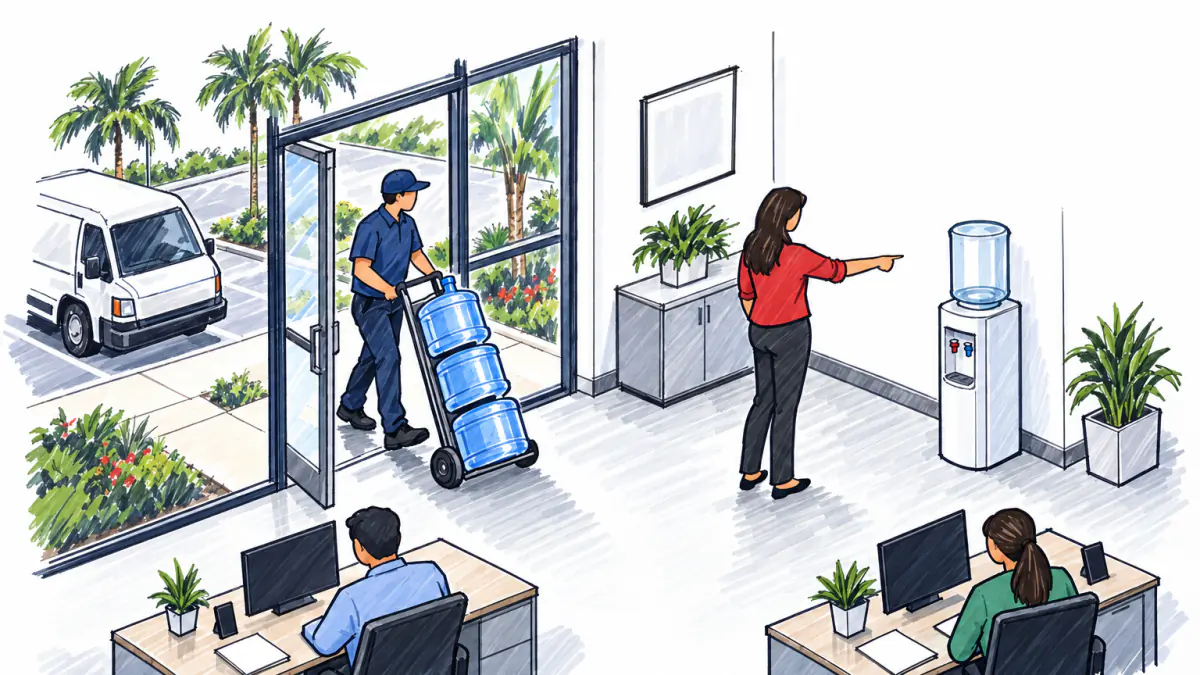
Below: the seven steps, a channel comparison, and one real check run through all of them, an office water delivery route in Tampa.
What a marketing strategy is, and when you need one
The strategy is your choices: one customer type, one promise, a spending cap, one or two channels. The marketing plan is the calendar of tasks that carries them out; it can change weekly, while the strategy holds for a quarter.
You need one before the first dollar on promotion, at launch, and when a channel that brought customers stops. If customers keep arriving at a cost you can afford, keep what works and review it every 90 days.
How to build a small business marketing strategy: 7 steps
Each step has one output. The seven outputs on one page are the strategy.

Step 1. Name one customer
Pick the buyer you’d most like ten more of, and fill in five fields.
| field | what to write |
|---|---|
| who | job title, business type or household |
| where | the area you can serve |
| trigger | the event that makes them buy now |
| what they use now | a competitor, a workaround, or nothing |
| where they look | Google, a social network, a neighbor, a trade group |
In our example, the customer is the office manager of a small Tampa business on a biweekly 5-gallon water delivery plan with a monthly cooler rentalex. The trigger is a late or missed delivery; the manager looks on Google Maps and asks other managers in the building (both our assumptions).
Mistake: writing «small businesses» or «everyone» in the who field. More: how to profile your customer.
Step 2. Read your competitors and their customers’ complaints
List each business your customer could buy from instead, with its offer, published price, and whether it shows in local search for your main service. Then read their one- to three-star reviews, tag each complaint (late, rude, wrong item, billing, quality) and count the tags. Your promise closes the most common complaint first: if competitors charge more and nobody complains about service, lead with price; if they are cheap and miss deliveries, lead with reliability.
Mistake: comparing websites and skipping the reviews. The method: how to find your competitors and how to read complaints in reviews; the competitor analysis tool and the free idea check both return a competitor list with complaint counts.
Step 3. Write a one-line promise
One line that answers the top complaint and that a customer can check after a month. «Quality service you can trust» fails. «If we miss your delivery day, the next delivery is free» passes, if step 4 shows you can afford the guarantee.
Mistake: promising what the market leader already does better. See positioning and a one-line promise and how to write the offer.
Step 4. Set the budget ceiling before the channels
What a customer earns you over their life is the most you can pay to win them. Our method, and our unit calculator, use four formulas.
| quantity | formula |
|---|---|
| monthly contribution | price × purchases a month × margin |
| customer lifetime value (LTV) | monthly contribution × lifetime in months |
| LTV to CAC | LTV ÷ cost to acquire one customer (CAC) |
| payback, months | CAC ÷ monthly contribution |
The rules we apply:
- Never plan to pay more to win a customer than their LTV. Cash budget = new customers you want × the CAC you can afford.
- LTV to CAC on our scale (our rule, not a market benchmark): 3 or more leaves room to spend; 1 to 3 is thin; under 1 means every new customer loses money.
- When payback comes close to the customer’s lifetime, the plan has no slack: cut CAC with cheaper channels, or lengthen lifetime with retention.
- Count owner hours as a cost. Oregon SBDC advises owners to spend 5 to 10 hours a week on marketing, or 10% to 15% of their work time1. Put a dollar value on them.
Before launch, CAC is an estimate; after 30 days, use your real cost per new customer. Percent-of-revenue rules are only a cross-check (see the FAQ).
Run your numbers in the unit economics calculator; its «weakest lever» shows which input to fix first. Unit economics, step by step explains each formula.
Step 5. Choose one or two channels
Pick by where your step 1 customer looks:
- they search when they need you: Google Business Profile and search;
- they scroll: one social network;
- they ask peers: referrals and local partners.
Drop any channel whose cost per new customer can’t fit under the step 4 ceiling, and run at most two for 90 days (our rule): a third splits the owner’s hours. A bakery with a storefront starts with its Business Profile and Instagram; a bookkeeper serving contractors, with a Business Profile and referrals from two local suppliers.
Mistake: adding a channel because a competitor is on it.
Step 6. Put 90 days on one page
For each channel, write the weekly task and who does it, for example «Monday: ask last week’s new customers for a review (owner).» Add the day-30 and day-90 review dates. For milestones, see a 90-day roadmap.
Step 7. Measure, then cut or keep
Track per channel the new customers and the cost per new customer, cash plus owner hours. At day 30 and day 90, keep a channel under the ceiling; cut one still above it at day 90 and move its hours to the one that works.
Mistake: judging a channel by likes and opens.
Small business marketing channels compared
You run one or two of these for 90 days, picked in step 5. Cost and speed are relative to each other; your own figures come from step 7.
| channel | cash cost | owner time | starts working | best fit |
|---|---|---|---|---|
| Google Business Profile + reviews | none | low, steady | weeks | any local business people search for |
| social media | none to low | high | months | visual products, local audiences |
| email to your own list | low | low to medium | weeks, once a list exists | repeat purchases |
| content and search | low | high | months | services people research first |
| referrals and partners | the reward only | medium | weeks | B2B, trust-heavy services |
| paid search and social ads | high, per click | medium | days | offers with a known ceiling |

Google Business Profile and reviews
A Google Business Profile is free to create and manage2. Google reports that customers are 2.7 times more likely to see a business as reputable when they find a complete profile on Google Search and Maps3. Fill in contact details, hours, service area and primary category, upload photos of your actual premises and staff, then post updates and reply to reviews.
The Spiegel Research Center found that a product with five reviews has a purchase likelihood 270% greater than a product with no reviews4. Ask within a day or two of a good visit or delivery, send the direct review link, send one reminder, then stop. Reply to each bad review once, in public, with the fix.
Do not buy, fake or hide reviews: the FTC’s rule on consumer reviews and testimonials took effect on October 21, 2024, and authorizes civil penalties for knowing violations5.
Social media: one network, on a schedule you can keep
Pick the network your customer uses:
- Facebook, local groups: answers to questions;
- Instagram, visual products: before-and-after shots;
- TikTok, younger buyers: short how-to clips;
- LinkedIn, B2B: client results;
- Nextdoor, neighborhoods: jobs nearby, recommendations.
Hold two posts a week for 90 days (our assumption), scheduled weekly in one sitting (Meta Business Suite, Buffer, Later). Split each long post into short ones. At day 90, count new customers it brought.
Email: own the list, send on a fixed rhythm
A list you collected stays yours when a platform changes its rules. Collect addresses at the point of sale, with consent, and send a welcome within a day of signup; two or three follow-ups over the first month (how to use the purchase, then a review ask); and one offer or useful note every two weeks or once a month.
Under CAN-SPAM, every commercial email must carry a valid physical postal address and a clear way to opt out, and you must honor opt-outs within 10 business days6. Since February 1, 2024, Gmail has required senders of more than 5,000 messages a day to authenticate their mail with SPF and DKIM, publish a DMARC policy, offer one-click unsubscribe and keep spam complaint rates below 0.3%; Yahoo applies the same bulk-sender rules7.
Content: answer what customers already ask
Take topics from customer questions, competitors’ reviews and Google’s suggestions for your service and city, and check that people search for them: Google Keyword Planner is free, though Google requires you to complete Google Ads account setup and create a campaign to access it8. A delivery business gets more from «How many 5-gallon bottles does a 10-person office use?» than from a post on hydration. Plan with a launch content plan.
Referrals, loyalty and local partners
Ask for a referral right after a renewal or a five-star review: «Glad it’s working. If another office in your building needs water, send them our way and their first month’s cooler rental is on us.» The reward plus your other acquisition cost must stay under the LTV. Retention raises the LTV, and the ceiling with it: call after the first month, log every complaint and fix its cause.
For partners, pick businesses that share your customer and sell something different, and propose one thing, such as a month of mentions in each other’s emails. More: where to find your first customers.
Paid search and social ads
Search ads show on the keywords people type; social ads reach an audience you define (targeted ads). They bring clicks in days. Set a daily cap, run for two weeks, and divide spend by new customers; if that tops the step 4 ceiling, pause until you fix the offer or the landing page.
Example: a marketing strategy for an office water delivery route in Tampa
The idea, checked on October 15, 2026: a route delivering 5-gallon bottled water and coolers to small businesses in Tampa, Florida, whose managers buy biweekly delivery plans with monthly cooler rentalex. We ran 17 search queriesex across 25 sourcesex; the verdict was «Possible, with caveats»ex with a score of 51ex.
Step 1, customer: the office manager on a biweekly plan.
Step 2, competitors: the check found 8 direct competitorsex and a published market size of $14.4 billion for 2024, from IBISWorldex. The leader holds under a fifth of visibility (example by our method):
| competitor | visibility share |
|---|---|
| Crystal Springs | 17%ex |
| Zephyrhills | 15%ex |
| Primo Brands | 13%ex |
| Water Boy Inc. | 13%ex |
| Culligan of Tampa | 7%ex |
Complaints in the example by our method: reliability and trust, 4ex; convenience, 1ex; quality, 1ex.
Step 3, promise: deliveries on the day promised, and a call before any change. The check found no search-demand source for this nicheex, so the promise wins accounts through reviews and word of mouth.
Step 4, budget: a $65 deliveryex, 2 a monthex, a 12% marginex and a 10-month lifetimeex give an LTV of $156ex against an estimated CAC of $150ex (example by our method). LTV to CAC is 1.04ex, thin on our scale, and payback is 9.6 monthsex against a 10-month life, so paid acquisition at this CAC has no room. The calculator holds this preset.
Step 5, channels (our method’s reading; the check does not pick channels): a Business Profile with reviews, where reliability shows; referrals between offices on the route; outreach to office managers. Paid search waits until the cost per new account is under the ceiling.
Step 6: every Monday, ask last week’s deliveries for reviews; every week, visit buildings on the route. Step 7: at day 30 and day 90, divide cash plus hours by new accounts and compare with $156ex.
The risks the check names (example by our method): «Crystal Springs already covers most of the offer, so local offices may stay with it instead of switching.»ex «At a 12% margin and a 10-month payback, a delivery route may run out of cash before it grows.»ex «Reliability and trust complaints are the most common complaint type, so late or missed deliveries could cost accounts.»ex
FAQ
How much should a small business spend on marketing?
Pay no more per new customer than that customer’s LTV, and multiply by the number of new customers you want. As cross-checks, Western Australia’s Small Business Development Corporation suggests 3–5% of actual or expected annual turnover9. A secondary source reports an SBA recommendation of 7–8% of revenue for businesses under $5 million, assuming 10–12% margins10; no SBA page states it.
Sources
- oregonsbdc.org, 01/29/2026
- business.google.com, 10/03/2026
- support.google.com, 05/18/2026
- spiegel.medill.northwestern.edu, 12/04/2025
- ftc.gov, 11/08/2024
- ftc.gov, 08/09/2023
- support.google.com, 10/03/2026
- business.google.com, 12/25/2024
- smallbusiness.wa.gov.au, 10/08/2026
- boomcycle.com, 07/22/2026
Check your idea for free
Describe your idea and the check collects demand, competitors, complaints and prices, with sources.